

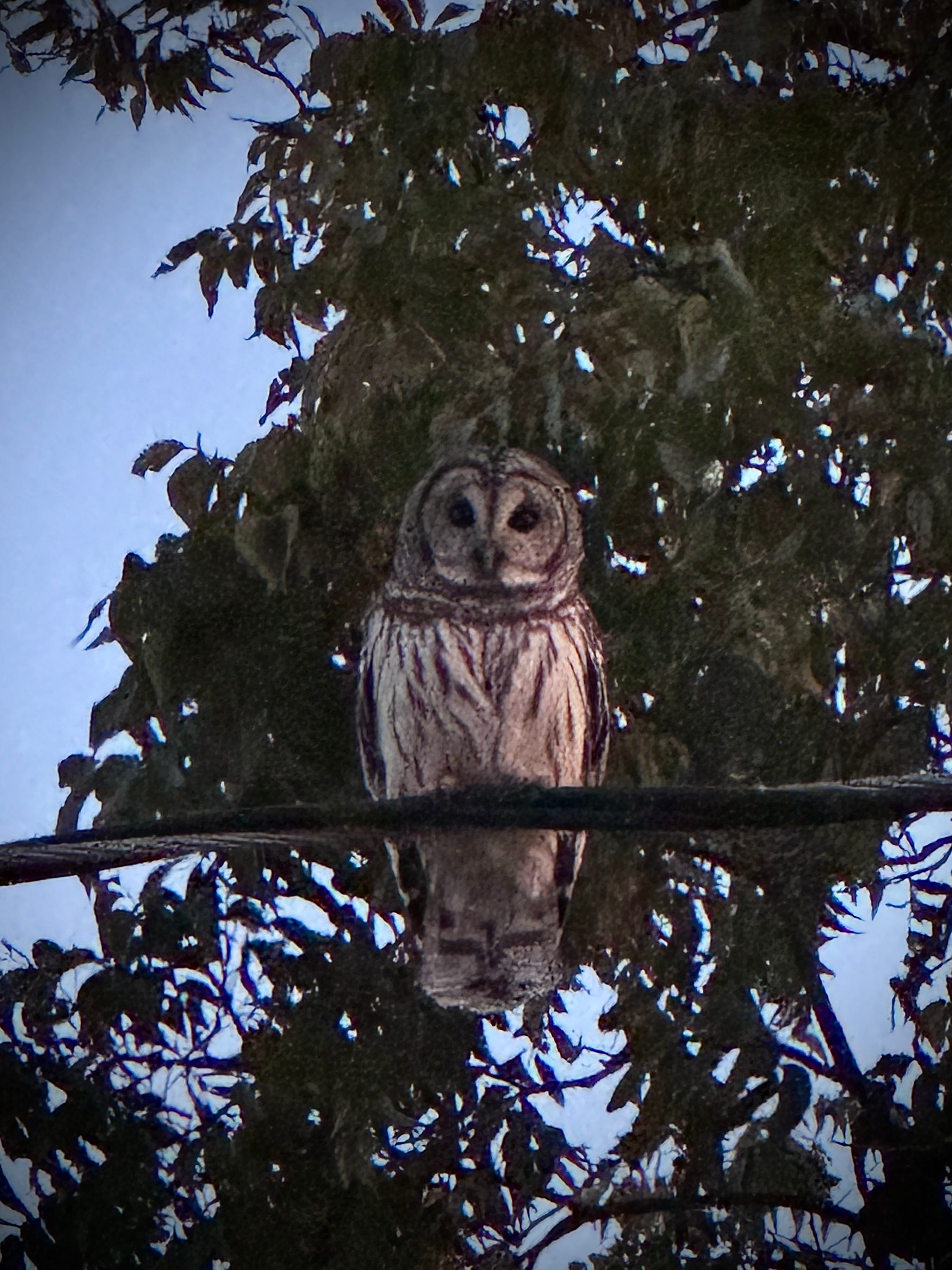
On Veterans Day as we turned onto our street on our way home from grandma’s, my daughter and I spotted a barred owl sitting on the power line. We’d seen a mated pair right before Halloween, as reported in my last installment, but later at night. This was much earlier, around 5:45 p.m., just after official sunset but before the twilight had fully bled out. I slowed, opened the windows and the sun roof, and then stopped right in the middle of the lane. Octavia was quite excited about the sighting, and immediately tried the call we had practiced when we saw the pair. The bird books often say it sounds like “Who cooks for you,” but I don’t really agree. It’s much more alien than that, and when we imitate it, as I’ve been trying to teach our 7-year-old, it comes from a deeper place in the body than the sounds we usually use to communicate.
The owl did not respond, but it did not seem annoyed, either, watching us with those enigmatic eyes like black marbles. I took the above photo on my phone, through the sunroof, and we drove off before we might have caused it to fly off.
“It’s still watching us!” exclaimed the kid as I put my eyes back on the road. “I just saw its head move.”
Barred owls are known for a watch-and-wait method of hunting. This one was surveying a remarkably urban hunting ground: the dumpsters and greasy blacktop behind the margarita factory and taqueria known as De Nada. The restaurant was already packed and noisy that evening with the usual gathering of young singles getting properly lubricated with sweetened tequilas, and as we watched the owl the feline white Waymos and goldbug Cybercabs were pulling up from the other directions for drop-offs and pick-ups. None of the hundred other humans around us seemed to notice the owl. Some of the Argos-eyed robot cars may have had a vantage, but the owl on the line would not be an object their programming would require a response to unless it moved within one’s path. I assumed the owl was waiting for rodents to show up around the rapidly accumulating food trash. I have seen foxes at night around that same spot.
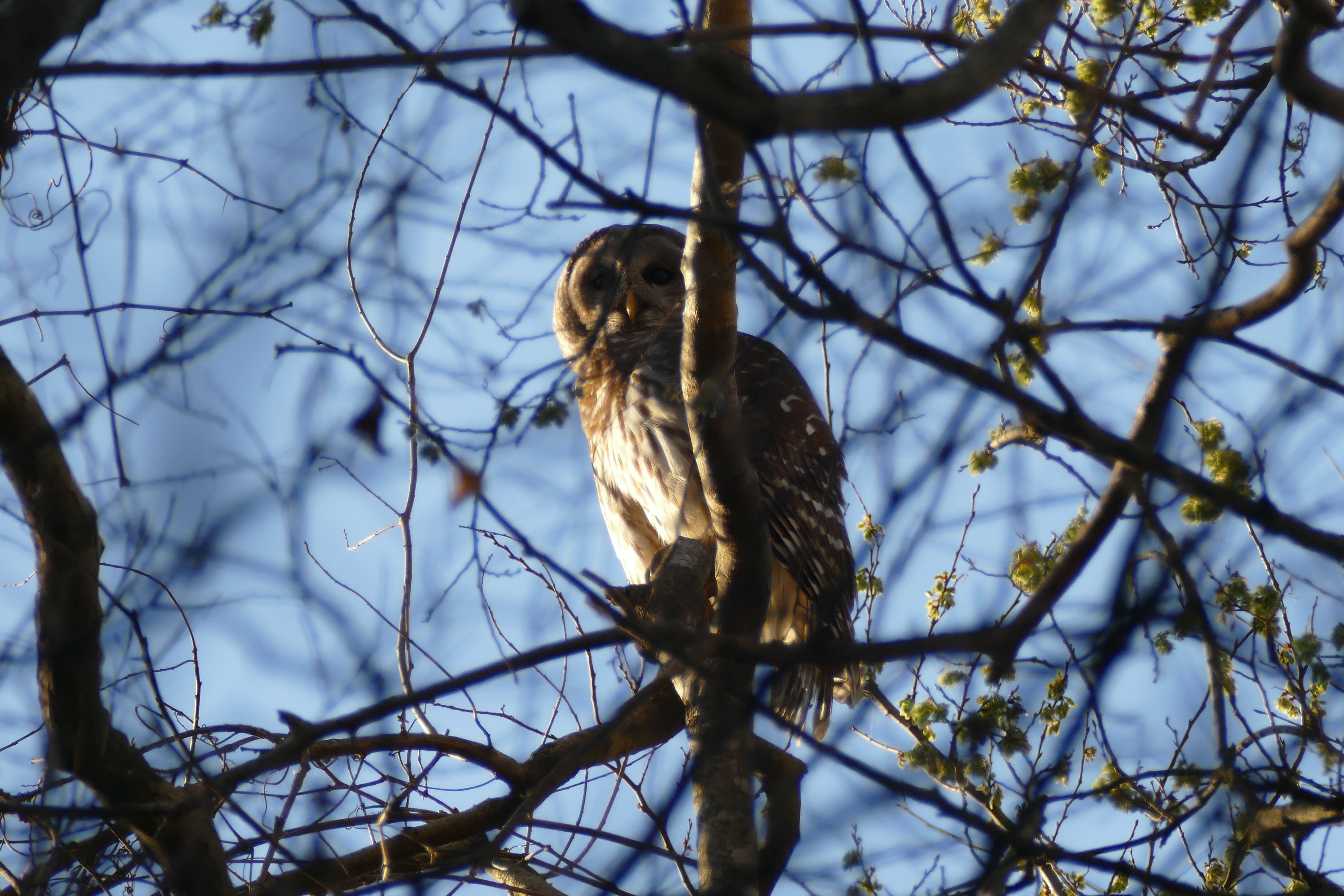
Barred owls have been our neighbors since we moved to this weird little corner of town sixteen years ago, when what are now popular bars were still 20th century machine and metal works. We hear the owls often, see them on occasion, and it is always a wonder. Perhaps because my first encounters with them were in the acres of riparian woods behind the old factories that our home backs up to, I long assumed that rare pocket of urban biodiversity was their precious habitat, and that their presence was threatened by the development that was coming. I never considered that they might be as capable of managing the urban milieu as grackles or raccoons, at least when certain conditions exist.
I looked into the recent scholarly literature. It turns out barred owls have adapted remarkably well to our urbanization of the continent—especially as agricultural countryside has morphed into suburbia. What they are most similar too, really, is the red-shouldered hawks we see even more often (because they are out and about when we are). The two species occupy the same habitat of hardwoods near water, and hunt similar prey—the hawks by day and the owls by night. They nest in similar spots. And both leave the urban forest to take advantage of the opportunities the city affords. Especially, in the case of the owls, the expansive and mostly defoliated lawns of suburbs, where the creatures of the field are more exposed to the avian hunter.
While on the faculty of UNC-Charlotte, ornithologist Richard O. Bierregaard and his students conducted a 12-year study of barred owls in that city’s prototypical Southeastern suburbia. He found that suburbs, which often have mature pockets of woodlands along creeks and streams, usually with less dense understory than rural woods in the same region, provide ample nesting opportunities. The owls are highly tolerant of human activity, with many of the nest sites in trees in suburban backyards or other sites very close to human homes. Their opportunistic and omnivorous hunting style produces an especially diverse diet in the warmer parts of the birds’ range, where reptiles and amphibians can be carried back to the nest as often as small mammals.
They even evidenced some urbanized deviations from the archetypal family structure the field guides prescribe, with Bierregaard’s students documenting one nest with a clutch of three eggs tended by two females and a male who occasionally stopped by with food. One wonders how they will further evolve as they adjust like our wild urban canids to a food chain that starts with human leftovers, and if the increasing presence of those robot cars in their domain will have an impact on the vehicular collisions that Bierregaard indicated was a principal limiter of their lifespan in this habitat.
Some Actual Field Notes
A few weeks earlier, as we investigated the contents of one of the boxes of stuff from my parents’ house we retrieved in our Sisyphean effort to work our way through the contents of the storage locker we had to get for the overflow when my mom moved here two years ago from her acreage in southern Iowa, Octavia discovered a really nice Staedtler drawing pencil set in its own fancy case, and put it immediately to use while I kept working. I assumed it was property of my late brother Alex, a painter, but when I looked at the little cheapo memo pad she was using, I saw it was partially filled in the hand of my dad. A few pages of field observations he had made in his 80th year, mostly of birds, but also some butterflies and wildflowers, with text and drawings.
Here’s the first one, of a kestrel:
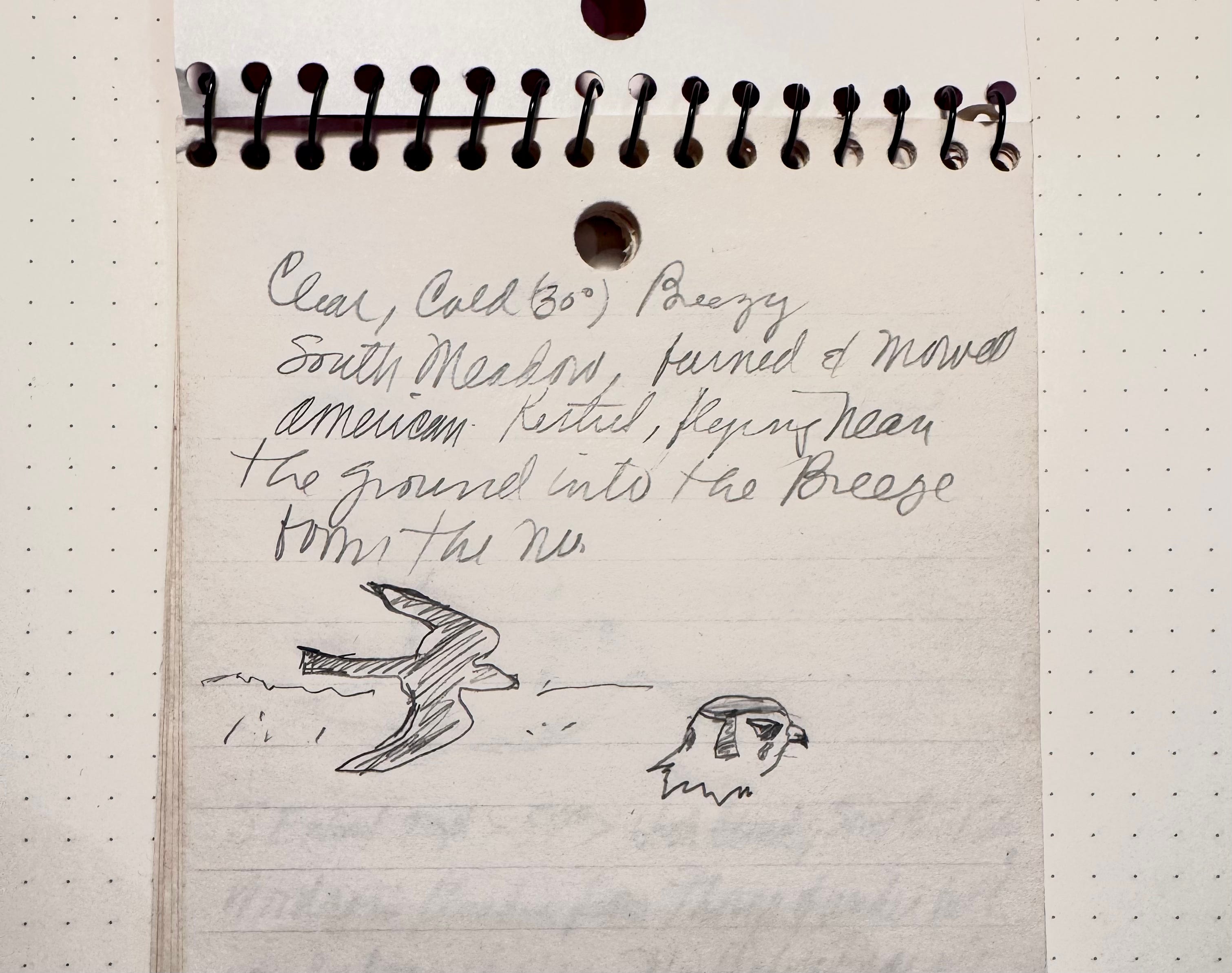
I explained to Octavia who it was that had partially filled the notebook she was using, but I did not bother to share the layers of feeling that I got leafing through it. Thinking about my dad, the gregarious and socially gifted dentist finally retired for real, his capacity for work of any sort constrained by his deteriorating cardiac health, his last real connections to the city where all his real friends were attenuated by the hour drive there from the solitary country retreat my mom preferred, and by the obituaries he would read every morning. Looking for something to do without friends to hang with, he started to read a lot more (he was especially keen in that period on the country stories of Turgenev), filled his days up with manly homesteader chores, and started to pay more attention to what was going on outside.
I had almost forgotten what a natural illustrator he was, a child of the 1930s who could give my brother and me N.C. Wyeth-grade pirates and cowboys on command. His birds are great, and he even nailed the challenge of drawing a comma butterfly, comma and all. But what’s really cool about his field notes is how his Midwestern weather watcher point of view comes through, every observation accompanied by a notation of the temperature, wind, and other conditions. It struck me as a very insightful context to better understand the behavior and point of view of the birds, a posthumous lesson from Dad that I immediately began to put into practice.
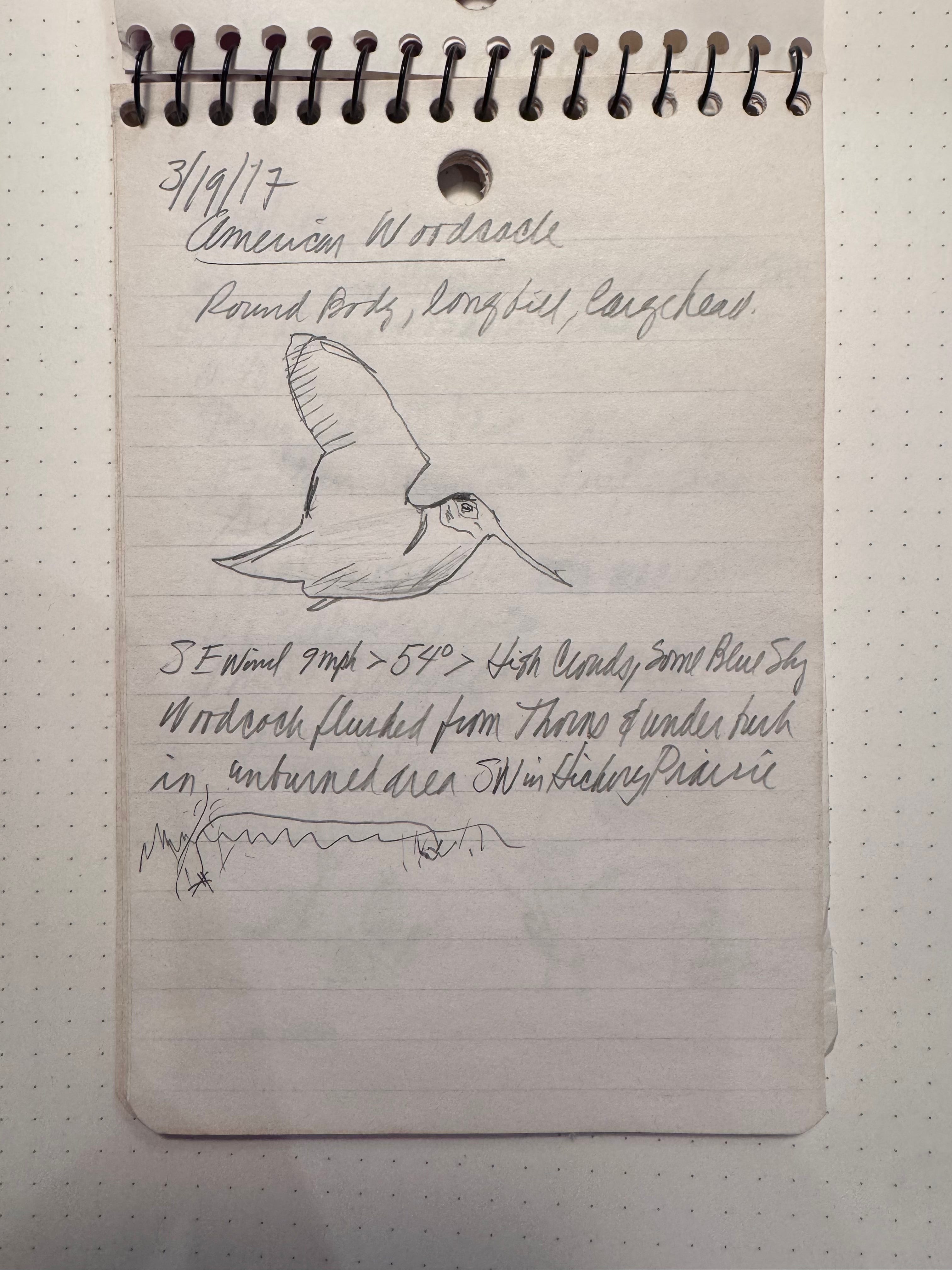
This weekend Octavia and I will be setting up a little home weather station to get our own local analog measurements, which will go well with the weather radio Dad gave me late in his life that I only set up after we returned from sending him off. Our discovery of his notes was a good reminder of how it’s never too late to start paying attention to the things you’ve been ignoring, or to appreciate the wonder and learning they can provide.
As homage I aim to experiment here and elsewhere in briefer little posts that riff on that inspiration, which hopefully will also lend this newsletter some fresh structure and frequency. (Feedback welcome—comments are always open, and if you get the newsletter by email, you can reply and I should receive it.)
Reading Room
Another lesson by example I took to heart as I work on new material:
“To prevent useless repetitions, I will extract those parts of my journal which refer to the same districts, without always attending to the order in which we visited them.”
— Charles Darwin, The Voyage of the Beagle, entry for July 26, 1832 (Montevideo)
I recently picked up a copy of Darwin’s record of his youthful trip to South America as onboard naturalist. As a narrative of exploration and discovery, it’s pretty great—Darwin had natural descriptive gifts, and the advantage of kind of being along for the ride, the act of observation his so-called work. The expanses of time he was afforded to experience the place he visits are remarkable, almost unimaginable from an overclocked 21st century vantage. But what was most striking was how much weird there is in the text, at the edges of eco-horror, like the passages where he discusses his experiments carving up live flatworms while passing a couple of months hanging out in a beach cabin at the base of the Corcovado in Rio:
I found no less than twelve different species of terrestrial Planariae in different parts of the southern hemisphere. Some specimens which I obtained at Van Dieman's Land, I kept alive for nearly two months, feeding them on rotten wood. Having cut one of them transversely into two nearly equal parts, in the course of a fortnight both had the shape of perfect animals. I had, however, so divided the body, that one of the halves contained both the inferior orifices, and the other, in consequence, none. In the course of twenty-five days from the operation, the more perfect half could not have been distinguished from any other specimen. The other had increased much in size; and towards its posterior end, a clear space was formed in the parenchymatous mass, in which a rudimentary cup-shaped mouth could clearly be distinguished; on the under surface, however, no corresponding slit was yet open. If the increased heat of the weather, as we approached the equator, had not destroyed all the individuals, there can be no doubt that this last step would have completed its structure. Although so well-known an experiment, it was interesting to watch the gradual production of every essential organ, out of the simple extremity of another animal. It is extremely difficult to preserve these Planariae; as soon as the cessation of life allows the ordinary laws of change to act, their entire bodies become soft and fluid, with a rapidity which I have never seen equalled.
Not long after that, Darwin discusses the hunting excursions he went on during the same period “with an old Portuguese priest,” which are more like harvests than hunts—accompanied by a semi-feral “wild Brazilian youth” with tattered old clothes, “an old-fashioned gun” and a machete, they unleash dogs in the tropical forest and kill everything they can that’s flushed out. Darwin complains how many boring parrots and toucans they got, and what a hassle it was to have to cut down a tree to collect the dead monkey that locked its prehensile tail around a branch as it died. After these gripes, as consolation prize Darwin brags that “I profited, however, by my acquaintance with the Portuguese padre, for on another occasion he gave me a fine specimen of the Yagouarundi cat.”
Full text available at Project Gutenberg.
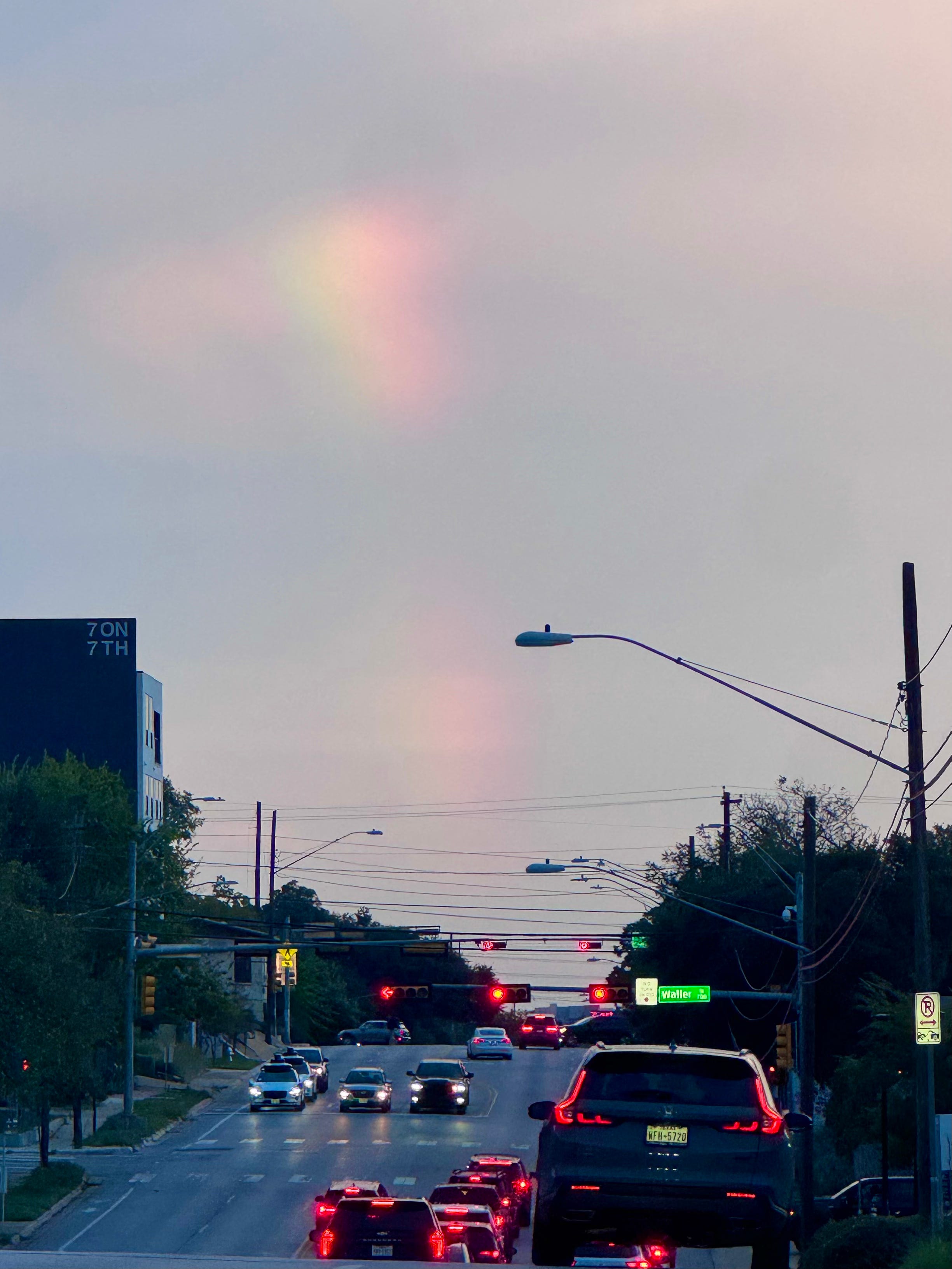
I saw the trippy rainbow pictured above over East Austin right after I saw the amazing news that Field Notes friend M. John Harrison won the Booker Prize for his latest novel The End of Everything. It was the sort of rainbow that seems evidence of the liminality of reality, which suits a celebration of Mike’s work, and the happiness of the rainbow suited the smile of hearing that a writer who has for six decades been impecuniously and uncompromisingly writing work mostly ghettoized by its categorization as science fiction finally got his due from the literary establishment at the age of 81.
Harrison was one of the British writers who emerged as part of the late 60s/early 70s scene dubbed the New Wave of SF—writers who saw the potential for the repurposing of science fiction in service of literary innovation, stylistic liberation, and a narrative approach to the depiction of real life as it exists in the media-saturated world of media, screens, and alternate selfs we occupy. There have been many great practitioners of variants of that experiment, but Harrison has been at it the longest, and taken it the furthest.
Mike is also a lover of the outdoors—a mountain climber, trail runner, and devotee of the edge zones, and those interests show up all over his work, especially in his less fantastical novel Climbers, which is finally coming out in the U.S. next year from McNally Editions.
You can read more about Harrison and his work at the Science Fiction Encyclopedia, join the crowd checking out The End of Everything, or try some of his amazing short stories (short fiction is where the New Wave writers really pushed the boundaries of style)—I really loved the work collected in his 2017 collection You Should Come With Me Now.
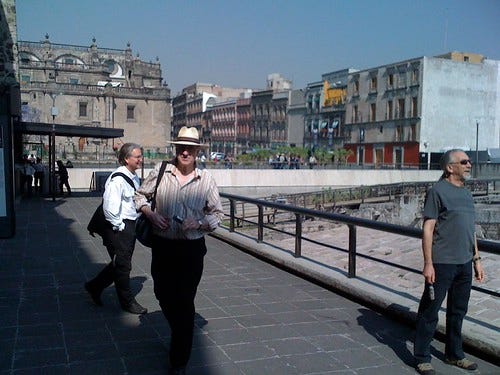
Here’s a picture I took in 2009 of Mike on the right, with Bruce Sterling and Christopher Priest on the left, admiring the wonders of the Templo Mayor of Tenochtitlan as it was being excavated in the heart of Mexico City.
((Mike also said some nice things about my last book, for which I will be ever grateful.))
As for the political news, I kind of related to this meme:
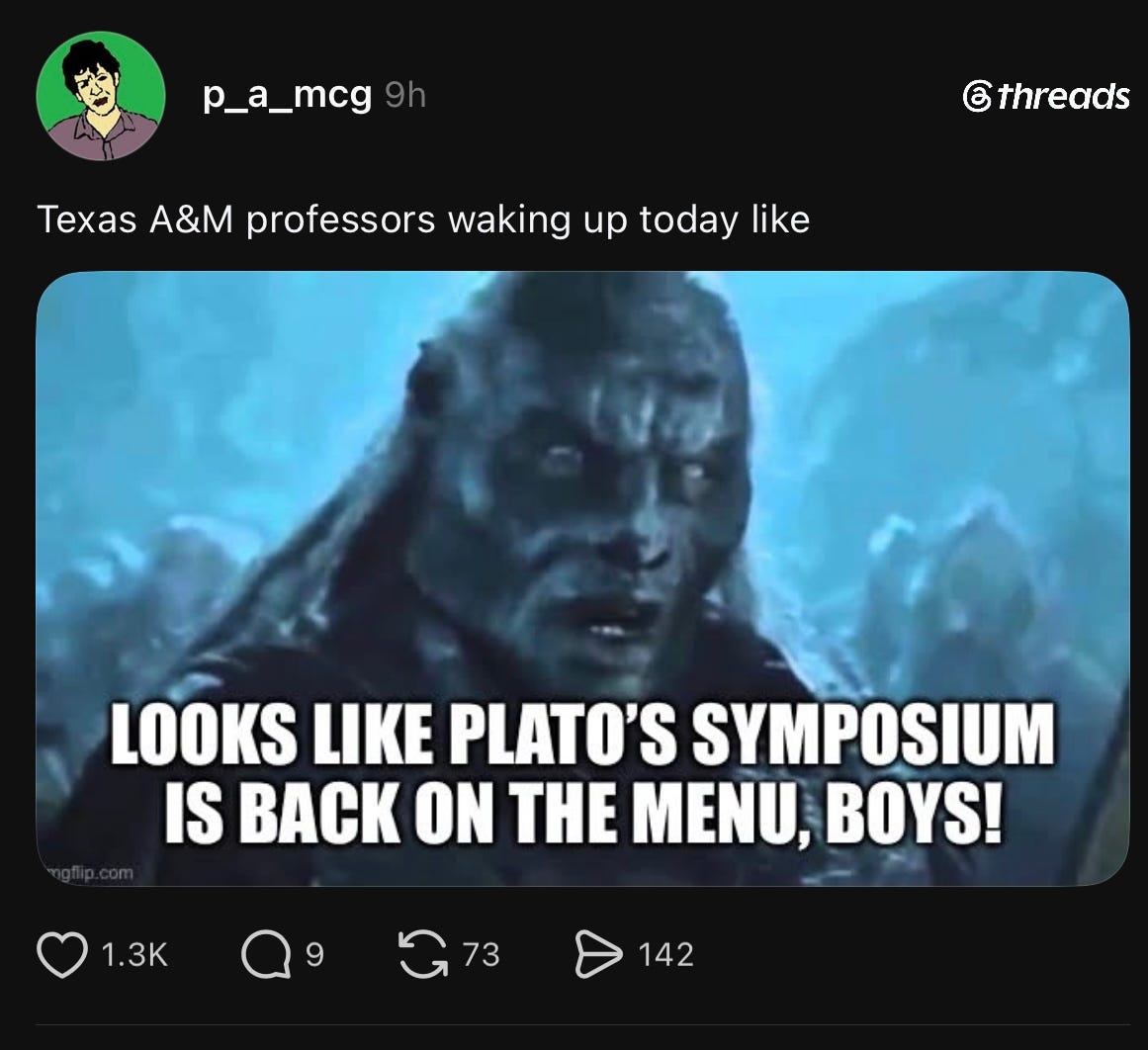
The Lord of the Rings riff felt apt—I have been describing the feeling of sudden and sweeping regime change in Texas being like the scene in The Two Towers in which Gandalf exorcises Saruman from King Theoden.
Beyond Texas, I was delighted to see my home state friend and fellow Truman Scholar Rob Sand has been elected Governor of Iowa.
What these changes mean for climate and biodiversity, in a moment that seems preoccupied with human inequality & short-term needs, and incapable of seeing how it all is interrelated, remains to be seen. Continued organization and advocacy is perhaps more important than ever while the Overton window is open.
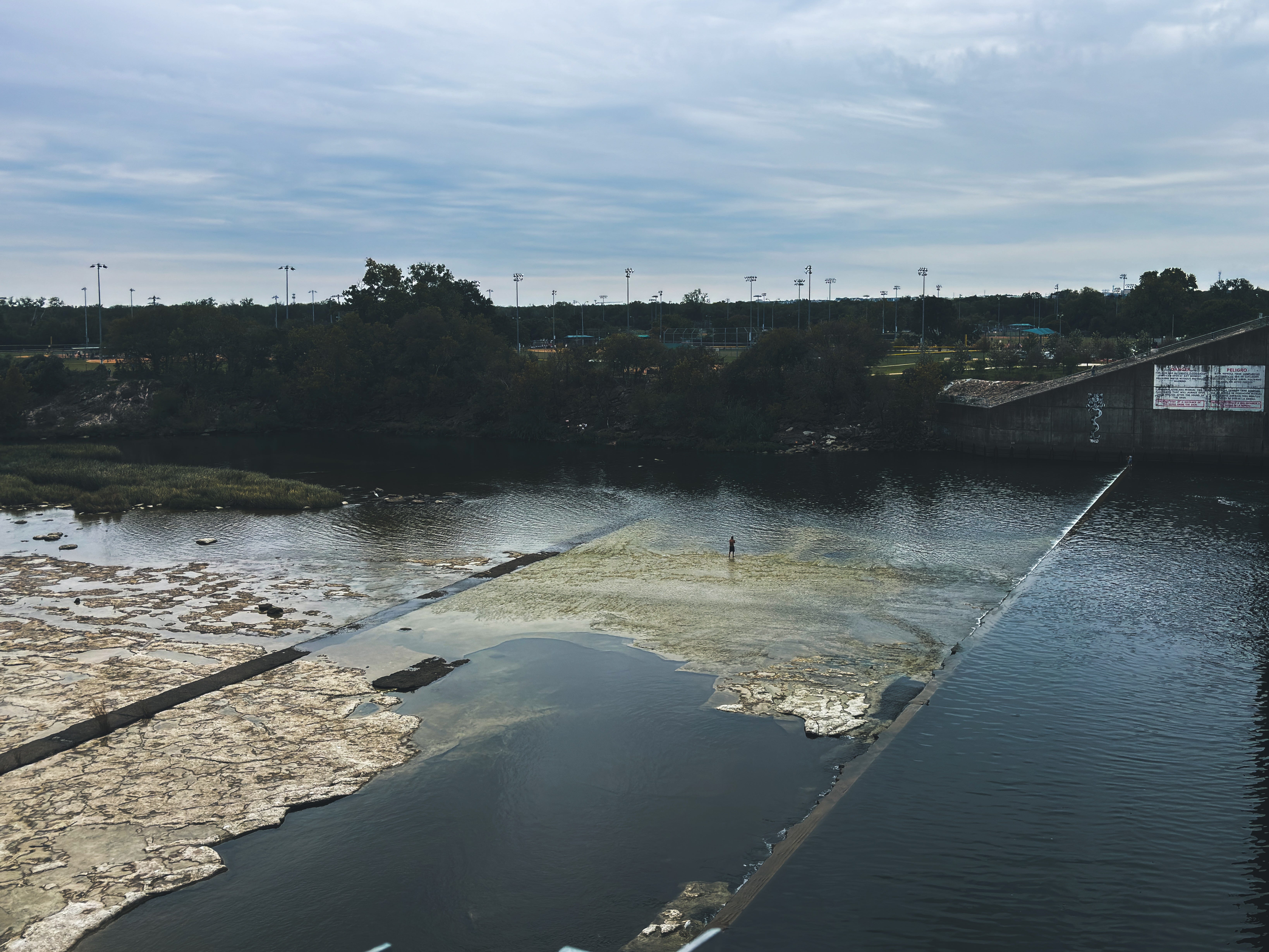
I had a blast last Sunday walking with artist Erin Johnson, UT Visual Arts Center Director Max Fields, and Curator of the University of Georgia’s Athenaeum and Dodd Galleries Rachel Waldrop, as we explored some of the sites related to the 1961 DDT spill and fish kill in the Colorado River that Rachel Carson discussed in Silent Spring, which Erin has been investigating. The above picture by Max is the view from atop Longhorn Dam, where the pesticides entered the river after running off from a factory where they had been left outside in a powdered form during a big rain. If you’re in or near Athens, check out Erin’s current exhibit at UGA, The Measure is Something Else. And if you’re in Austin, keep an eye out for upcoming exhibits at VAC.
For more on barred owls, Prof. Bierregaard co-authored the excellent entry at the Cornell Lab’s Birds of the World.
In urbanized canid news, Chihuahuas, we can now confirm, are part coyote.
And there’s a humpback whale breaching in NYC.
Lastly, Evan Rees shared this amazing photo of the freed bull that roamed an East Austin edgeland this summer with such mystery and majesty that we called it the Minotaur, as featured in my last installment:
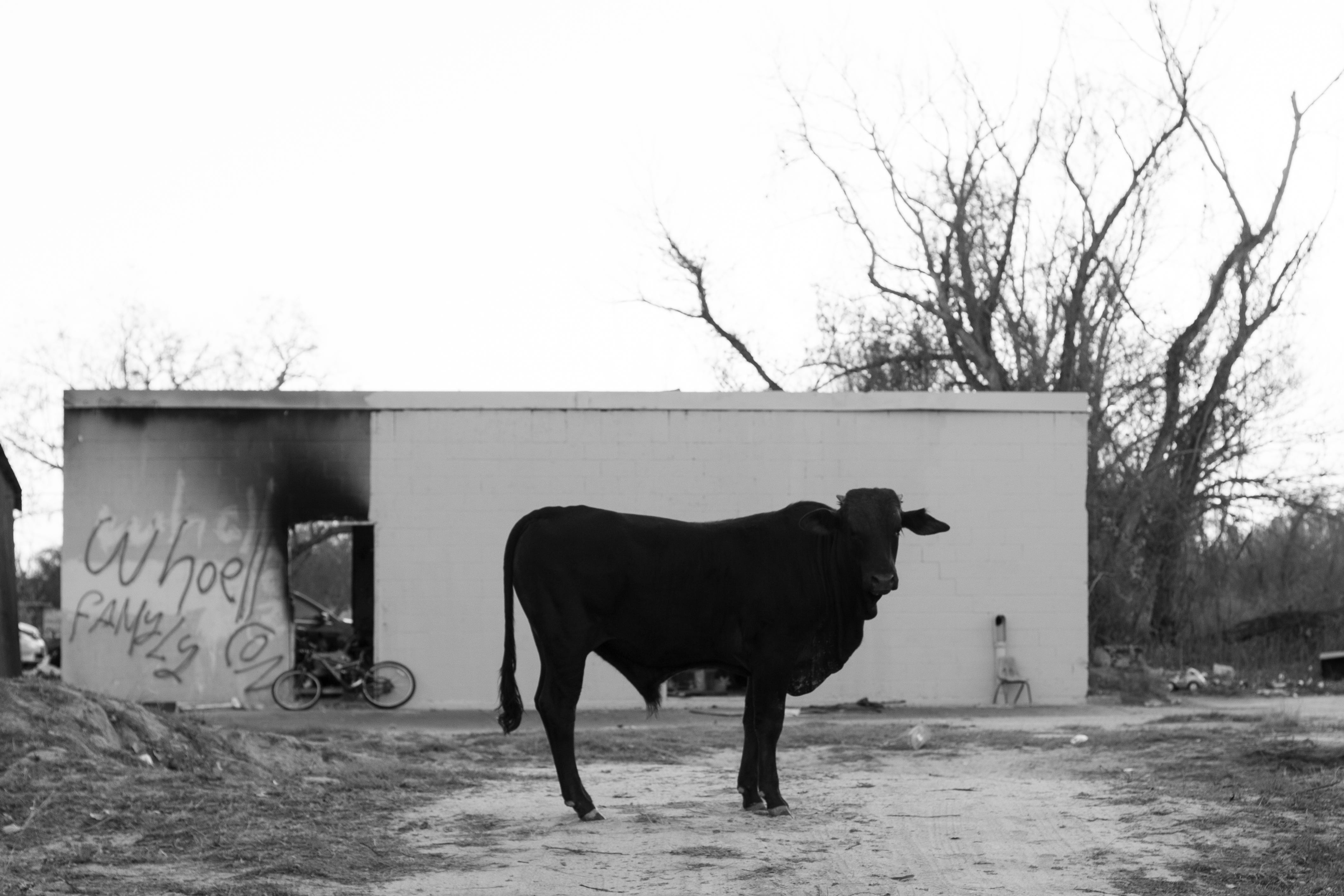
The building behind the bull is an old switching station that was part of the former aggregate factory, made into an unofficial homesite in recent years, and torn down around the same time as the authorities captured the bull. Evan reports that the last time he saw the bull, it seemed scared by a car backfiring on the nearby tollway. It was not long after a man was found dead in his truck on a nearby embankment, victim of a shooting. “It made me wonder what things he saw at night.”
Be safe out there, and have a good week.
I simply can't read everything that flows through my in-box, but this latest column is so off the charts wonderful in so many ways I'll not be able to pass on any of your essays in the future!
Another fine essay, Christopher. One of those pieces that makes me feel smarter, more inspired and engaged than before I saw your post. The barred owl photo is a fine one, reminds me of the bird photos I've taken thru my own windshield. Could be a genre of bird photos. The Rachel Carson paragraph is exciting, as are many other threads here that I'm going to have to explore later today, as I've got to saddle up for the day, meeting writer friends in conjunction with the Texas Book Festival and artist events for Austin Studio Tour. At the risk of sounding like I'm just doing self-promotion here on your platform, I want to share some of my early artwork with you, when I was in my Minotaur phase. Again, your essays always remind me of a nurturing parent or friend when you're leaving for a trip and they keep adding helpful items to your bag that you might need on the journey. And that's a good thing.