

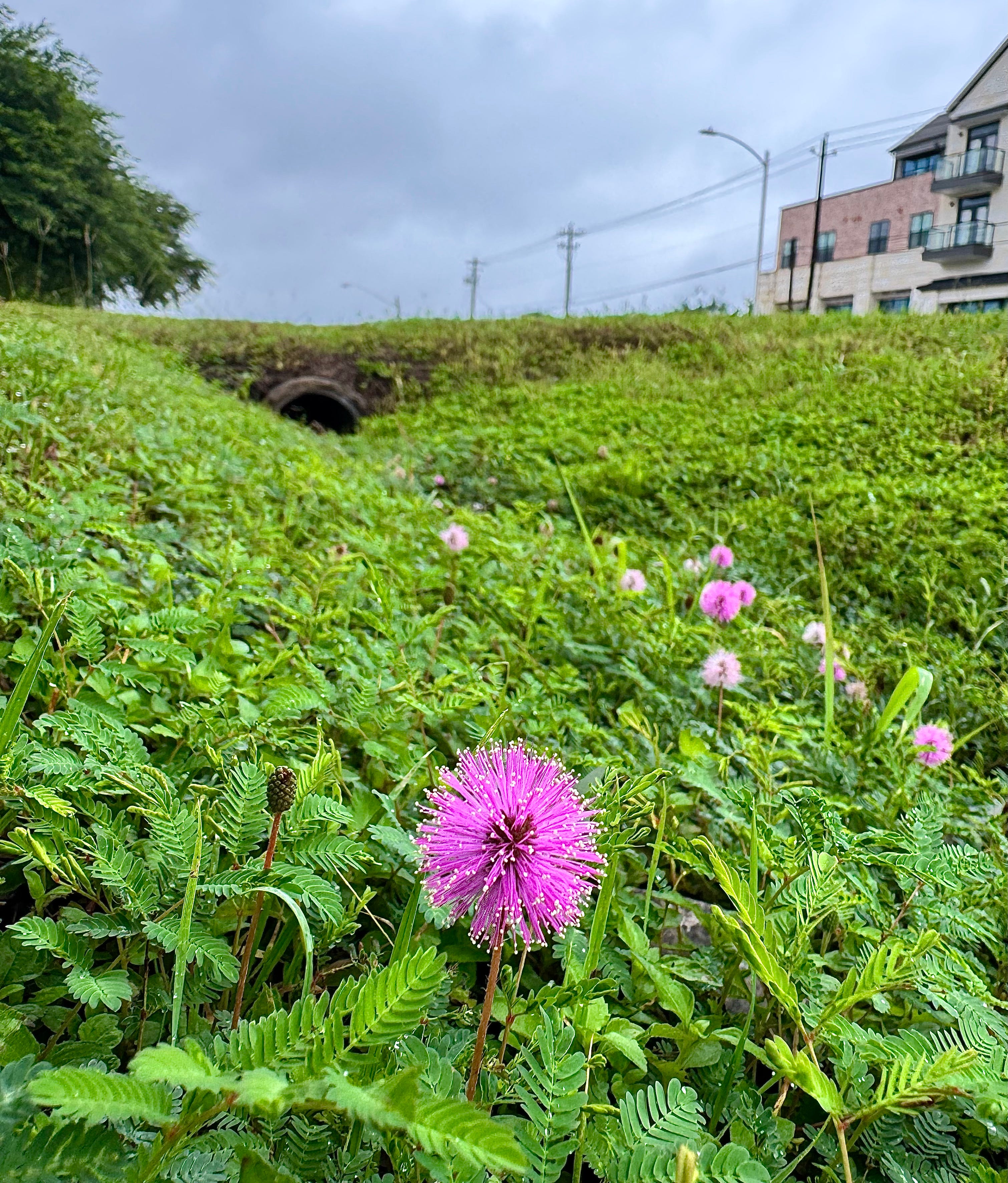
The brutality of our Austin summer was deferred this year by an abundance of June rain. The late afternoon downpours, which feel more like what you would expect in Houston or New Orleans, seem especially effective at conjuring signs of life against the concrete canvas. Stopped at a traffic light as the sun broke through one Tuesday, hundreds of brown lacewings suddenly became visible in the low-angled rays, fluttering over the intersection like fairies. Walking the dog the next morning I noticed hundreds of sod webworm moths on the wildflowers along the sidewalk—what an extension officer might call an infestation, but looked like abundance to me. On a Thursday morning run I could see the cliff swallows coming and going from the seasonal nests they’ve built under the tollway bridge, silhouetted by the rising sun. The next day I found a thick patch of hot pink powderpuff mimosa blossoming in the drainage ditch, almost invisible unless you know to look. The flower pictured above is about the size of the head of a Q-Tip.
Last Saturday I took advantage of the absence of triple-digit heat to go for a long mid-day run, following an urban trail route down along the railroad tracks, over a creek and into the abandoned gravel pits slowly rewilding along the river, land that has been owned by the city for almost twenty years but is a long way from ever being domesticated into parkland. The spot I traversed is right off the north-south tollway where I saw those swallows, and if you drove by it you probably wouldn’t notice it unless the retama trees that grow near the frontage road were in bloom. The Camino Real de los Tejas allegedly went right through there, to a low water crossing where you are still likely to find a few Cormac McCarthy-grade wanderers hanging out on any given Saturday, drinking beer and fishing from pickups with ample sound systems. Penetrate the dense foliage off the trail and you might find a car that’s been stripped, or a freshly dumped household of trash.
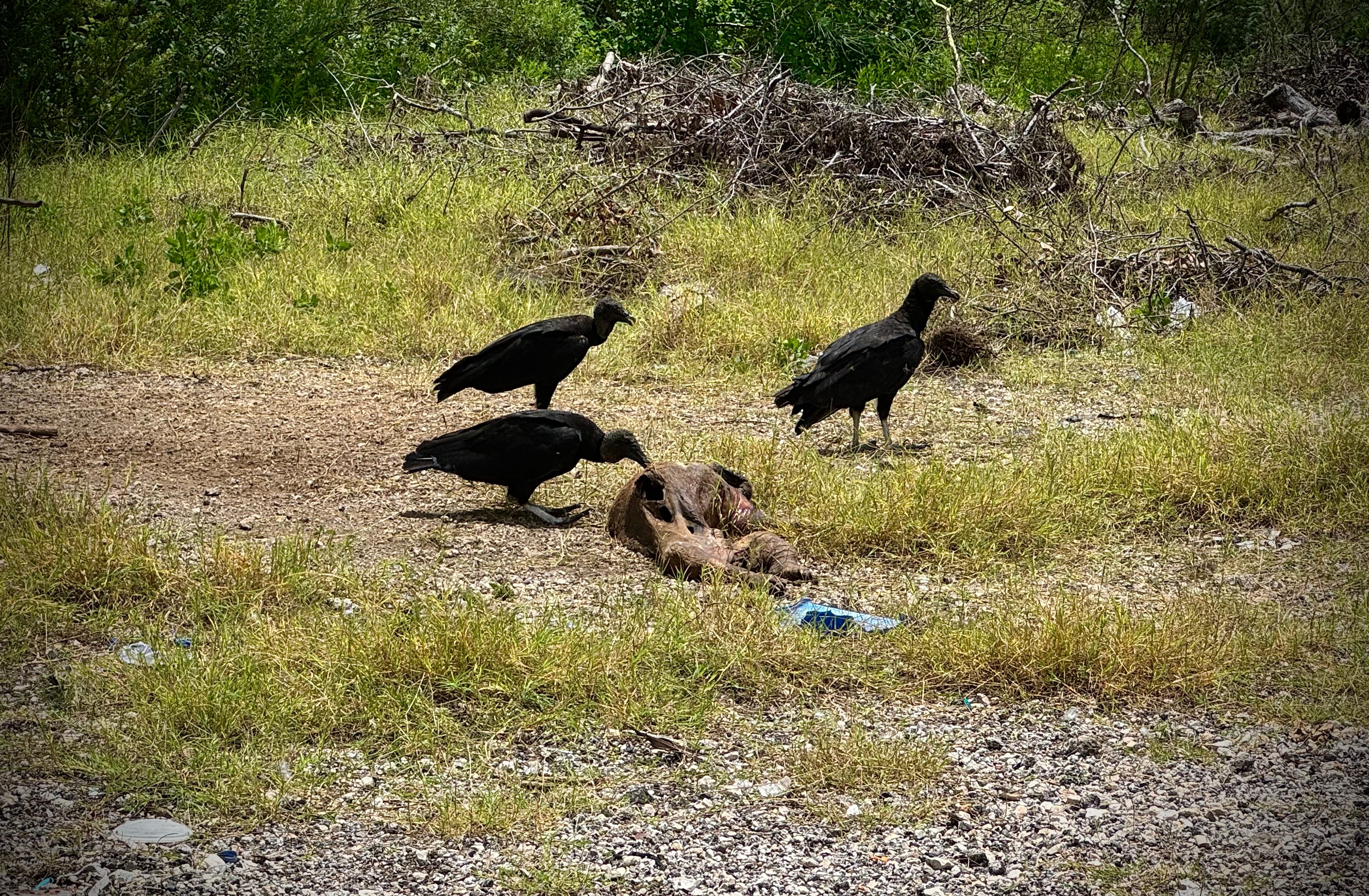
I was about a quarter-mile in on one of the double-tracked dirt trails you could call Jeep roads when I came upon the above scene. Three black vultures working a brown furry carcass. I assumed it must have been a deer, until I walked up to take a look. You could tell it must have been pretty fresh from how reluctant the vultures were to move along as I approached. No wonder, I realized, when I finally saw what it was. Not some doe left behind by the coyotes, but a more thickly muscled creature: a big-ass pit bull, half-rotated onto its back. Almost a cartoon version of a pit bull, with the front shoulders of a football team mascot, exaggerated by postmortem bloat. An intact male, as they say in the trade, swollen belly exposed and ready for the vultures’ hooked beaks to pierce.
Its head lay to one side, eyelids closed in forever sleep. The snarl that exposes an aggressive dog’s deadly incisors was now permanent on the side you could see, part of the upper lip chewed away, or pulled back taut in some rictus of death. I wondered what the backstory was. The dog had no collar, and was far from the road. A beat-up old white minivan rolled slowly by on an intersecting path a hundred feet in, reminding me how many free-ranging humans you can encounter back in there. Having had more than my share of run-ins with off-leash pit bulls over the years, I wondered if it might have charged the wrong crew and gotten itself shot. As I moved on, I accepted it as a sign that the real Texas summer has arrived.
Only later in the week did I get to thinking how that involuntary park marks the zone where the city ends and you enter the unincorporated territory now controlled by the planet’s first trillionaire and the developers scrambling to trail in his wake, remaking other old aggregate mines downriver into beachheads for the colonization of the future. I’m not sure if it’s my hard-earned cynicism or my unextinguished capacity for hope that makes me find the liminal space I was in, with its premature scenes of post-apocalyptic ruin and unregulated rewilding, a more plausible expression of our trajectory.
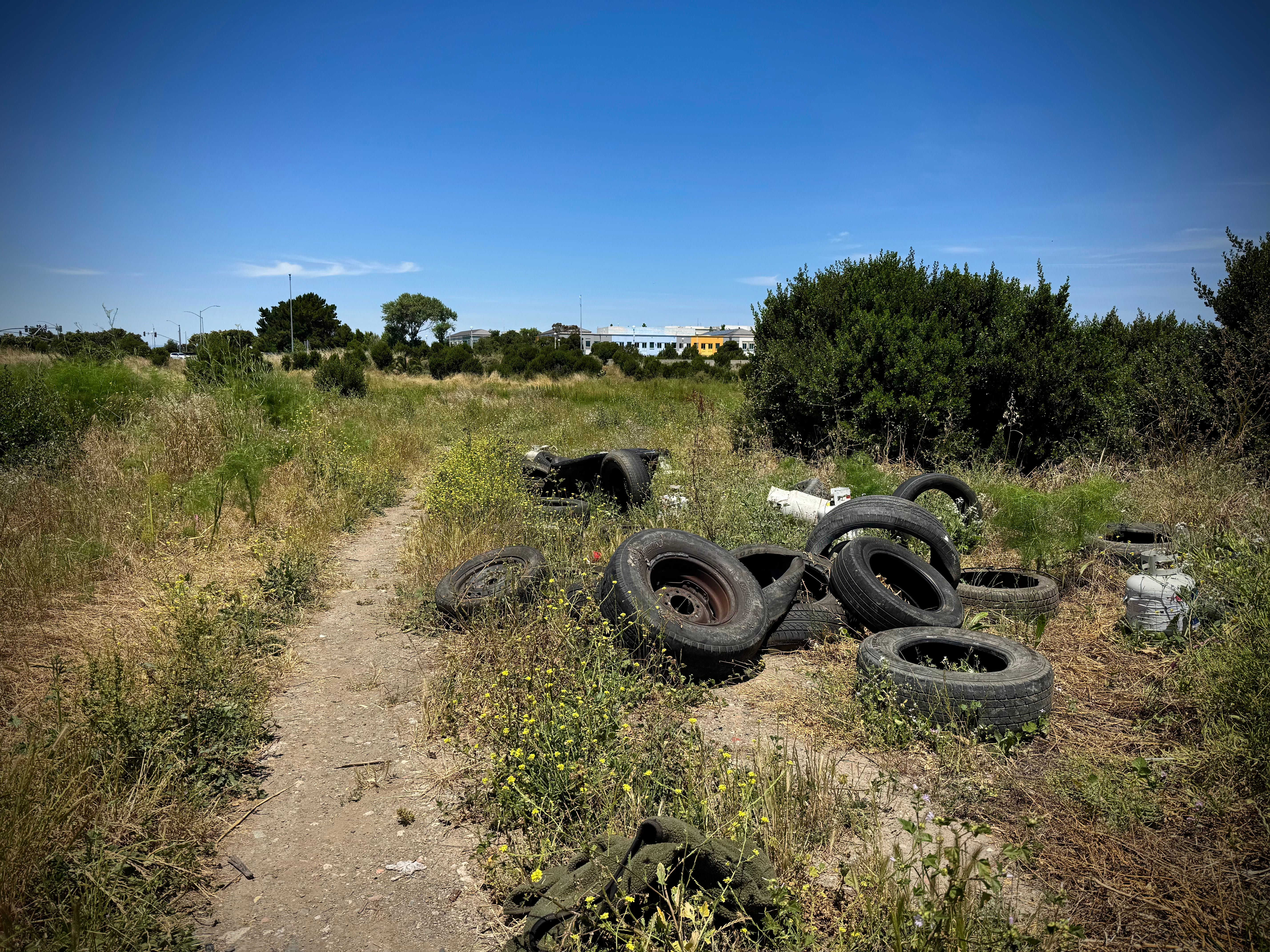
I walked a similar zone the Sunday before Memorial Day, in a very different location: across the highway from One Hacker Way, the beginning of Meta fka Facebook’s sprawling campus in Menlo Park. I had been trying to figure out how to get on the campus to take in the quiet weekend energy and look for signs of life. I parked at a little strip mall Starbucks, crossed the old railroad tracks that divide Meta Park from the suburban neighborhoods behind it, and was headed to cross Highway 84 on foot when I noticed a similar Jeep road cutting off into some burned-out green oblivion behind a storage locker facility.
I hadn’t walked far in before I heard the towhees on the power lines, and started to see the tiger swallowtails working the flowers that had been allowed to grow wild, there in what was probably right of way owned by the state. There was a dirty little wetland a quarter-mile in, surrounded by piles of illegally dumped trash, all with a view of the first big Meta campus, formerly the offices of Sun Microsystems and before that Silicon Graphics—a campus by the bay historically referred to by its employee-occupants as “San Quentin.” As one whose first computer at work was a Unix workstation I barely knew how to use, it was a strange sense of return.
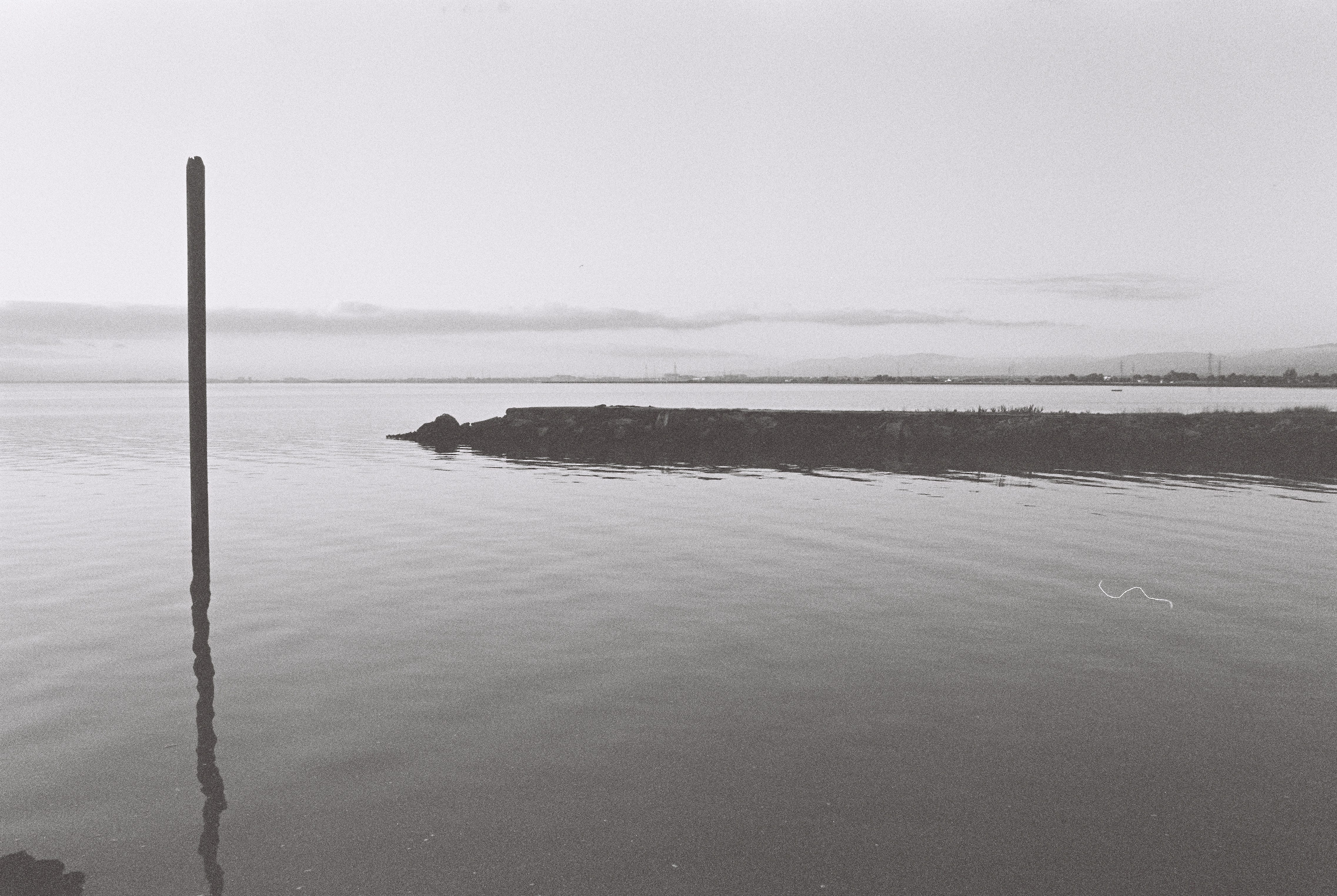
I had spent the morning exploring the waters beyond that campus, paddling around the salt ponds and coastal marshes of South San Francisco Bay. We were in the East Bay visiting friends, and after a Saturday exploring the tunnel tops and the tree museum with the kids, I took advantage of still being on Central Time to get up at 3, drive down 880 to Dumbarton Bridge, and cross over to paddle around the salt flats of Silicon Valley as field research for my new book.
More on that in an upcoming installment.
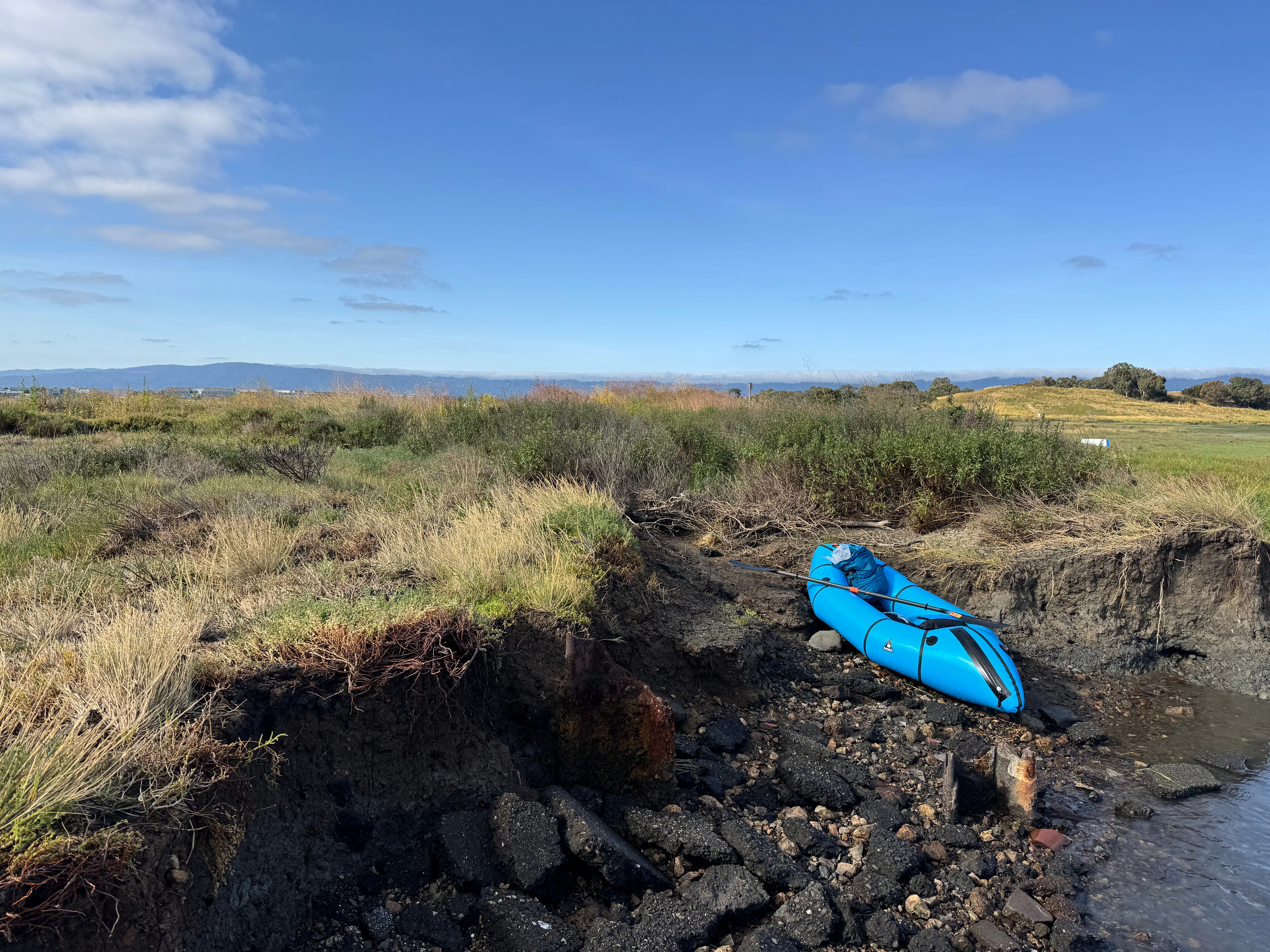
This Friday aka Juneteenth I went with my brother-in-law and nephew exploring the insane waters of industrial Houston, from Baytown to Armand Bayou and back again. We shared the water with a very large number of alligators, many of whom we saw staring us down, some of which we knew were there only from the muddy clouds in the water. My fellow travelers shared an old 17-foot aluminum canoe. I had planned to take my old Wenonah, but when I went to load it I found a bird nest with eggs in the upside-down bow, so decided to leave it alone and stick with the bright blue packraft pictured above. Paddling shallow waters packed with large reptilian predators, some of whom may be tending to their younglings, in a thin little rubber inflatable, definitely works to heighten one’s awareness of what’s going on in the water.
After an amazing morning we grabbed lunch at the Monument Inn, just north of the Mordor-grade obelisk that commemorates the battle that ended the Texas Revolution. The cafe is right at the mouth of the Ship Channel, where it enters San Jacinto Bay, and the second floor dining room provides an amazing vantage to watch the tankers coming and going. As we headed to the car and drive back to Austin, I walked to the water’s edge to take a picture of the next big orange leviathan coming in to port: the Happy Albatross, carrying a load of LPG from Cartagena. There was no actual albatross in sight, but when I looked down I noticed this odd little killdeer, big-eyed and weirdly still, not moving an inch from the pile of plastic and wooden flotsam it was surrounded by:
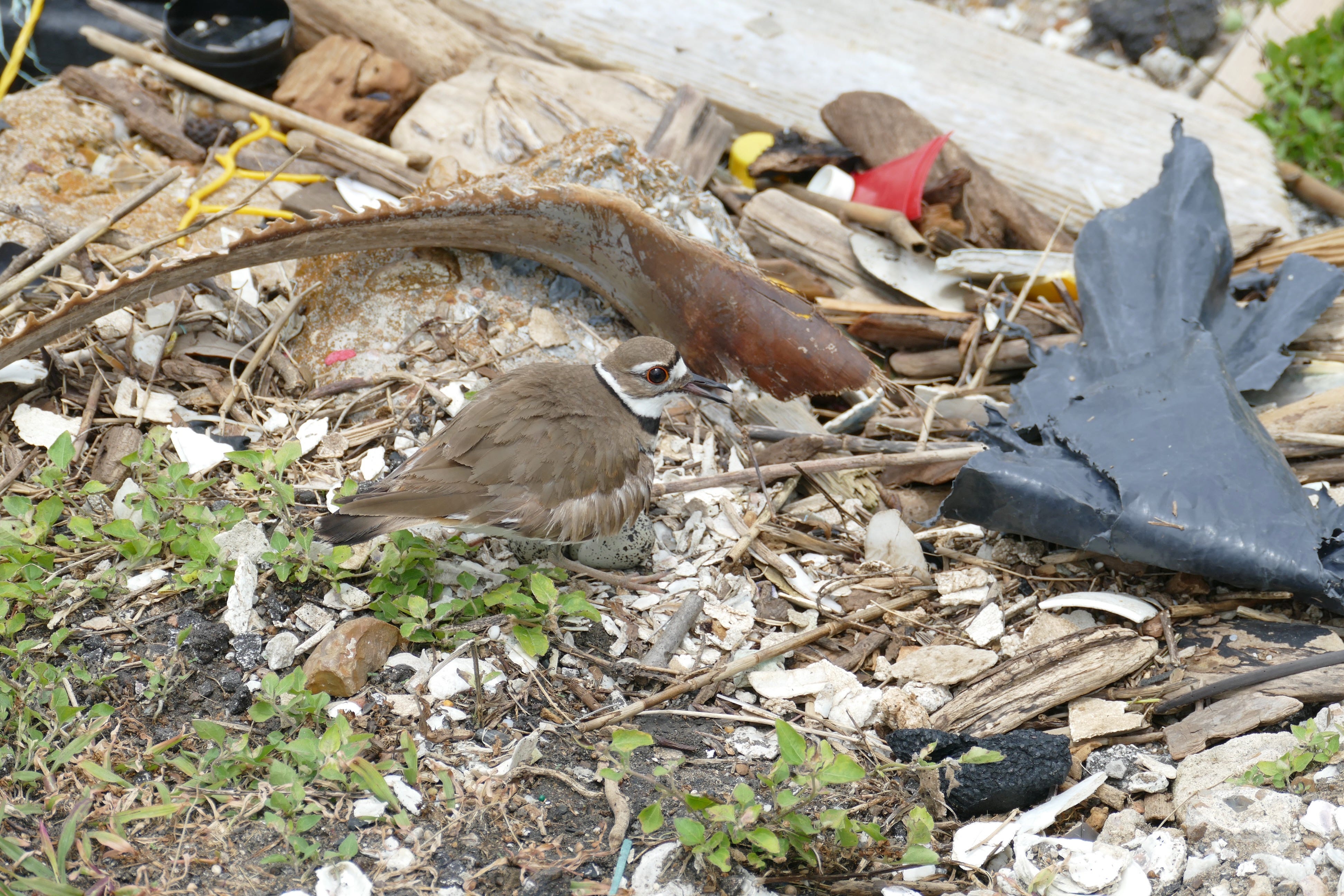
Only when I looked at the scene more closely, after I uploaded the photos, did I notice the clutch of eggs it was guarding—speckled objects visible there in the little shadow made by the plover’s body. I hadn’t known killdeer lay their eggs on open ground, requiring them to guard them constantly. And I wouldn’t have expected that trash-strewn channel bank to be the sort of open ground one would pick. But I suppose that may be the best it could find.
I went to Houston looking for evidence of biodiverse adaptation to our most brutalized late capitalist landscapes, but I hadn’t expected such a seemingly fragile little creature to provide the most profound vignette from the trip.
Notes to the Prospectus
The Kindle edition of A Natural History of Empty Lots is (or was as of this writing) on sale for $1.99, cheaper than a cup of coffee at a proper bookstore, if you’re into feeding algorithms and having extra reading copies on your phone.
Thanks to my rising ninth grader nephew, I learned last week of the popularity among his demographic of the term “Clanker,” borrowed from some Star Wars backstory as a derisive term for contemporary robots and AI-controlled machines. Roll over PKD, tell HAL 9000 the news.

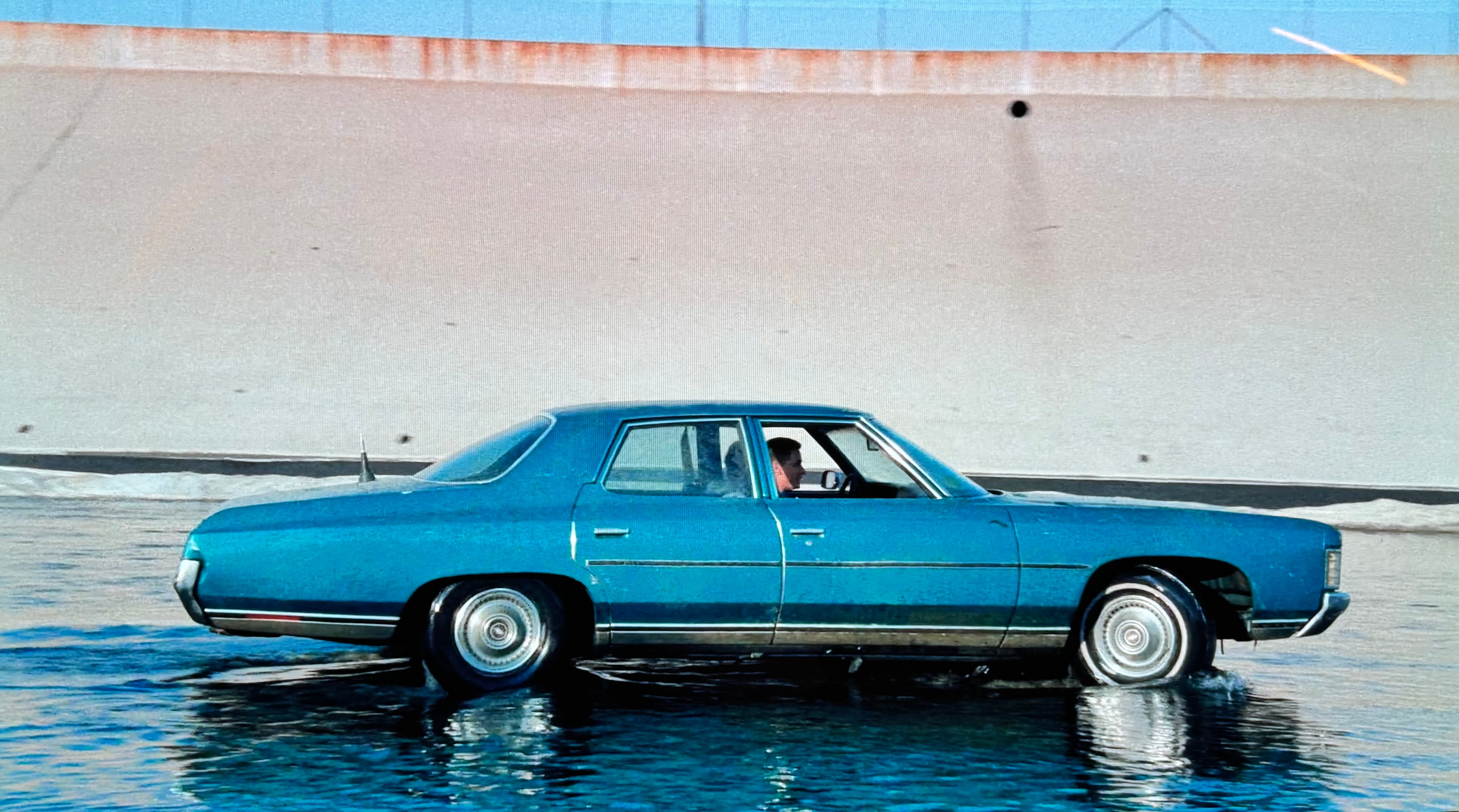
On a more analog note, I missed the recent screening of Repo Man at Austin’s Paramount Theater, which included a live performance by the Circle Jerks, but the movie is also streaming at Criterion this month as part of an Alex Cox retrospective, and holds up remarkably well. I had forgotten the awesome scene pictured above where Harry Dean Stanton takes Emilio Estevez’s Otto for a drive in the Los Angeles River.
I had a blast helping Eva zu Beck during her Austin stop touring her new book The Wilder Way, which is a remarkable personal story of liberation and reconnection with real life that I enjoyed getting to read.
When my daughter and I visited First Light last week, I picked up a copy of David Griscom’s The Myth of Red Texas: Cowboys, Populism, and Class War in the Radical South, which I started reading and am excited to finish. I'm familiar with parts of the story, but not others. Like that fact that voters who grew up in Texas are not the ones electing our current cast of characters—the majorities come from the transplants.
More on the insane plans for re-development of the Colorado River “Dog’s Head” area—an annexation with almost no public notice or debate that will allow 100% impervious cover, unregulated modification of the floodplain, and no height limits other than what’s mandated by the FAA—in this Austin Current story from the perspective of some of our friends and neighbors most impacted.
Photographer Kristian Thacker has an amazing piece just up on the orphan oil & gas wells of Muskingum Island—both words and pictures from Kristian in this one.
The June 12 TLS has an excellent Nick Holdstock piece on the newest novel by Field Notes friend M. John Harrison, a reprint of an older novel, and a broader consideration of Harrison’s oeuvre and mastery of oblique narrative strategies.
The July issue of Harper’s that arrived in last week’s mail has some amazing pieces on the upcoming 250th anniversary of the founding of the United States, including a Thomas Frank memoir of the 1976 Bicentennial, William T. Vollman field-stripping the Constitution, and an epic Christopher Hooks field trip to D.C. in advance of the official celebrations.
And then there’s the final prospectus of SpaceX, which opens (after a multi-page portfolio of spaceship pics) with this doozy of a corporate mission statement:
Our mission is to build the systems and technologies necessary to make life multiplanetary, to understand the true nature of the universe, and to extend the light of consciousness to the stars. To do this, we have formed the most ambitious, vertically integrated innovation engine on (and off) Earth with unmatched capabilities to rapidly manufacture and launch space-based communications that connect the world, to harness the Sun to power a truth-seeking artificial intelligence that advances scientific discovery, and ultimately to build a base on the Moon and cities on other planets.
Imagine what they could do if some of that capital and entrepreneurial energy were directed to connecting us with other life on this planet.
Happy Solstice, and have a great week. To welcome summer, here’s a young and unwary gray fox Fifi and I encountered last weekend, demonstrating how that species’ vocalizations are as if cats could bark:
Lots to digest! Look forward to reading more of your out-of-Austin explorations.
If cats could bark-- quite apt!