

I was chilling by the pool surrounded by screaming first graders when I saw the object from space.
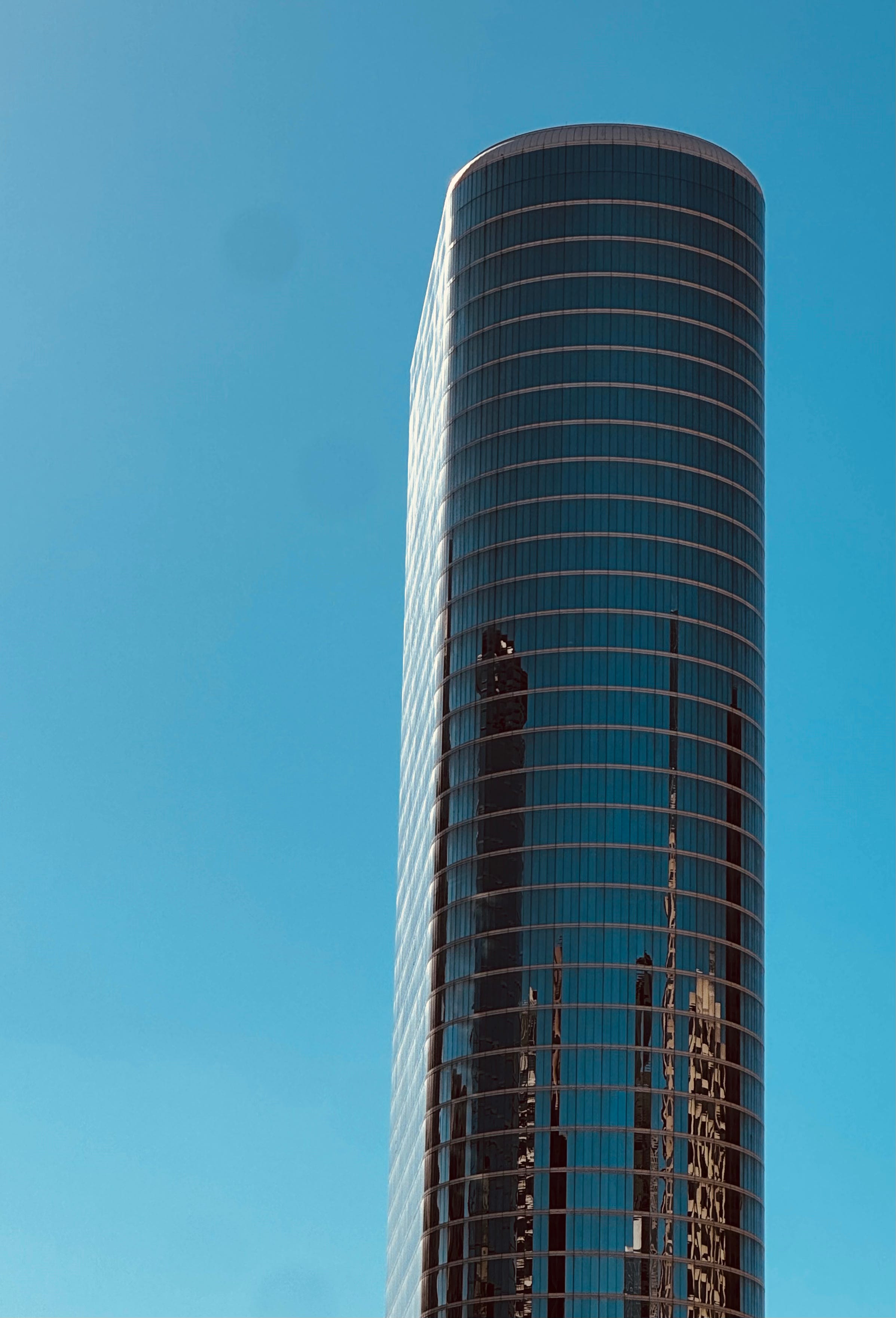
We spent the second weekend of spring break, which was also the vernal equinox and the official beginning of the new season, visiting Houston with two other couples and their same-aged kids. Three of the four parents are professors, and the one who is not had the awesome idea to get us all down there to take the kids to Meow Wolf Houston and check out the outstanding Frida Kahlo retrospective at the MFA. So that’s how we found ourselves waiting for the sun to come around the high-rises and warm the third-floor outdoor pool at the downtown Residence Inn, which occupies the former corporate headquarters of Humble Oil built in 1921. I was reading the prior weekend’s paper that I had thrown in my bag, periodically looking up to check on the kids and the progress of the sun, which I was certain would soon come out from behind the high-rises, shine on the pool, and warm us up. The other parents were more properly focused on the kids, and so no one else was looking when the meteor momentarily lit up the sky before disappearing behind the Enron Building [pictured above; now occupied by Chevron].
I have seen many a shooting star over the years, but always at night. This daytime phenomenon was much more spectacular: an intensely bright projectile moving at the speed of a UFO, with a blue and white corona that suddenly flared a platinum yellow flame. I immediately announced the sighting to the other parents, testing my credibility already strained as a science fiction writer hanging out with literary scholars (our view of the glistening Enron building had me thinking about the 1975 dystopian film Rollerball, presciently set in a 21st century Houston & USA where democratic institutions have been replaced by corporate rule). I looked on the flight tracker app to see if the radar had any info, and convinced myself it had been a small aircraft glistening in the late afternoon sun.
But after we got home Sunday, one of the other parents sent me a news story about how NASA confirmed it really was a meteor—one that flamed out over the city traveling 35,000 miles per hour and then crashed through the roof of a suburban home whose residents found the remains on their living room carpet. This local news clip has a great roundup of amateur videos of the thing I failed to capture, and a visit with the homeowner:
Later in the week, I found myself reading some of the scholarship on meteorites as omens and objects of human veneration, from the Stone of Delphi and the Heliogabalus of the Emperor Macrinus to the Hajar al-Aswad. Some classical-era Confucian cultures, including the Josean Dynasty of Korea, evidently took the appearance of flaming objects from space as signs of a loss of legitimacy of the current executive political power, and in medieval Europe they often foretold the imminent demise of the monarch. Such is the case in Shakespeare’s Richard II, when the Welsh Captain gives this report to the Earl of Salisbury:
The bay trees in our country are all withered,
And meteors fright the fixèd stars of heaven;
The pale-faced moon looks bloody on the Earth,
And lean-looked prophets whisper fearful change;
Rich men look sad, and ruffians dance and leap,
The one in fear to lose what they enjoy,
The other to enjoy by rage and war.
These signs forerun the death or fall of kings.
The European-American settlers of the United States found a wide array of extraterrestrial stones in the landscape, but unlike the Native cultures they displaced, they mostly treated them as utilitarian objects, like the 320-pound mass in Wichita County, Texas that had been an object of worship for the Comanche only to end up cut down into souvenirs, the meteorites of Kiowa County, Kansas that were used to hold down stable roofs and cover rain-barrels (until the farmers realized they could be sold to scientists for enough money to buy another farm), or the massive chunk of iron from space that the founders of Tucson repurposed as a public anvil. Perhaps the problem in those cases was that the settlers had not seen the objects fall from the sky.
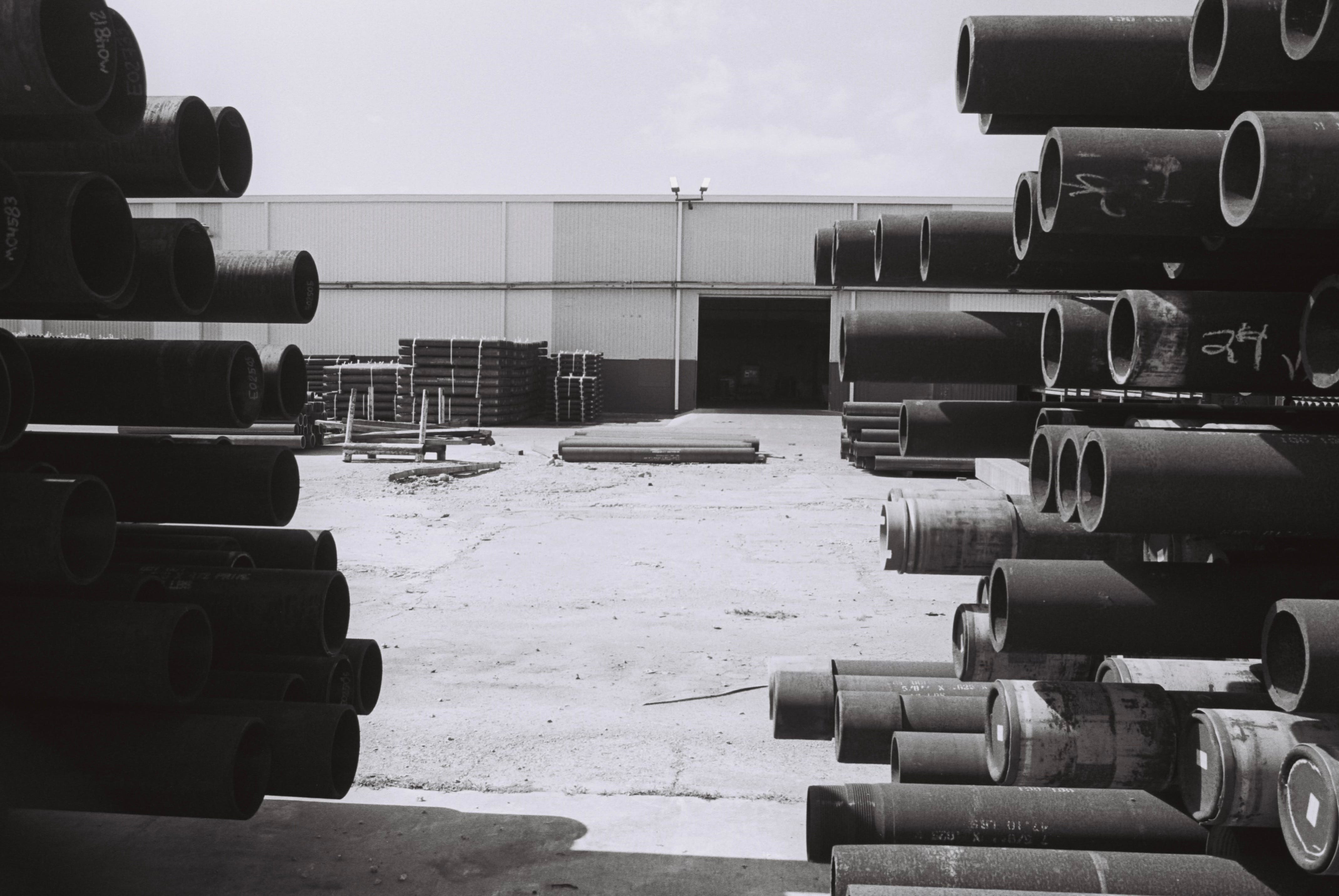
The next morning, while the oil wars raged on the other side of the planet, we roamed the industrial expanses of East Houston, scouting material for new projects—the site of a public art commission my wife is competing for, and the zone along Buffalo Bayou and the Ship Channel that I plan to explore in connection with my new book. Sundays, when the machines have mostly stopped, are a good time for those kinds of explorations — you can get closer to the interesting sites, and the chances of danger are lower.
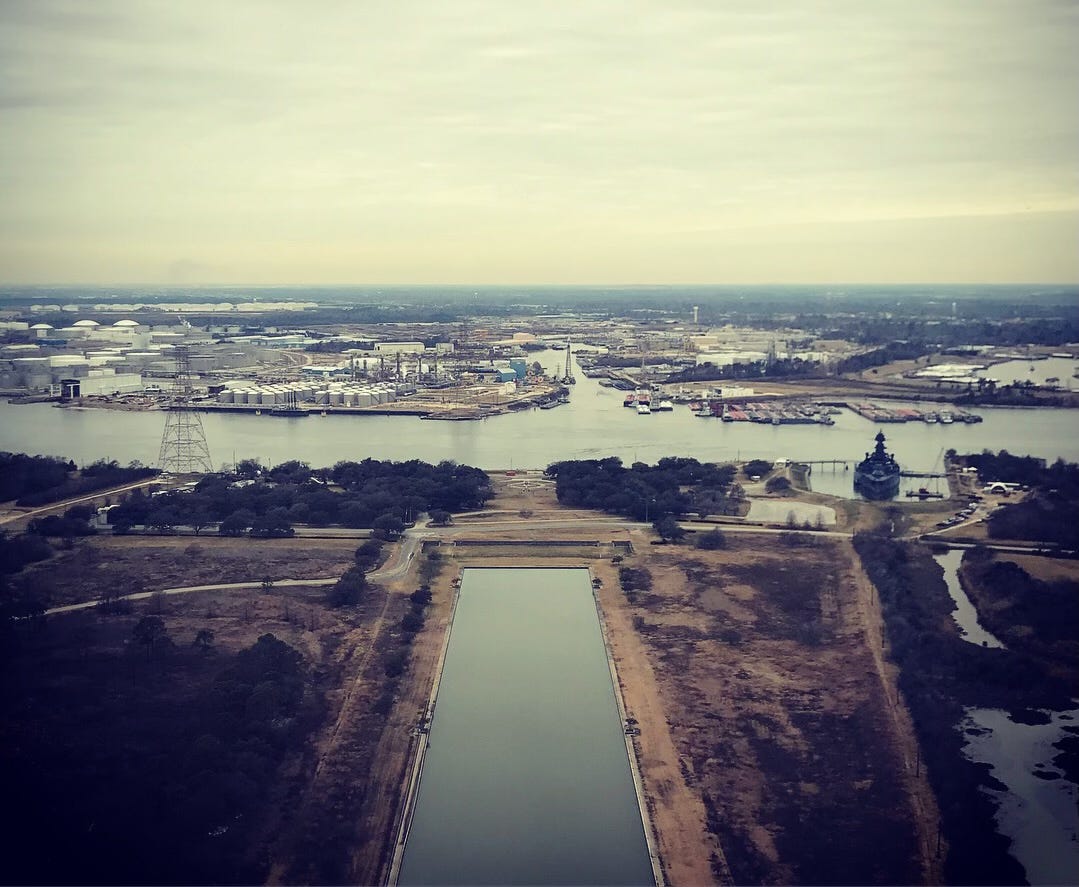
Houston famously has no zoning, and has been in a state of more-or-less continuous industrial development since the discovery of oil at Spindletop near Beaumont in 1901 and the opening of the Ship Channel in 1914, which engineered Buffalo Bayou—Houston’s connection to the sea—into a channel capable of supporting the infrastructure of oil export and import. The result is a minimally regulated sprawl of massive installations along a 35-mile stretch of river, far too expansive to get more than a few glimpses of on a Sunday morning.
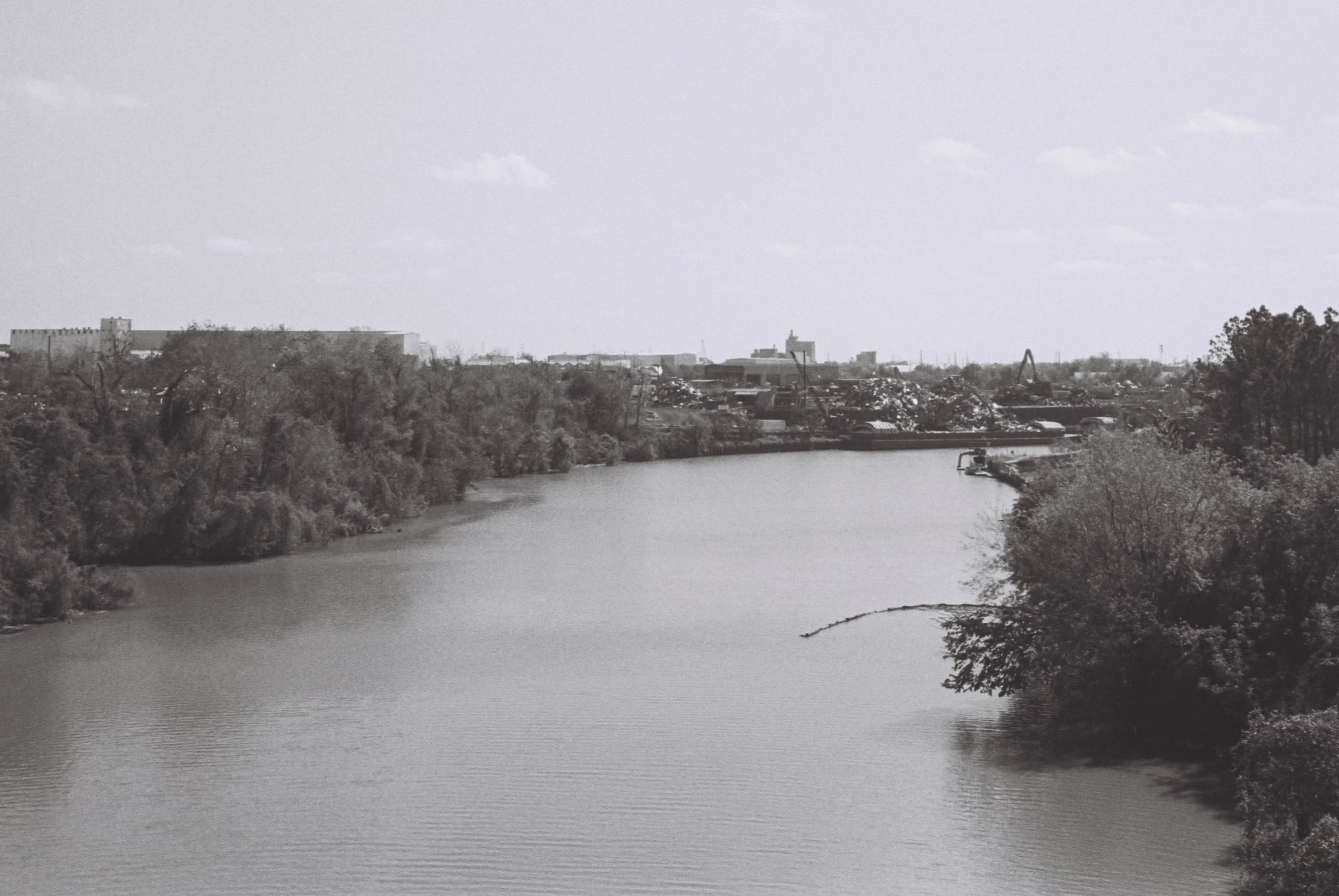
There’s something intensely, charismatically feral about that zone, where our most brutal Promethean infrastructure coexists with pockets of swampy coastal wild. Not just in the river corridor—you can also see it in the endless blocks of beat-up old industrial buildings that sprawl across the flats of East Houston, and even in the shiny corporate towers that crowd around the metropolitan freeways. Extensions of it can be found all along the Gulf Coast, from Boca Chica to Florida, but this is its beating heart.
As we scouted ways to penetrate the labyrinth of security fences and closed-off sites, aiming to witness both the pulse of petrocapital and the wildlife that manages to survive in its margins, I concluded the best way will be by water, and perhaps by bicycle, through the interstitial commons.
In the news that week I had read about the Administration’s plans to convene the so-called “God Squad”—the interagency committee statutorily empowered to grant exemptions from Endangered Species Act protections for threatened species—in order to unburden oil & gas extraction activities in the Gulf on national security grounds at the request of the Pentagon. The principal measures at issue were those designed to save Rice’s whale, which is the only baleen whale native to the Gulf, with a population believed to number fewer than a hundred.
The committee met on March 31, and essentially concluded that it had no legally permitted choice other than to grant the self-proclaimed “Secretary of War” the exemption he had requested, as required by the plain language of the statute. But the basis on which the request was made, judging from a review of the backup memoranda that were published, was specious (focused not so much on national security risks as economic ones), speculative (worried about what would happen if pending litigation results in future rulings that disrupt oil & gas activities in the Gulf), and hypocritical (proclaiming the action was designed to prevent exactly the kind of economic shock from disrupted oil & gas distribution that the self-parodically named Operation Epic Fury has already caused).
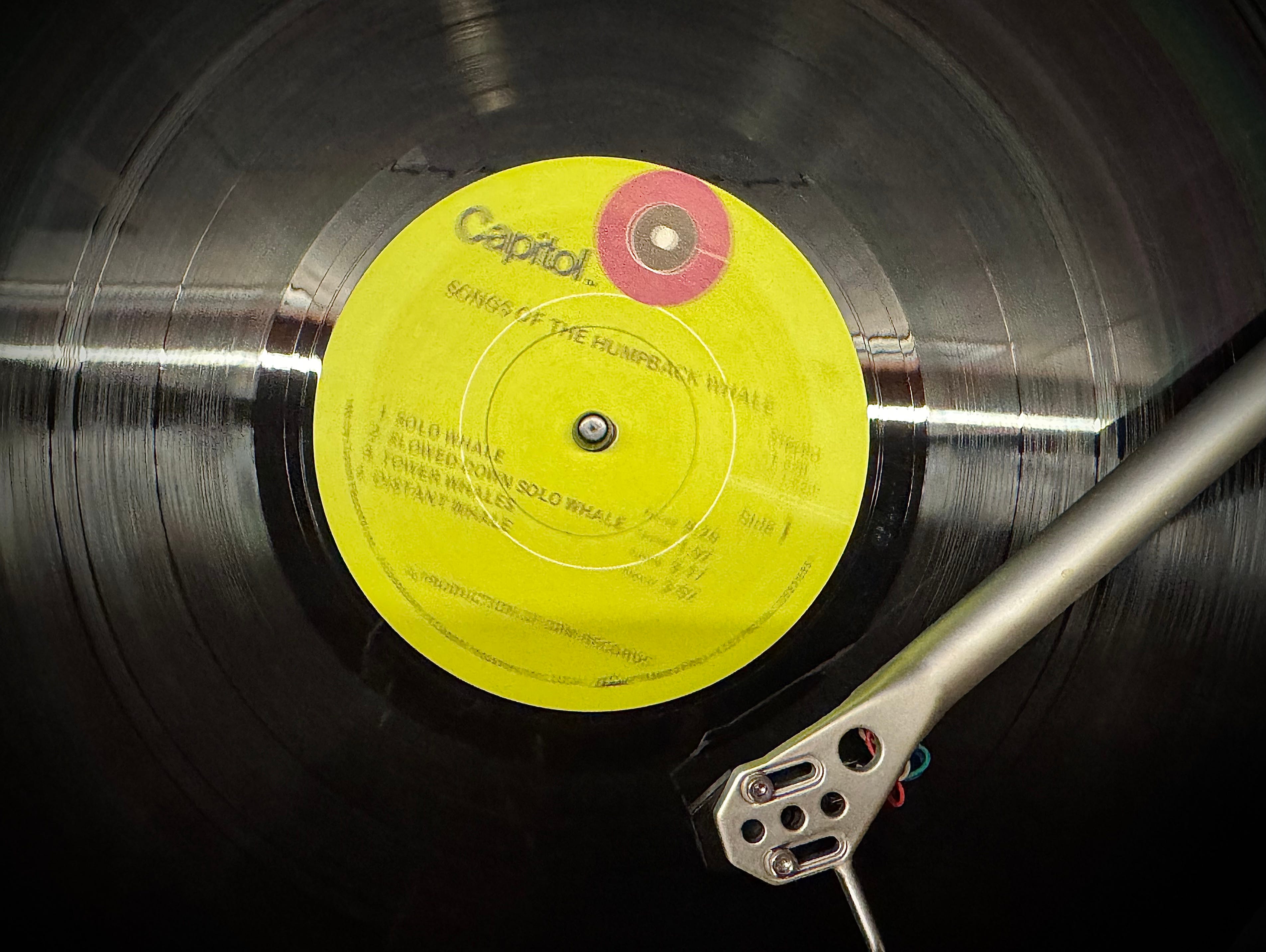
I found myself reading NOAA’s papers on the wildlife impact of underwater noise associated with offshore industrial activity, and remembering the enigmatic recordings of whalesong that were popular when I was a kid in the 70s—so popular that, by helping people empathize with the cetaceans, they engendered the popular support that helped save the humpback whale from extinction. I found two of those records in my stacks, Roger Payne’s Songs of the Humpback Whale, which started the fad, and Andre Kostelanetz’s And God Created Great Whales, which uses whalesong in orchestral arrangements of Sibelius, Skalkottas, and even Weill’s “Mack the Knife.”
Playing Payne’s remarkable disc, an album of field recordings of nature sounds that went multi-platinum, I could remember how strange it was to first hear those songs as a kid. Hearing it now, I can better appreciate the way the sounds give you a deeper sense of that undersea environment, and what it must be like for those animals when we come down there and start blowing things up. It’s hard to imagine a slow media phenomenon like the whalesong fad of the 70s being replicated in today’s digital ecosystem of platforms that enable us to channel-surf all night without any actual channels. Maybe Druski can get his Jacques Cousteau on.
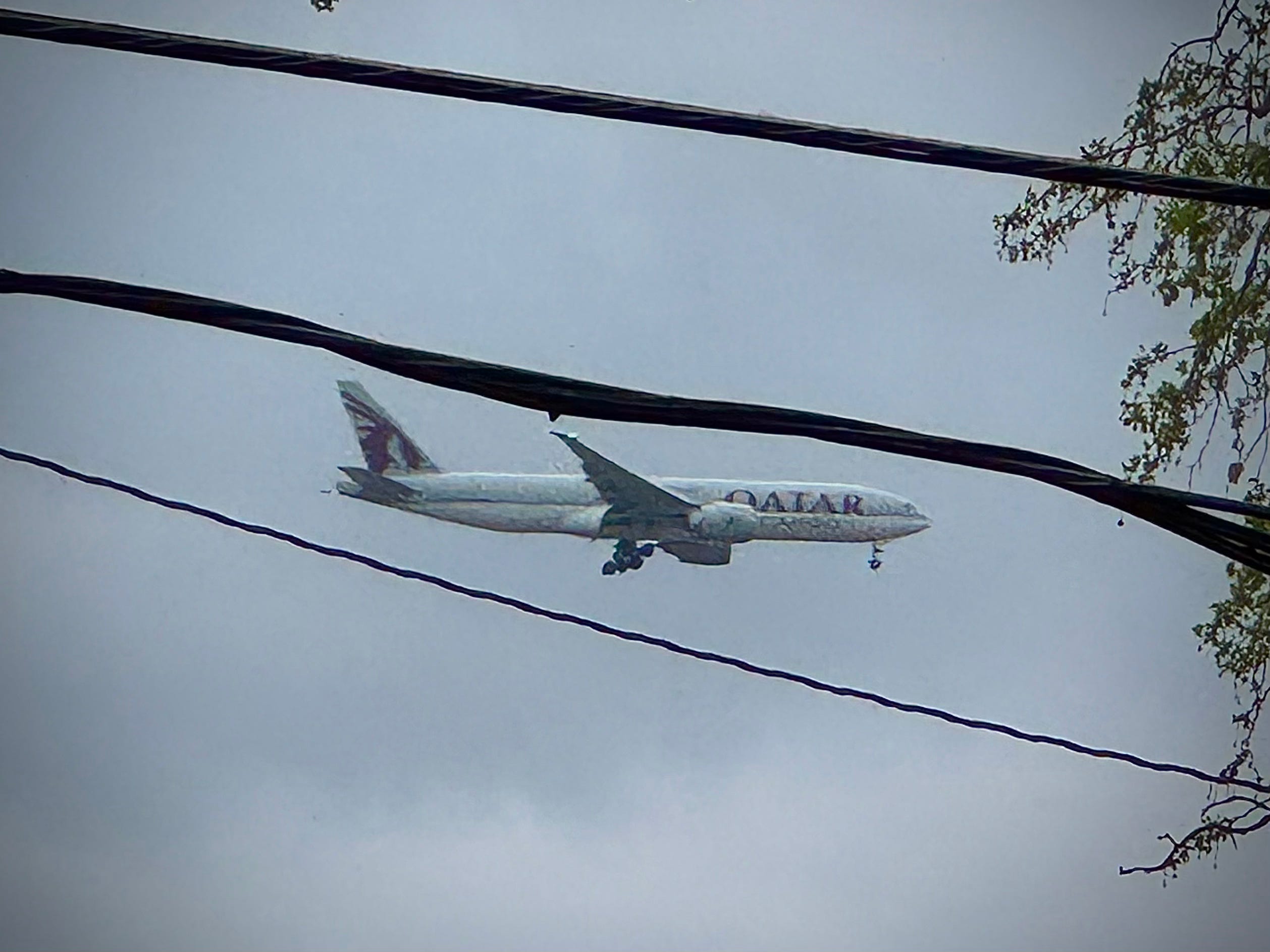
The only enigmatic migratory leviathan I personally witnessed in March was this Qatar Airlines 777 I noticed flying over our street the last Thursday morning of the month on final approach into Austin, a destination that airline doesn’t regularly serve. I pulled up the flight tracker again, and saw it had originated in Brasilia. I wondered if it was a luxury charter, carrying rich evacuees from Dubai, or some mystery cargo tied up with the war they won’t call a war.
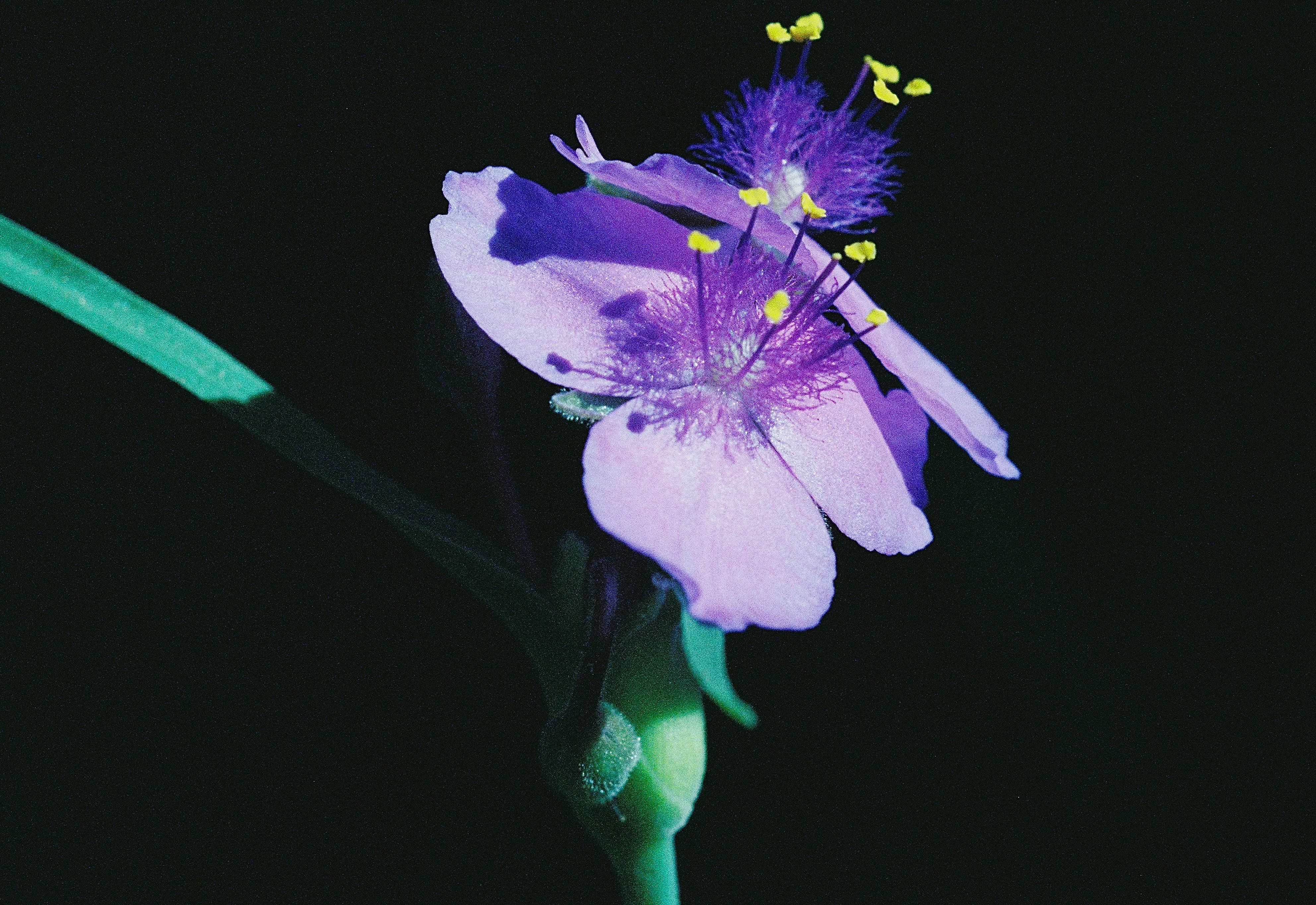
Today is Easter, so I suppose I will try to focus on the good news evident in the early wildflowers popping up all around here—bluebonnets, blue sage, cross vine, winecup, spiderwort, and tons of pink evening primrose, with other prairie flowers coming up green and ready to bloom soon. The folks are out selling big bags of cascarónes by the side of the road, and when she wakes up our daughter will be happy to break a few over my head the way her big brother did when he was her age. I might even shake the premonition I got Saturday, when the retama trees all started to open up their hot yellow flowers after the rain, of a hot brutal summer around the corner.
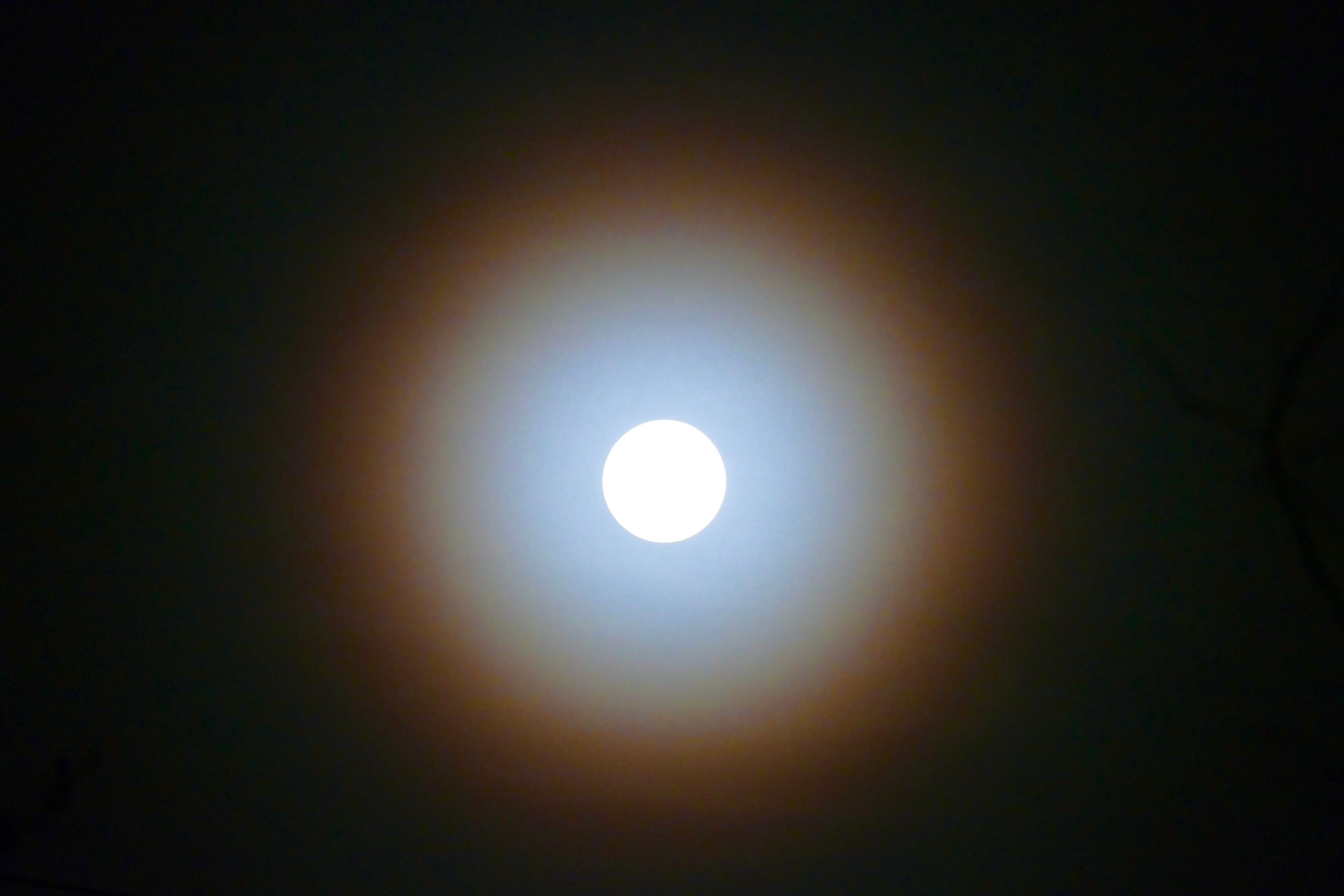
The rain came after an exceptionally trippy Pink Moon we got to see coming up Thursday night, just as the Artemis II expedition launched to go check it out more closely. Another celestial sign said to herald imminent changes in the land, it was so remarkable in those first moments when it came up over the treeline that I could almost believe the omen was real, and the current powers working to make the world their slave will soon have their own Enron moment.
The Roundup
For more on the wild ecologies of the Gulf Coast, check out my piece for Southlands magazine now available online on this side of the paywall.
And on the idea of paddling the Houston Ship Channel, check out this epic 2006 piece by Josh Harkinson on how he did just that. There’s also this interesting video from the Center for Land Use Interpretation’s Houston residency not long after that, which includes footage from some of their Buffalo Bayou boat tours:
I just sent to production the zine I made for the series of guided edgeland walks I’ll be taking folks on for the first-ever collaboration between Texas Book Festival and Fusebox arts festival, and I’m excited to see how they turn out. The walks are sold out, but I’m planning to do another one later in the year for newsletter readers, so if you’re interested shoot me an email (chris at christopherbrown-dot-com).
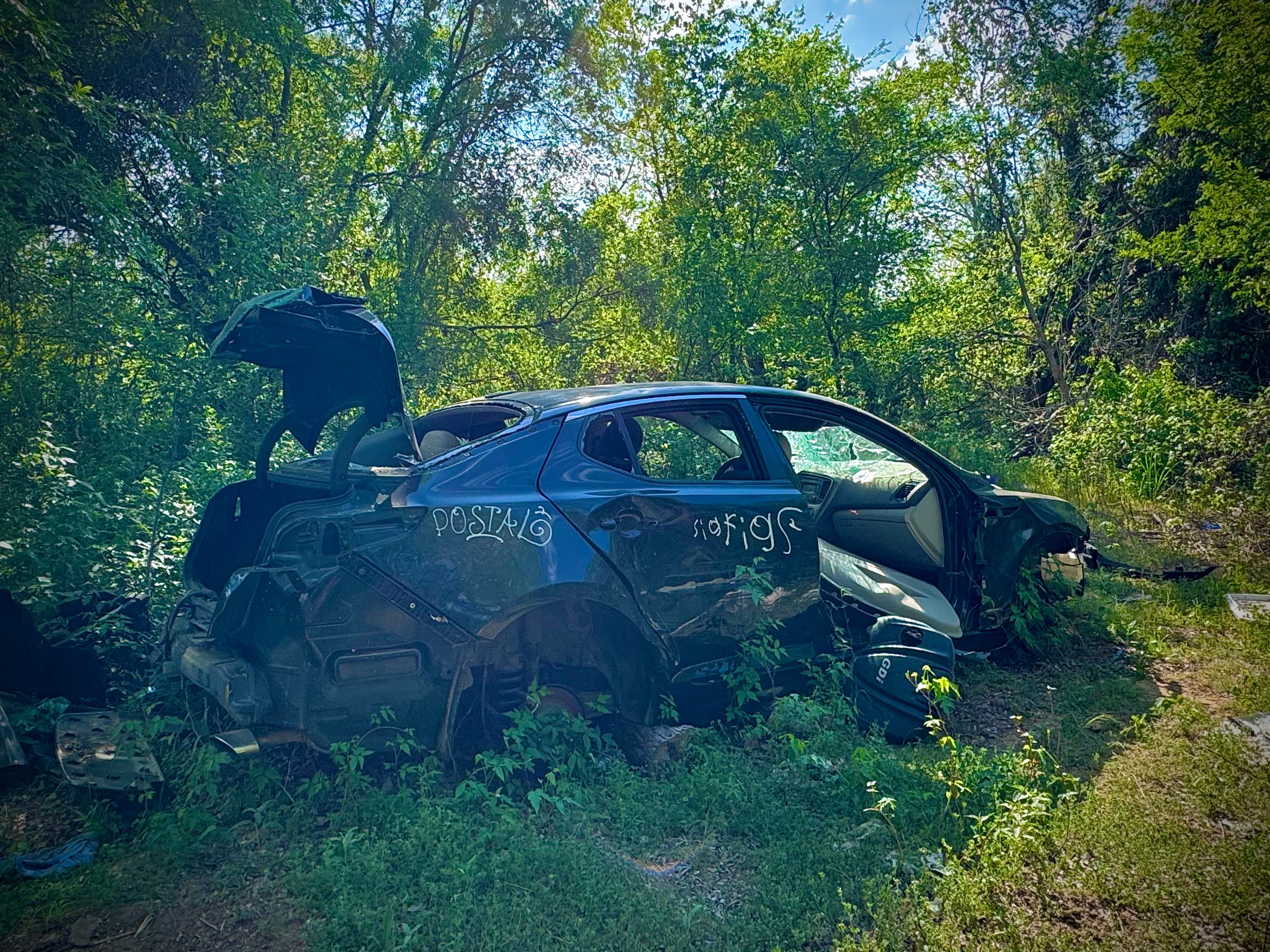
Here’s another Easter egg I found last Sunday, while scouting for the fourth and final walk:
The following week I’ll be at Alienated Majesty Books on April 22 in conversation with journalist and author Patrick Strickland on his debut short story collection, A History of Heartache. At the end of March I got to see Pulitzer winner Cristina Rivera Garza there in a bilingual presentation of the English translation of Autobiography of Cotton, and it was an incredible event from an exceptionally brilliant and charismatic author. If you’re in Austin and you’re not tracking that bookstore’s events feed, you should fix that (yes, they also host punk shows)—and drop by there and all the other stops on this weekend’s Austin Book Trail.
Friday’s episode of the public radio talk show On Point with Meghna Chakrabarti had great coverage of the new research about the decline in America’s bird population, its correlation with the intensification of agricultural practices, and possible remedies. Sobering but hopeful.
On the songs of the humpback whales, here’s a fascinating 2022 conversation with researcher Dr. Ellen Garland from the University of St Andrews:
And if you don’t know what I’m talking about when I mention Jacques Cousteau, here’s one of his whales episodes:
In other news a fiction writer or satirist couldn’t make up, Texas is trying to figure out how to annex parts of New Mexico.
Happy Easter to those who celebrate it, and have a great week. Here’s some blue sage (Salvia azuria) in bloom this week behind the factories:

well, not specific to This issue but more you’re working in general – I thought this article in the New York Times about desire path was interesting! https://archive.ph/h53nM
gorgeous -- and sobering, and informative, and helpful, and hopeful -- writing as usual.
💚 "intensely, charismatically feral"