

As my daughter and I hurtled down the tollway on our way to school one Tuesday morning in May while Mommy attended her welding final 👩🏽🏭🔥, I felt a little melancholy germinating in my mind as I considered how profoundly different our kid’s experience of that particular journey is than mine was, and how much that difference reflects an accelerating obliteration of culture, community and ecology by the paradoxically dehumanized human machine.
It was a beautiful morning. A rare thing in Texas: a cool spring day dialing up, with a cloudless sky after days of rain, the blue more deeply saturated than usual. We were traveling on an ancient pathway, the route of the Camino Real, and the native prairie flowers were in bloom along the roadsides. Some peppy upbeat anthem about tween unicorns was blasting from the car stereo, and the ritual is a positive one, as our daughter’s school is a loving and wondrous community where she is excited to go every day. And it’s a quick trip, only about 12 minutes even during rush hour. But that’s because most of it is at 80 miles an hour, on a 10-lane concrete tollway, from our home in the woods behind an industrial corridor to the 1980s office building near the frontage road that has been repurposed as her progressive little school. We blast ourselves there every morning through a landscape of concrete cloverleafs clogged with morning traffic, in which the faces of the thousands of people who surround you are hidden from view, and the signs of natural wonder are so marginalized that it takes active effort to notice them. So we turn up the My Little Pony pop, and try to conjure a vision of a more beautiful world.
I remembered being her age, attending first grade in the 1970s Midwest. On the first day of school, my mom walked me down our street, which was called Pleasant and largely lived up to its name, with beautiful trees, affordable and cute old brick homes, and lots of young kids packed into a single block where everyone knew their neighbors. It was just three blocks, and after that first day she had me do it myself or with my younger brother for the rest of my childhood. Even then, though, the future was slipping in. When I was in preschool they had bulldozed the woods behind the houses across the street from ours and replaced them with a freeway—an urban connector of the same I-35 that they built through the heart of Austin—and I had to walk over it to get to school. But the traffic you saw there was sparse, and not in a hurry. It would take a couple of decades for the culture of the automobile to fully divorce us from our connection with the world on the other side of the window glass.
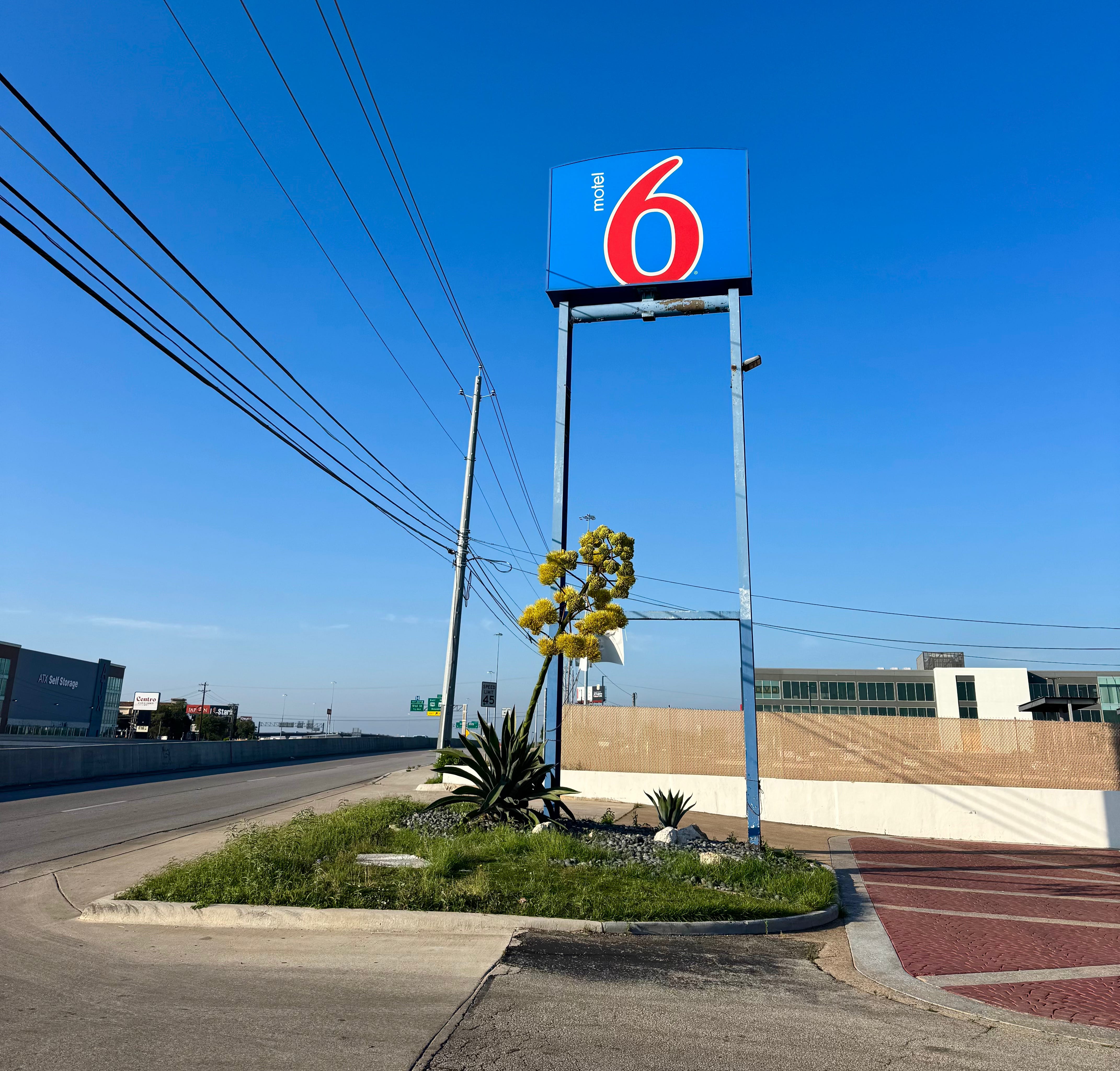
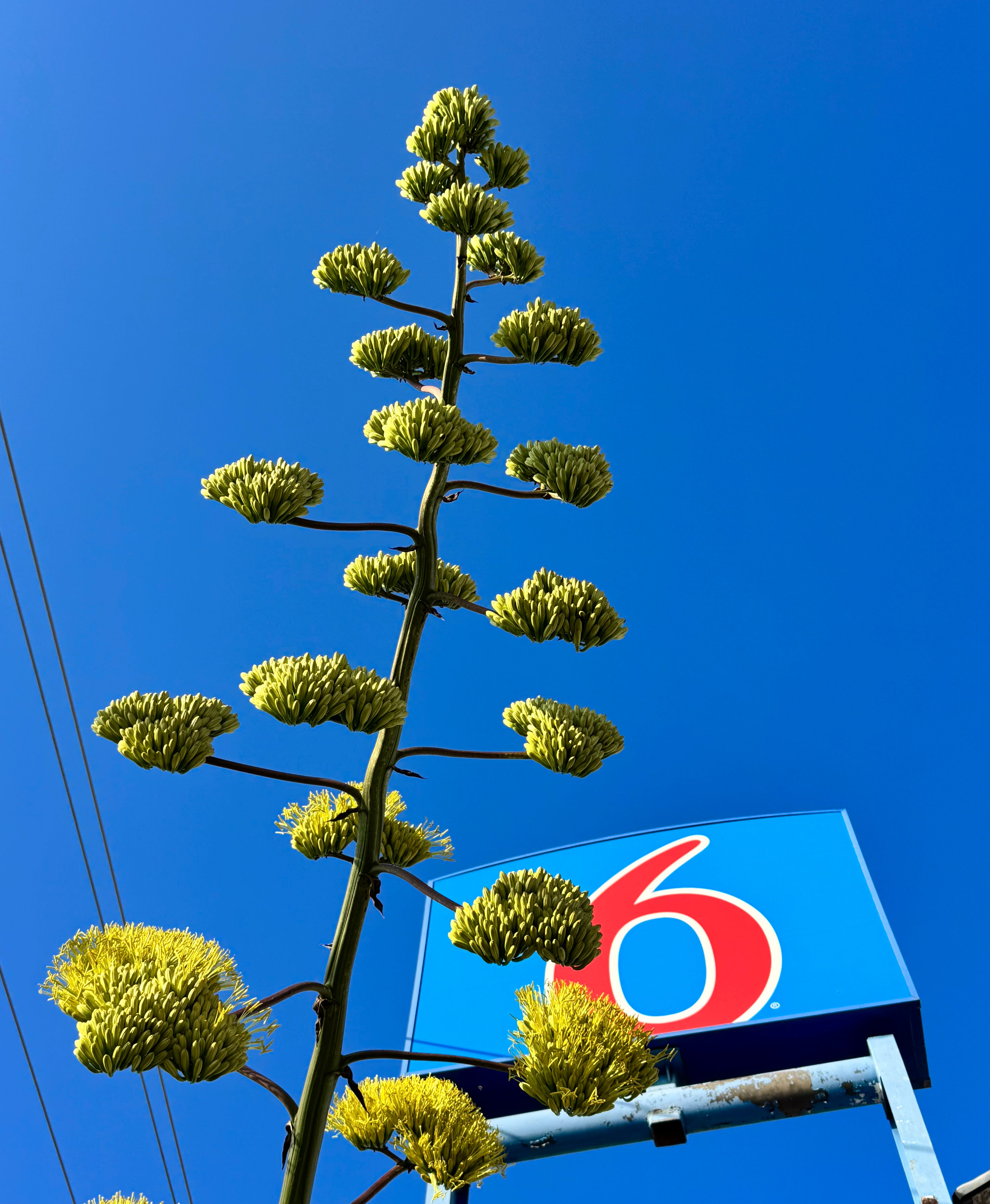
Right as we arrived at drop-off, just before our last turn to the school, I noticed this beautiful plant that had suddenly appeared in the all-American shitscape of the I-35 frontage road. A plant that had always been there, but I had never paid any attention to until now, when it had erupted with its extravagant green bloom, the intense life energy of which pulled us in as we slowed to turn the corner.
I went back after drop-off to get a closer look, parking at the Denny’s next door. The plant occupied the solitary island of dirt allowed to survive in that sea of concrete, and even that was blighted—some of the green was beat-up old astroturf, the rest invasive grass, and the big agave and the smaller one next to it were surrounded with ugly dark gravel. A thick sheet of white styrofoam was settling in to the turf as a little bonus. But something about the colors lent it an undeniable beauty. The way the blue of the Motel 6 sign matched the blue of the sky, a background against which the green of the bloom absolutely glowed. And then I saw all the bees.
As I stood there gaping at the flowers of this amazing plant, probably planted with little consideration by some landscape contractor in the wake of the 1990s xeriscaping boom, some birds started to gather with pigeon-like flapping. I looked over and saw a dozen of them alighting on the wooden alcove that welcomes guests to the motel lobby, which I now noticed was visibly rotten, the main beams exposed and splintered at the tips, maybe harboring the hives of the bees that were buzzing around me. The birds were not pigeons, but doves, acting as if they thought I might feed them. Or maybe they were there to earn their name, singing their gentle cries of mourning, as I remembered that the bloom of the monocot, which looked to be Agave americana, the so-called century plant, is the last extravagant thing it does before it dies.
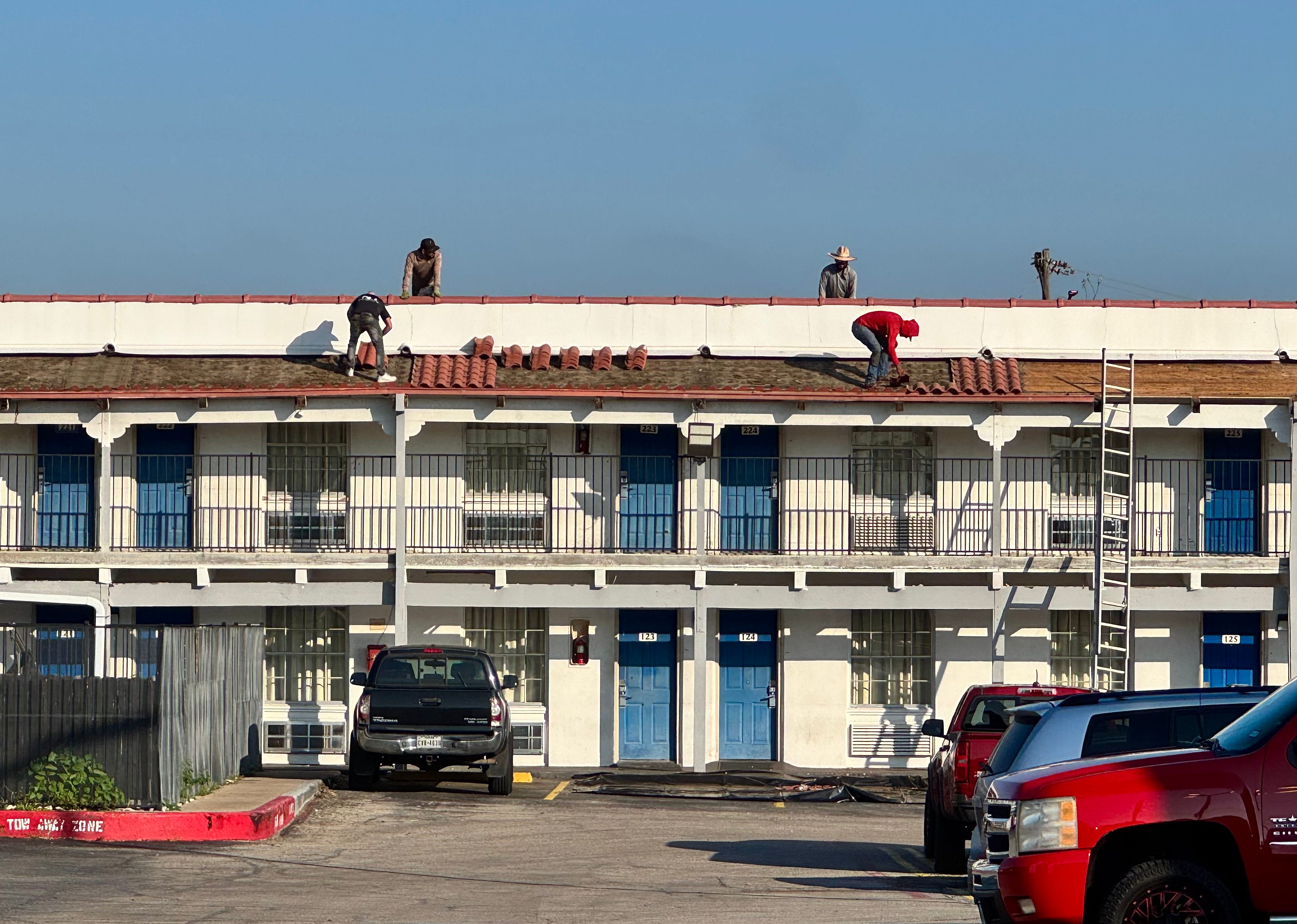
Out back, four dudes were re-tiling the roof with new Spanish-style terracotta, all dressed in a way that lent the scene a further atemporality. There were only four cars in the lot, suggesting the hotel was undergoing a complete renovation, or enough of one to perhaps have another shot at making money.
As I looked down at the astroturf and styrofoam, I wondered if the agave could propagate in that place, and what dreams might be born from the mezcal it could cook.
That afternoon, walking to grab a late lunch on the west end of downtown, I noticed a well-dressed old dude sitting on one of the benches, with a medical boot on his left foot, a ball cap with the logo of some fancy resort, and a Kindle in his hand. He was still there reading when I walked back an hour later. I envied his time available for non-required reading. And then I noticed the action in the tree above him. Two tropical green birds, monk parakeets, ripping thick green branches from the tree, which was a crape myrtle.
I frequently see the monk parakeets that have made their home in Austin come around to eat the pods of the honey mesquites in high summer, and often admire the massive nests they build in cell phone towers and light poles. But I had never seen them collecting the nest-building material, and was amazed to see how much energy it involved. Talons clamped onto another section, one bird bit its beak into a young green branch, right at the base, and put all the motion and muscle of its neck and body into breaking it off, with evident gusto. A long segment, maybe a couple of feet. They let me take a video:
Then they flew off down the street, in the direction of downtown. I tried to follow. It’s usually not that hard to track monk parakeets aurally, because they usually chatter loudly as they fly. And they are easy to see in motion in the city, a bright yellowish green, almost neon at times, against the concrete and glass canyon walls of the high rises.
They flew a block or so away, and I saw one disappear, into some crevice on a tall metal power pole connected to the nearby substation. I walked up. Close to the base, but above any unladdered human reach, affixed to the pole was a cylinder cable housing framed by a square rack. It looked to be a housing for the ground cables. And there atop the cylinder, behind the upper part of the frame, the parakeets were building their new nest. It was evident they were just getting started, but they were already able to hide there in plain sight.
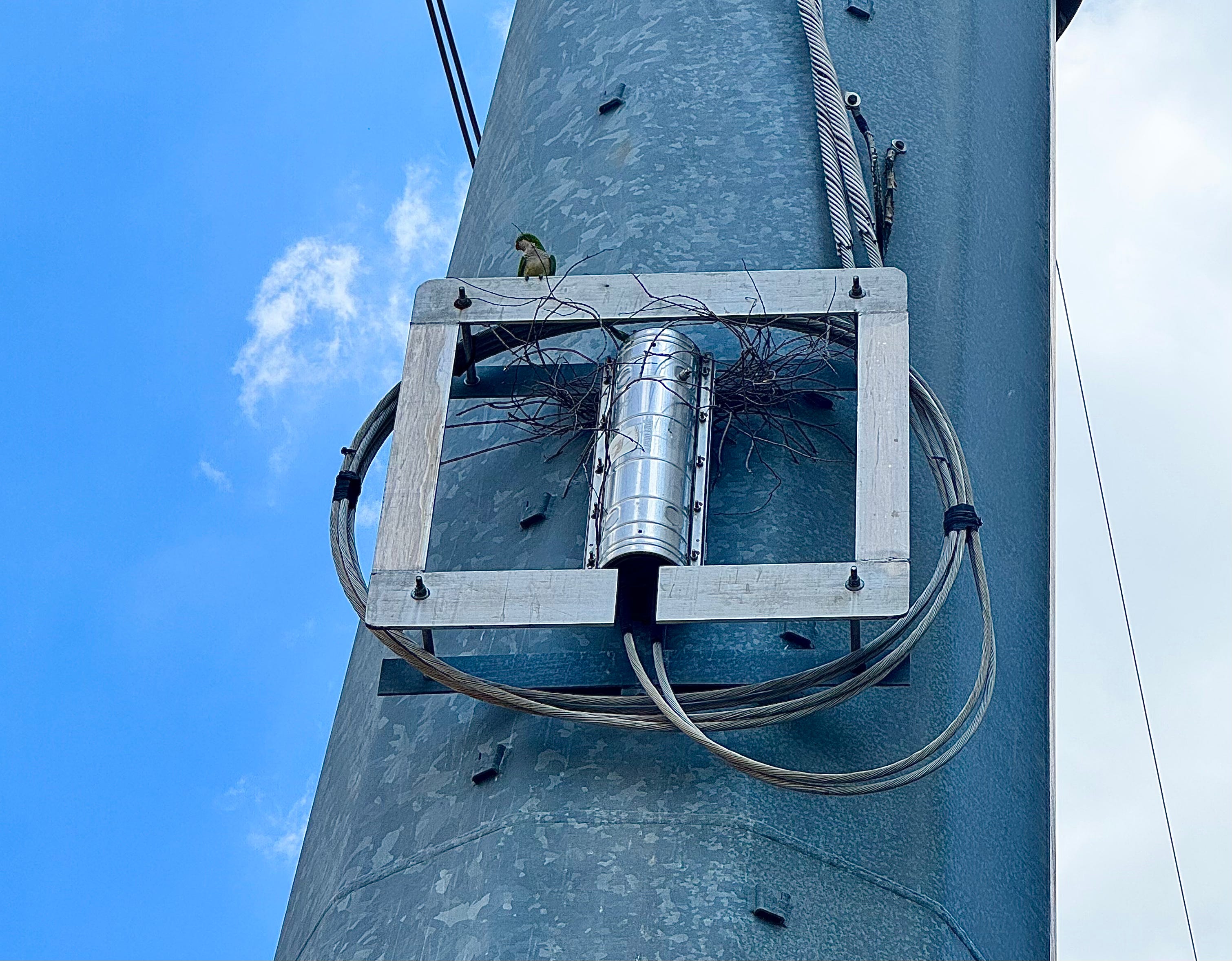
When I walked by a few days later, the nest was complete, filling most of the area behind the metal frame. The only species of parrots that build their nests from sticks, monk parakeets are also one of the only species of birds that build multifamily nests—stacking the sticks into huge structures with separate chambers for different family groups. I wonder if this pair, just starting a new nest that would soon be added onto, knew that they were building their avian co-op in the shadow of a dozen luxury condominium towers that have been built there in the past decade or so.
It was a beautiful moment of Anthropocene ecology, seeing these naturalized descendants of birds imported for the exotic pet trade using the material of exotic landscaper trees and the machine infrastructure of the electrified city to exhibit their successful adaptation to the world we have made, far from the South American jungles where they originally evolved. I also wondered how long the energy company will let them stay there. And if my instinct is right that their progeny will outdo us in their resilience, and still be here long after the power goes out for good.
Further reading
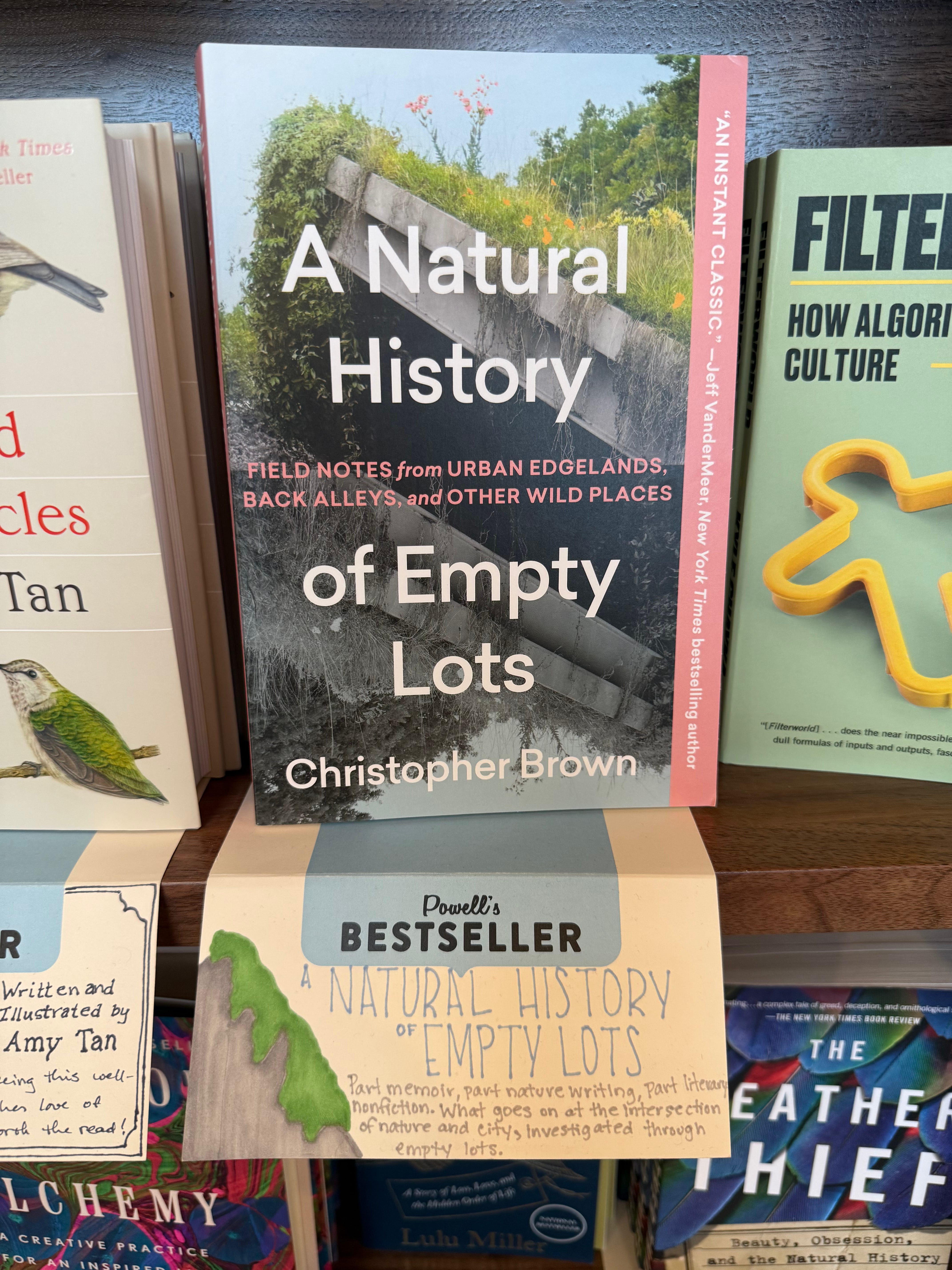
This month brought the first confirmed airport bookstore sighting of A Natural History of Empty Lots. Thanks to Dalia and Sona for the field reports.
I have dispatched copies of the Four Edgeland Walks chapbook from our Texas Book Festival x Fusebox series in April to all the folks who ordered one. If yours hasn’t shown up yet, let me know.
For more on the natural history of the agave, and the complex cultural history of the spirits we make from it, this JSTOR Daily piece from 2020 is a great starter.
For a deep dive into the ways monk parakeets have created challenges for power companies, a trio of researchers at U. Conn. and Brown published a fascinating study for NIH of the birds’ nest-building patterns on utility poles, with speculations on non-lethal removal strategies that might actually work.
Tuesday they euthanized Happy the Elephant, an involuntary resident of the Bronx Zoo who was the subject of one of the most successful animal rights cases in the U.S. to date thanks to the hard and innovative work of the Nonhuman Rights Project, which filed a habeas corpus petition on Happy’s behalf. While the courts all ruled against the petitioners, the final ruling from the New York Court of Appeals (that state’s highest court) produced two powerful, cogent and enduring dissents laying out the arguments for the idea of animals having cognizable rights. You can read both the majority opinion and the dissents here, and see if you agree it feels like the dissents are the kind that will later be quoted as having gotten it right when the law evolves along with us.
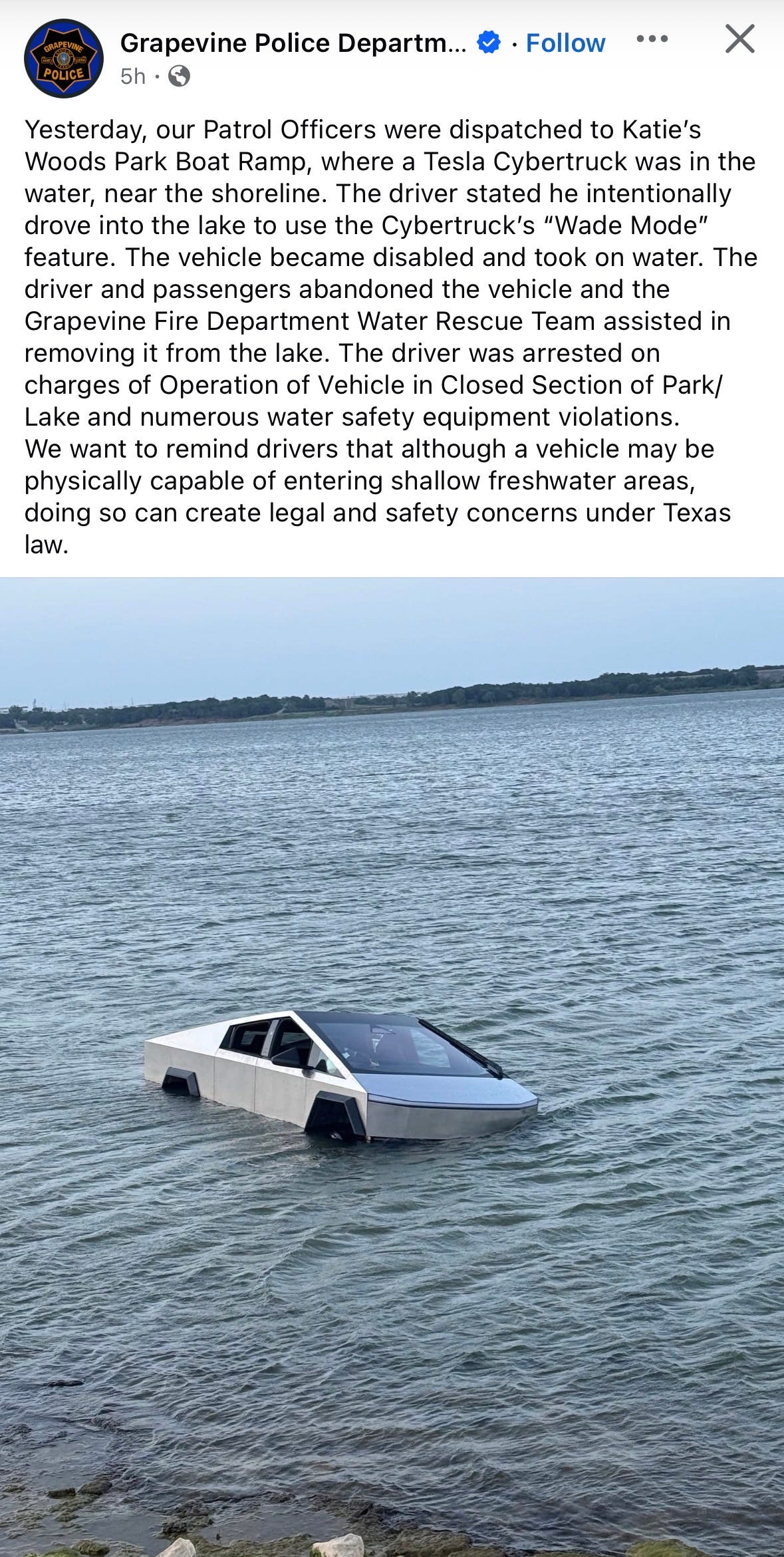
Meanwhile, my social media feed served up this picture-worth-a-thousand-words public safety notice from the annoyed first responders of suburban DFW:
If you’re in Austin on June 8, please come join me at BookPeople where I’ll be in conversation with Eva zu Beck as she launches her new book, The Wilder Way.
The new (June 11) issue of The New York Review of Books has an excellent piece on the remarkable novels of Makenna Goodman, Helen of Nowhere (published last year) and The Shame. I’m lucky to get to work with Makenna in her capacity as editor of other people’s books, and it’s awesome to see hers get such a closely read appreciation. Paywall version (for now) for subscribers here; archive copy here. If you’re in the UK, you can catch Makenna live this June—in London at BookBar on June 18 and at Charleston June 19 for an amazing-looking event with other Fitzcarraldo authors.
Some Actual Field Notes
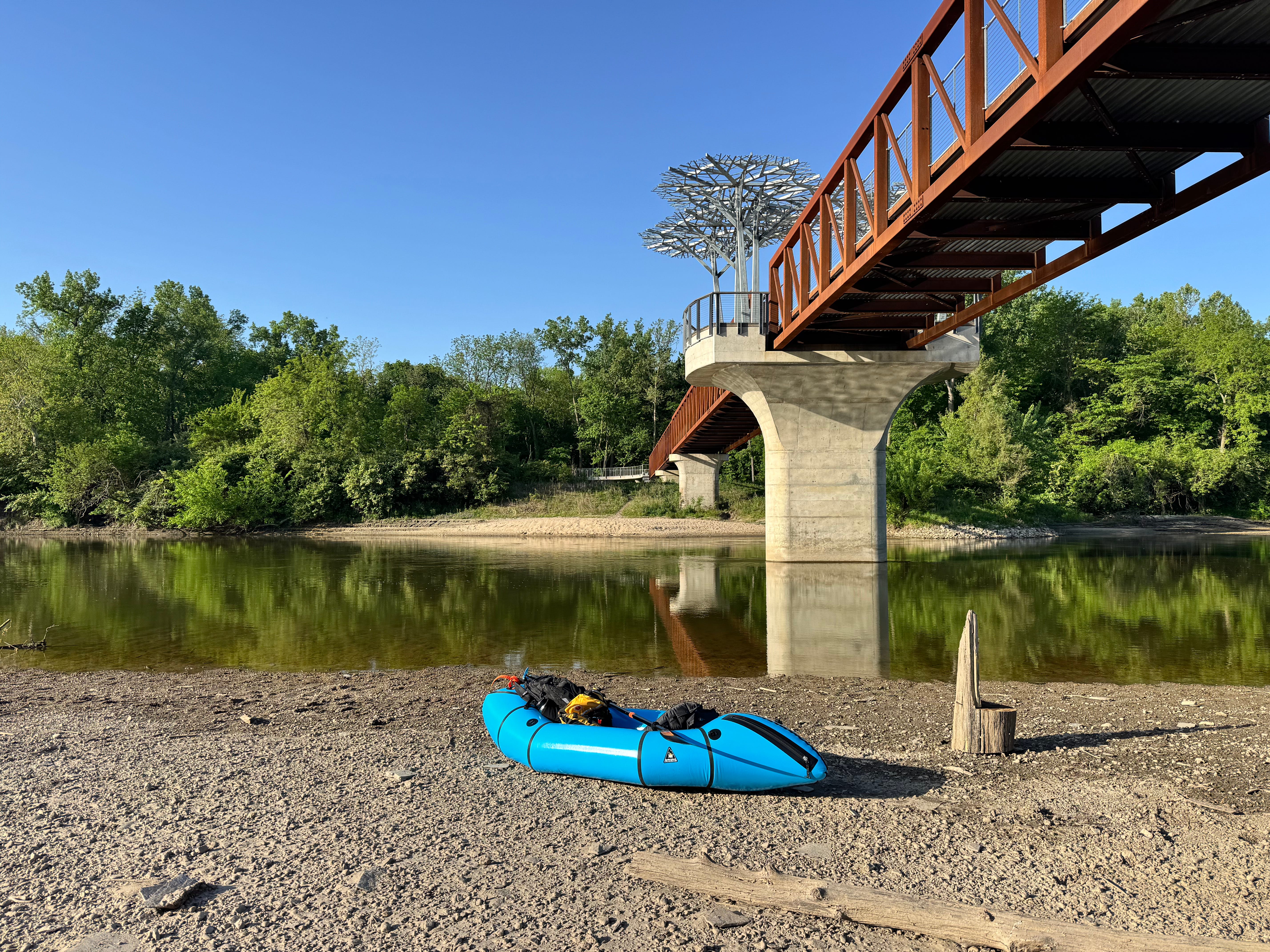
I’ve started the field work for my new book, working title Field Notes From a Near Future, which the AI inside Google describes as “a field-report narrative that explores how nature and wild/machine intelligences adapt and resist inside the infrastructure of modern capitalism.” To help me access some of the sites I want to explore around the continent, I invested in one piece of gear: an Alpacka packraft.
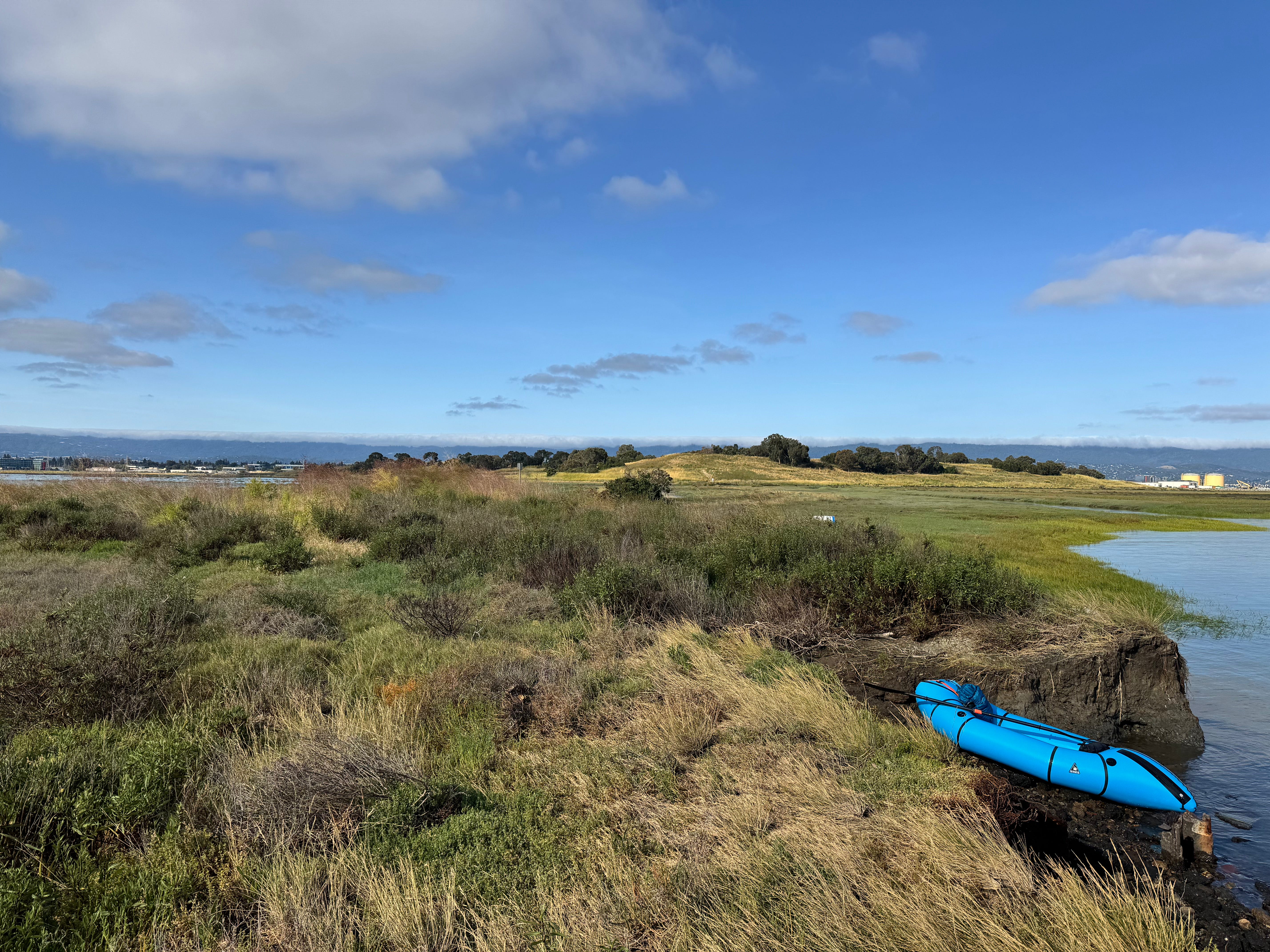
Packrafts are an innovation developed by backcountry explorers who liked to hike in and paddle out: an inflatable kayak/raft that packs down to less than five pounds and no more volume than a sleeping bag. I first used one in Alaska to paddle the Maclaren River, and have long waited for a good excuse to try one out in more urban settings. Scouting the industrial corridors of Houston this spring, I got the idea that could be a good way to get close to otherwise inaccessible industrial sites, and to see the wild life that coexists with them. This month I used it to paddle the wild and intensely polluted Raccoon River I grew up next to in Des Moines (put-in pictured above), and then last weekend to explore the salt flats across the highway from the Meta fka Facebook headquarters in Silicon Valley. I have trips coming up to explore the estuary of the Tijuana River in the shadow of the border wall, the Houston Ship Channel, the mouth of the Rio Grande around the SpaceX launchpad, and some locations on the East Coast. I aim to put some initial notes from these trips together here over the summer, so watch this space.
Here’s a pic from last Sunday morning, with the Meta HQ on the left, and a rewilded landfill jetty in the foreground:
My daughter and I recently dug out a box of DVDs that had long been in storage, which got us to dig out the DVD player as well and screen some. I rediscovered the wonders of Wholphin, the video magazine McSweeney’s did back in the oughts. I’ll close with one of my surreal favorites, Tactical Advantage by Daren Rabinovitch, which my daughter astutely interpreted as a parable on where thunder comes from:
Keep an eye out for today’s Blue Moon, and have a great week.
It’s been a great year for agave blooms (my husband calls them “death penises,” and I try not to roll my eyes), and cardinals.
Austin lost so many agaves in 2021, so it’s nice to see them having a banner year.
Thank you! With you traversing the shitscape(s)...