

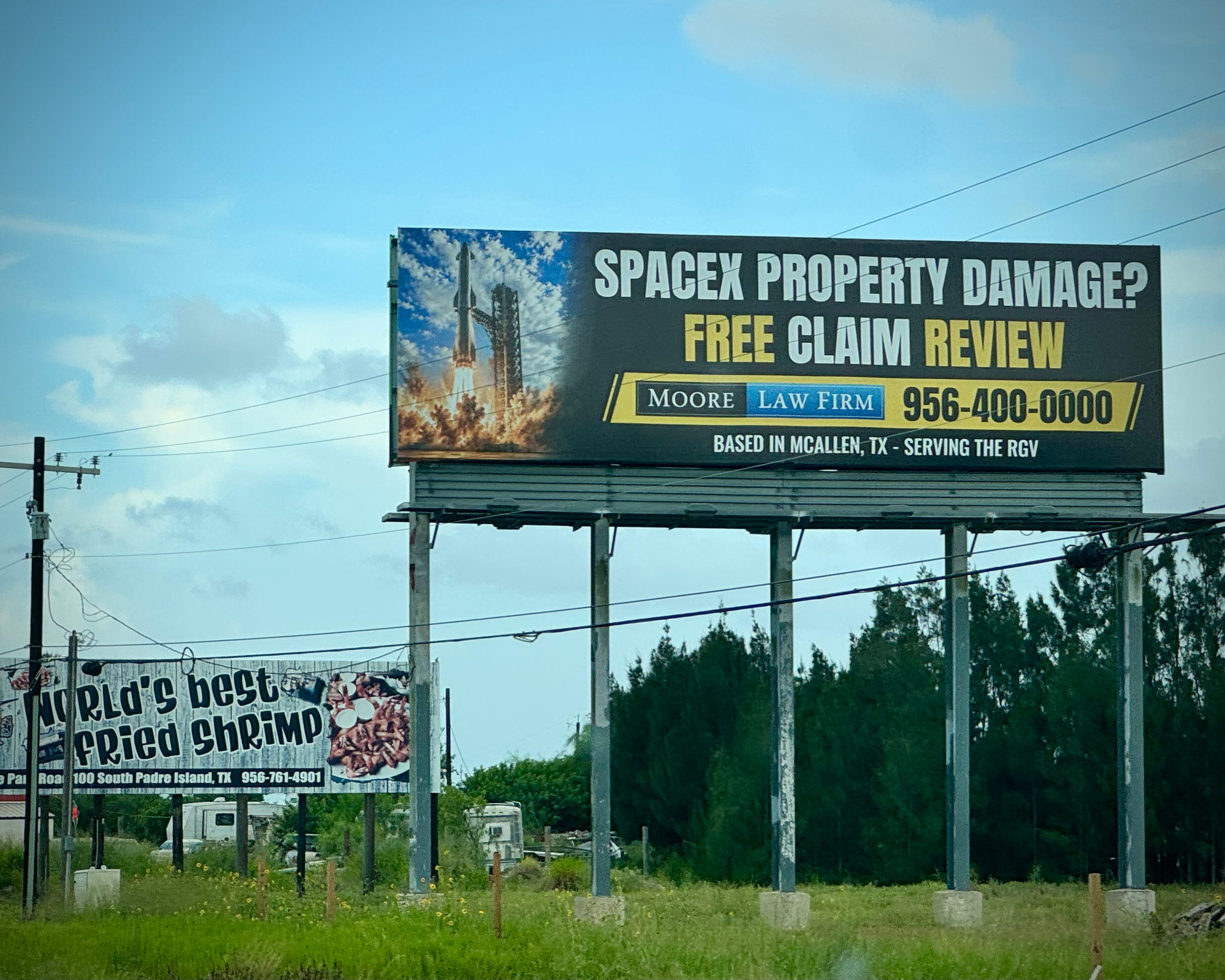
On the last leg of our extended family pilgrimage to South Padre Island, not long after we passed the Godzilla-sized Freddy Fender that adorns the water tower in San Benito, we stopped at a light in Los Fresnos and found ourselves looking up at a billboard that reminded us our very twentieth century-style road trip was taking place in a bent version of the sci-fi 21st-century future our childhoods promised. It was a huge lawyer ad, but instead of the usual portrait of some neck-tied paladin of the people promising justice measured in coin, it featured a picture of a rocket blasting off, and the opportunity to shake down SpaceX on a contingent fee basis in the event you might own some property in the Rio Grande Valley that got, as Devo used to sing, “hit by space junk.” Call now, our paralegals are standing by.
We’ve been going to Padre every July for a few years now, after giving up on Port Aransas following our dystopian Independence Day experience there in 2020. The water is cleaner, the landscape is wilder, the vibe is mellower, and the people you find yourself among are more diverse, with around half the vacationers families who drive up from Monterrey and other parts of Nuevo Leon. But you can’t escape the dark future, as was especially evident in 2023, the hottest summer in recorded history at the time, when the beach water our daughter played in were almost as warm as the baths we run for her at home, the feds’ border surveillance blimp loomed above the kites, and the air was so clear and bright you could see the outlines of the rockets lined up on the southern horizon, where the richest man in the world was spending his fortune trying to find us a new planet to live on now that we’ve trashed this one.
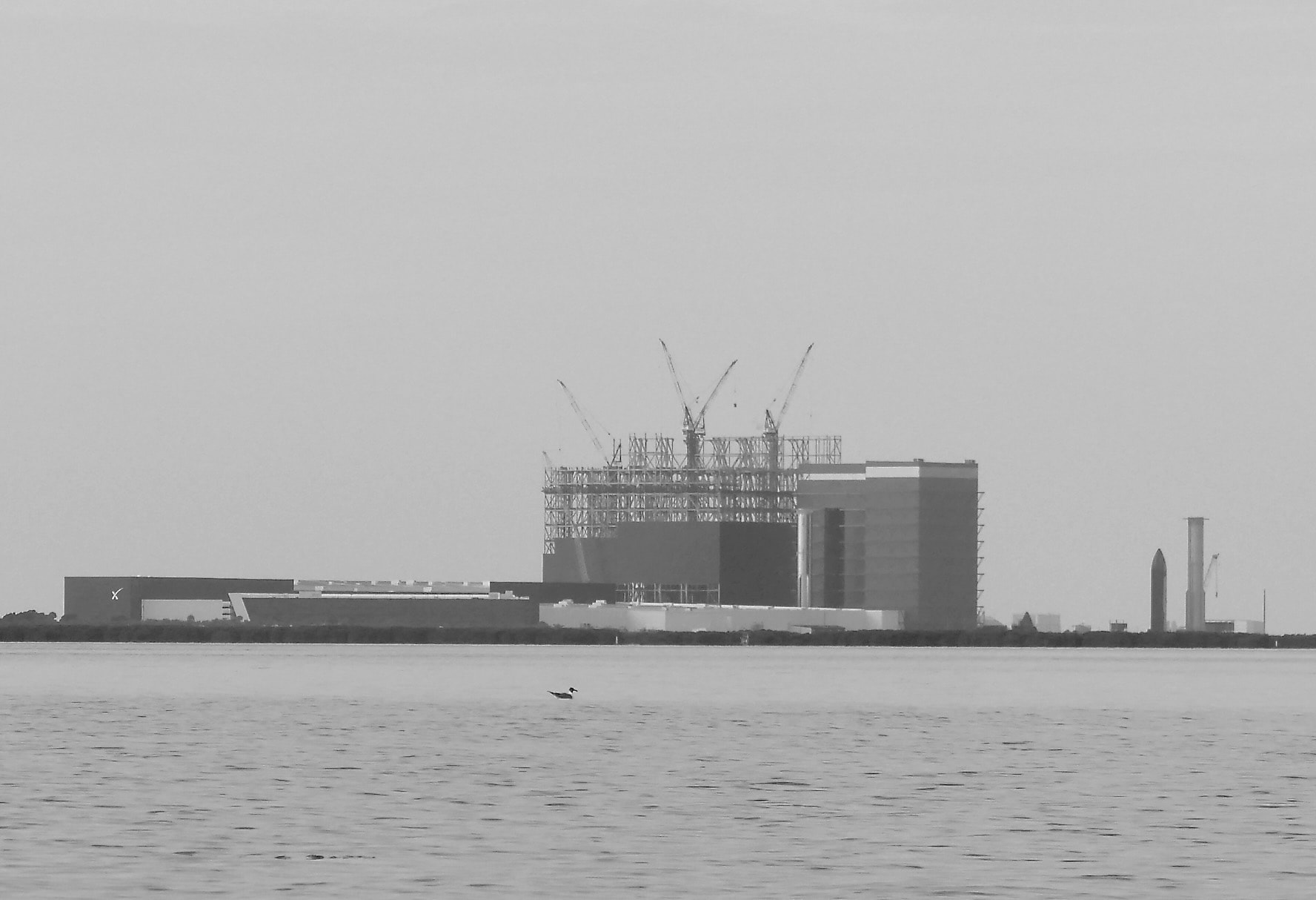
This year I decided to take a closer look. And to help me do so in a way that might also bring me closer to wildlife, I brought my packraft.
Distances are elusive in the Rio Grande delta, a coastal landscape of barrier islands, peninsulas, lagoons, resacas, and expansive marshy flats that might be full of water or dry as a desert depending on how much rain there has been. And navigating one’s way around the commons is never easy anywhere in Texas, where the idea of public lands is often coded as some kind of commie plot, and the navigable waterways near the Gulf are dominated by the leviathans of the petrochemical industry. But some research on the Parks & Wildlife Department’s site assured me it’s lawful to paddle from the southern tip of South Padre, across the Brownsville Ship Channel, and into South Bay, where I could get closer to the place now officially designated as Starbase. So at daybreak on the Thursday after July 4, that’s what I did.
My put in was in the park behind the municipal auditorium, right next to the Coast Guard base where DHS operates the tethered aerostat. It was grounded, and the place was quiet. No signs of the big tankers I feared in the channel. Just a few fishermen and, as I inflated my boat, some Alaska-grade mosquitoes dining on my exposed legs. Across the channel it was easy to see the landform I was trying to get to. So close and yet so far.
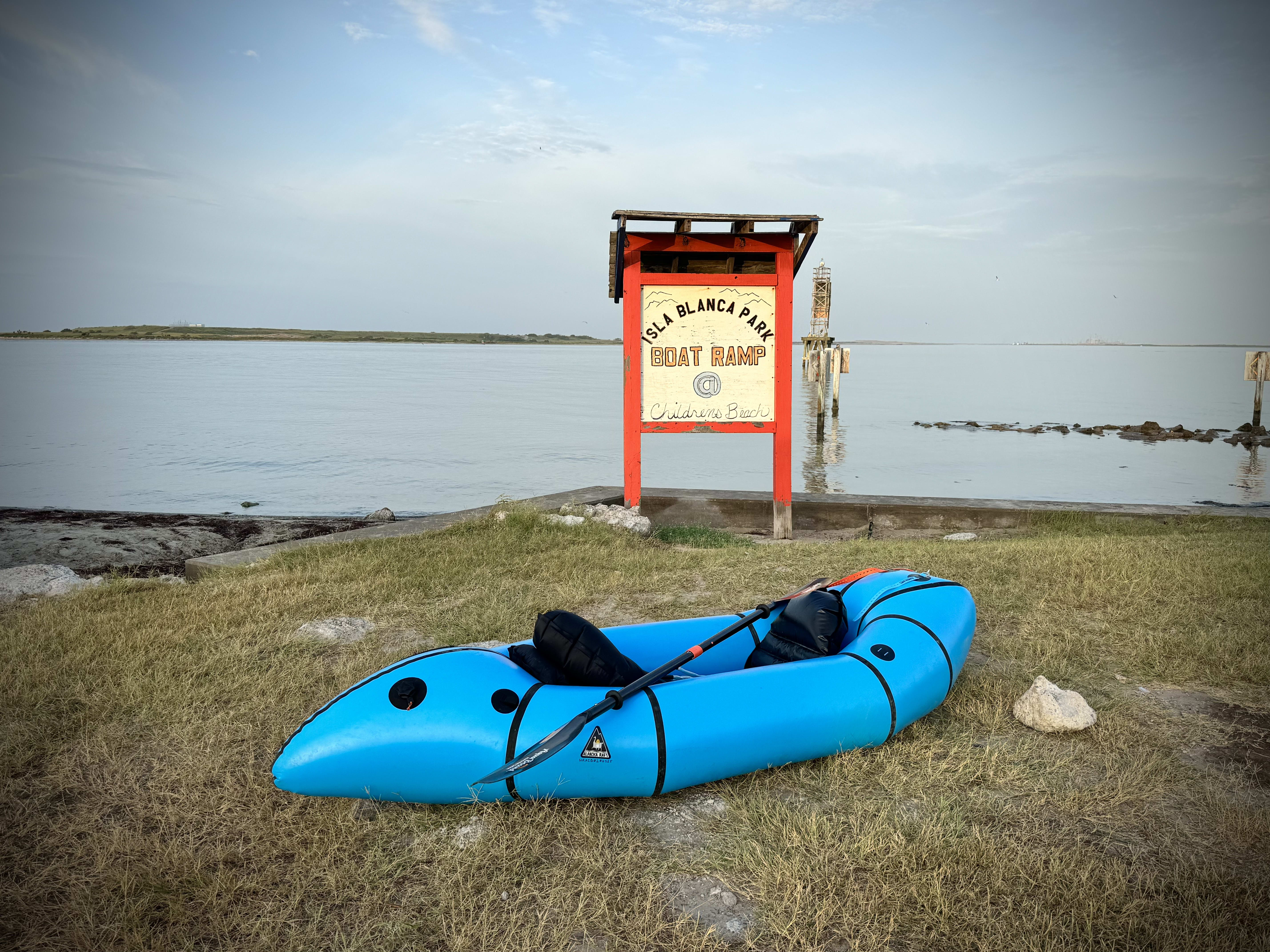
The packraft is unbeatable for portability, being designed to carry on your back in the high mountain backcountry so you can hike in and paddle out. That also means it’s designed for fast water, rivers charged with fresh melt coming off snowpack and glaciers. In flatwater like a Texas coastal bay or bayou, it can keep up with a canoe, but with a lot more energy on the part of the paddler, and little directional control when you stop paddling. You sit so low that it’s harder to read the water, and easier to get surprised by something in it.
I only had one close encounter with a shark, when the telltale dorsal fin appeared a few feet off my starboard bow, as if warning my weird blue tube creature away from its hunting home. But that was at the end of the morning, right as I crossed the bay to get back to the family before lunchtime. On the way out, you could see the fish jumping in every direction. And a little further out, a pod of dolphins headed the same direction as me.
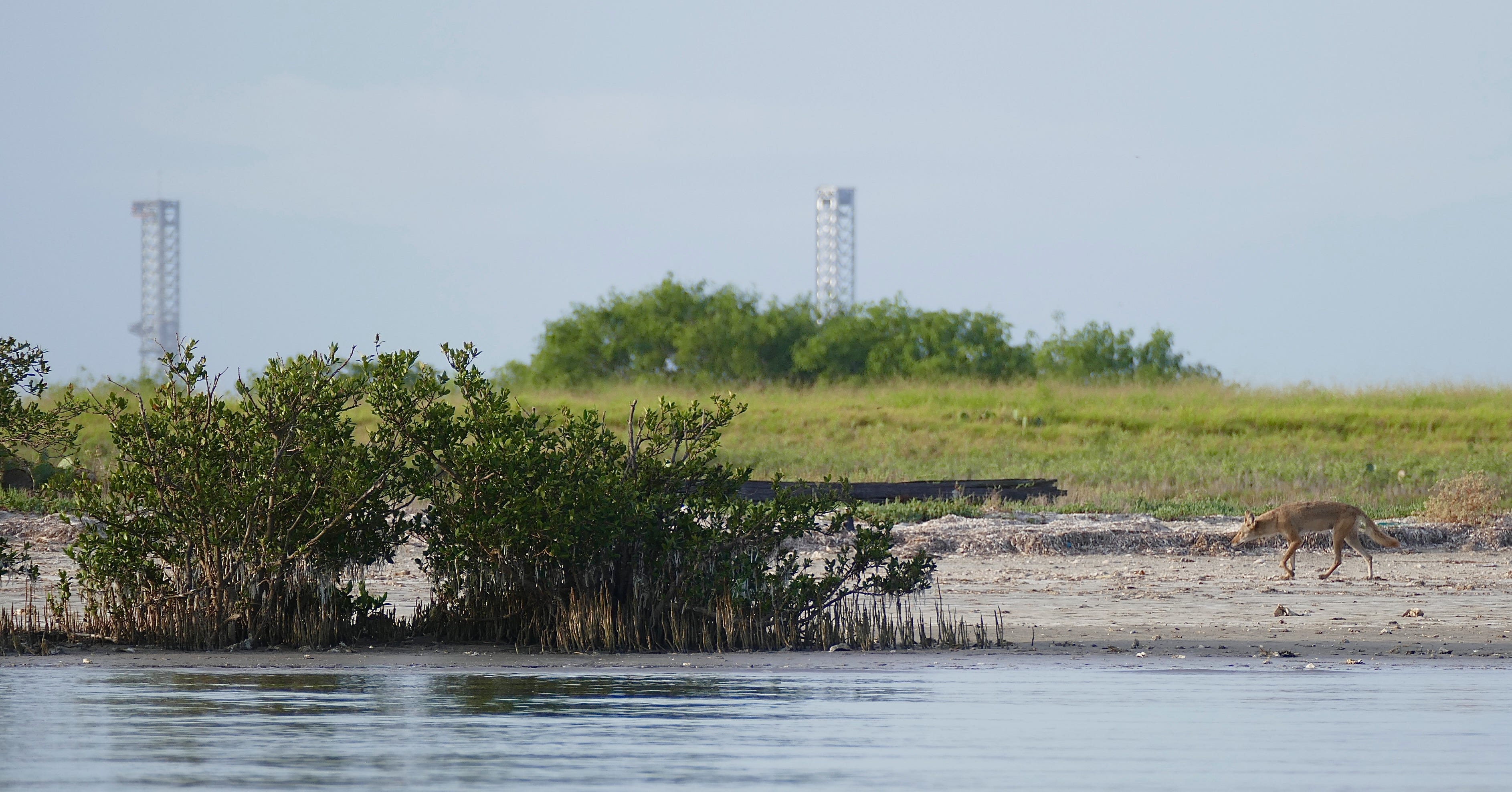
As I followed the shoreline looking for the baymouth, I spotted terrestrial movement in my peripheral vision. A coyote loped along the grungy beach. Short-haired and a little spectral, its rostrum looked weirdly streamlined, as if emulating its neighbor the armadillo, perhaps an adaptation over the generations to hunting in those thinly-vegetated dunes. I noticed I could now see the twin spacelaunch gantries much closer above the foliage behind it, confirming I was headed in the right direction.
I wasn’t as close as I thought. I paddled another mile or so until I finally found the way in: an expanse of dirty sand guarded by nine lanky herons you had to pass to paddle through to the twin towers whose geometries they subtly mirrored. I’ve never seen great blues gathered in a big group like that, all together yet weirdly spread out, just kind of standing around, loitering more than hunting. They had the air of a committee of priests or necromancers, wearing their wings like cloaks and their beaks like Venetian plague masks. I wondered what they had seen, what they were adapting to.
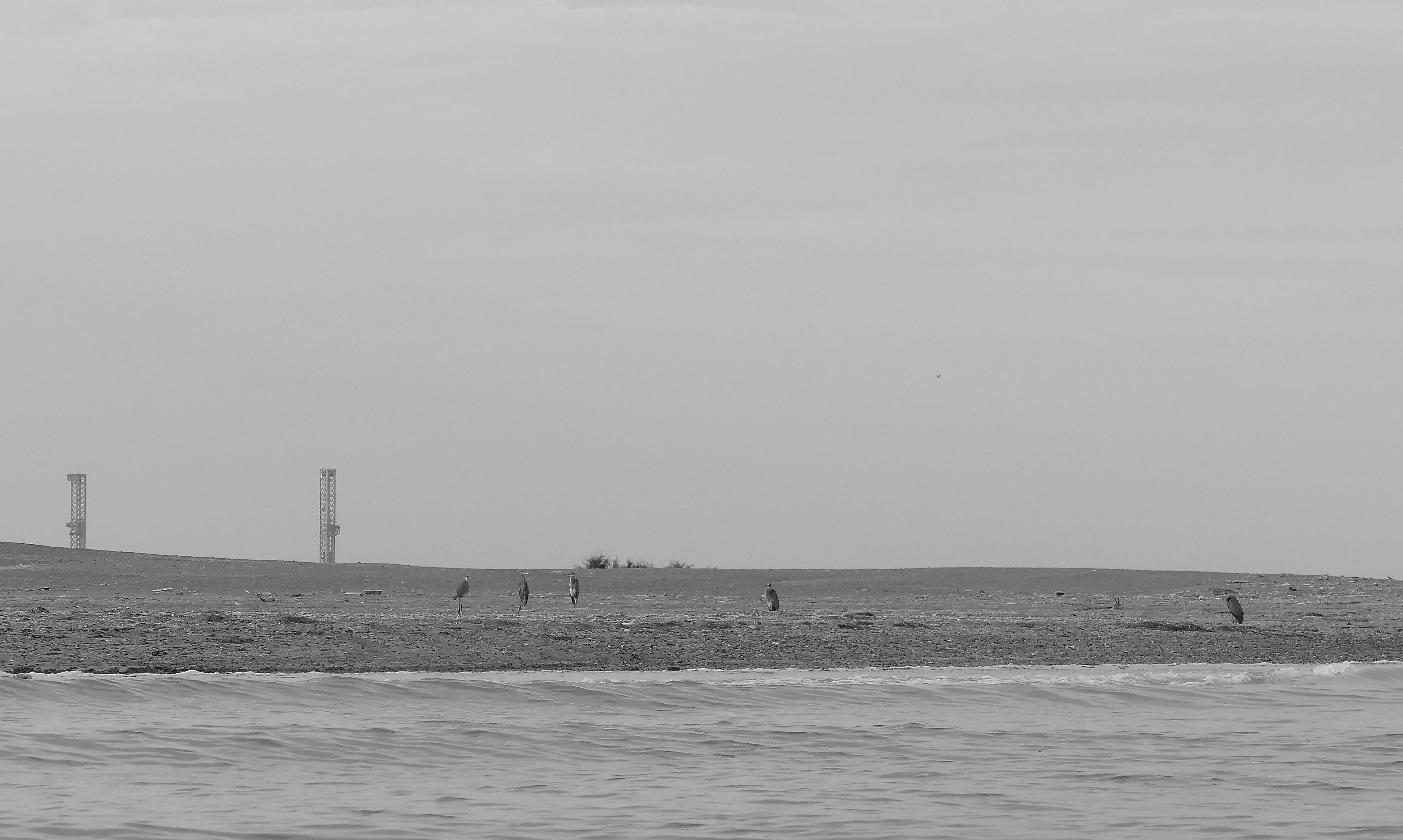
In the bay, the conditions quickly changed. The water was slower, and shallower. The fishermen were clustered in an area on the north end that must have been the guaranteed best spot for guides to take their clients eager to fill the cooler with trout and reds. Another boat was on the south end, near the rocket factory and office complex that now loomed large. The bird life in there seemed weirdly sparse—just gulls, a few herons and terns, and a lone roseate spoonbill foraging in the shallows to my left.
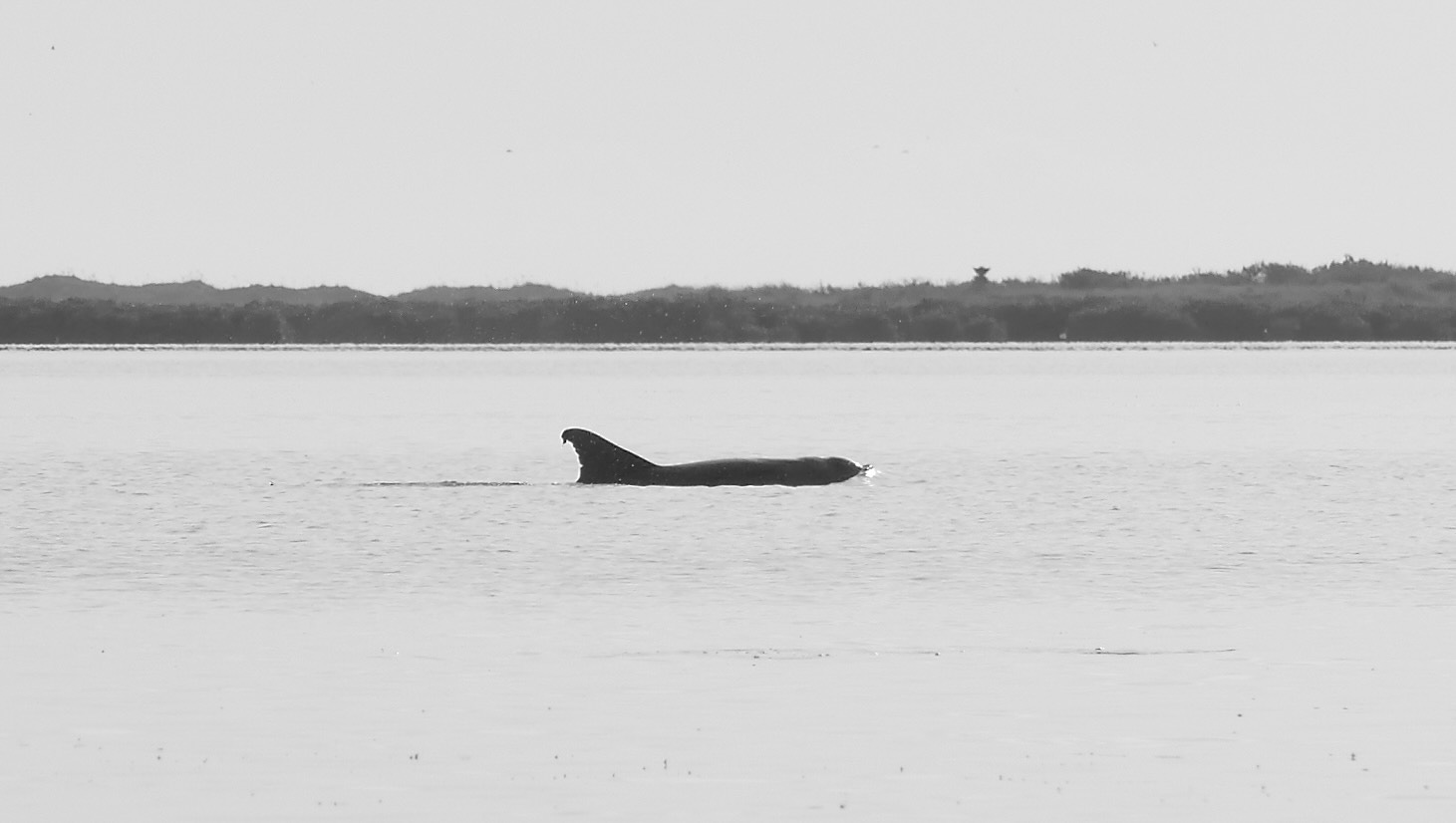
I paddled toward the Starbase, across still water that got shallower as I tried to cover the distance, shallow enough that the water plants were brushing against the bottom of my boat, and my paddle started to hit mud. I got right to the middle of the bay, where the water and wind were so dead calm that I could stop paddling and soak up the moment without my boat spinning around. I watched a pair of dolphins swim past me, pretty close, coming up more than they had in the channel, and could feel the slight tether of some kind of communion.
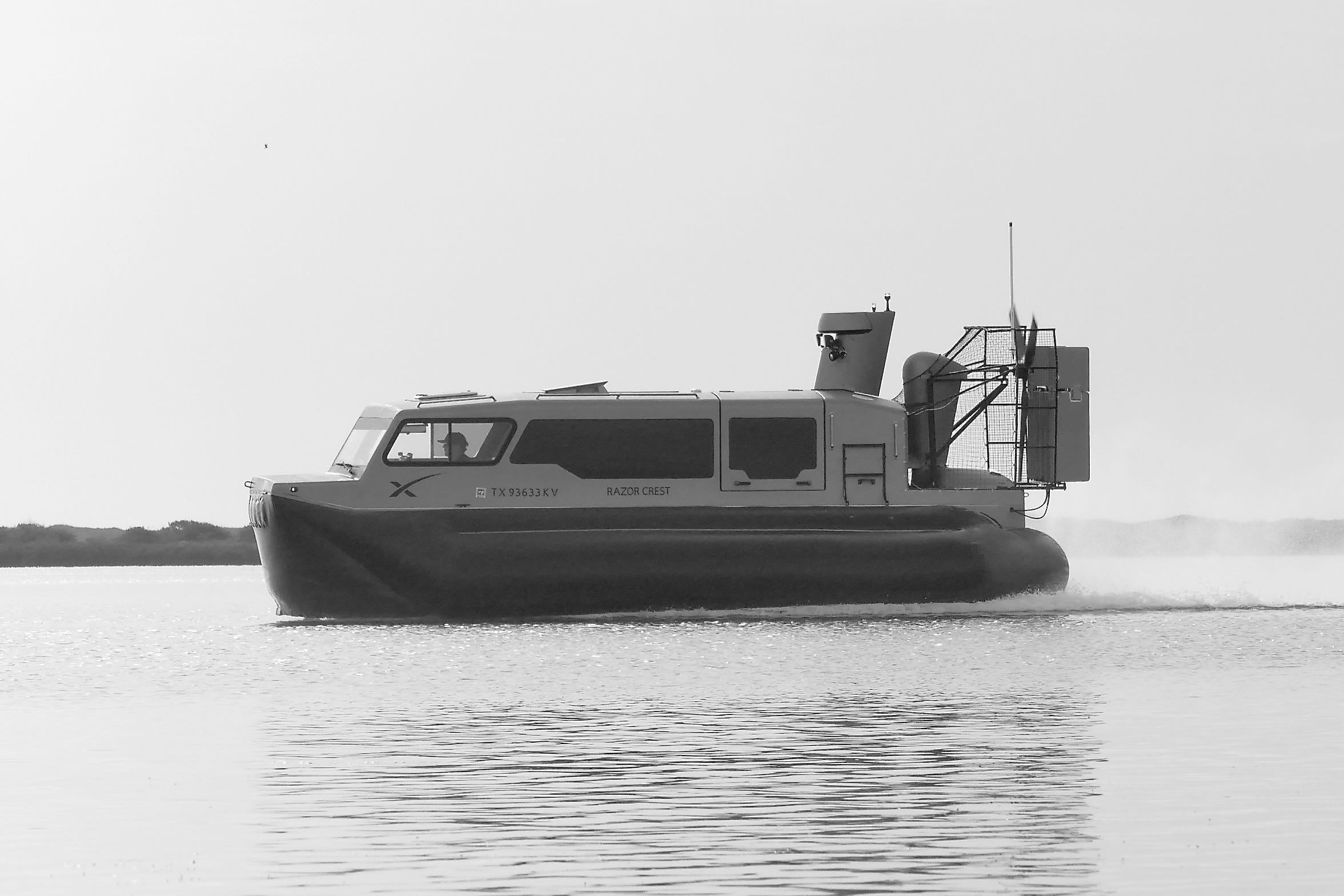
That’s when the first hovercraft appeared, a strangely futuristic variation on an airboat that looked like it had just entered the bay from one of those Gerry Anderson marionation machine dreams I loved as a kid. It had the SpaceX logo, and a name, EAGLE-5. A name like a space lander, for what was a company shuttle ferrying employees from their homes in Port Isabel to the office across the bay by the shortest and most direct route. I thought about the money that was about to flood into this zone following the IPO—some of the $85 billion in proceeds raised by the company, and another $116 billion in employee and early investor equity that would become eligible for sale on the public markets over the next six months. No wonder those herons had the look of the last Indians left loitering around the trading post.
Looking at the two rockets lined up there on the south bank of the bay, wondering where those friendly cetaceans went, I thought about the line from The Hitchhiker’s Guide to the Galaxy, the goodbye the dolphins give when they leave the planet before it’s destroyed to make way for an interplanetary bypass: “So long, and thanks for all the fish.”
“Our mission is to build the systems and technologies necessary to make life multiplanetary, to understand the true nature of the universe, and to extend the light of consciousness to the stars. To do this, we have formed the most ambitious, vertically integrated innovation engine on (and off) Earth with unmatched capabilities to rapidly manufacture and launch space-based communications that connect the world, to harness the Sun to power a truth-seeking artificial intelligence that advances scientific discovery, and ultimately to build a base on the Moon and cities on other planets.” — June 2026 IPO prospectus of SpaceX
Saturday morning, my brother-in-law and I went to get a closer look, heading out around 5:45 to drive down to Boca Chica. The week before they’d held a vote on the proposal by some Elon fanboy to rename it Cyberbeach, which was soundly defeated. I’d read about Boca Chica not long after I moved to Austin in the late 90s, when it was legendary for being the best and most remote unimproved public beach in the state, the sort of place you’d find the last hippies living in their vans at the end of America.
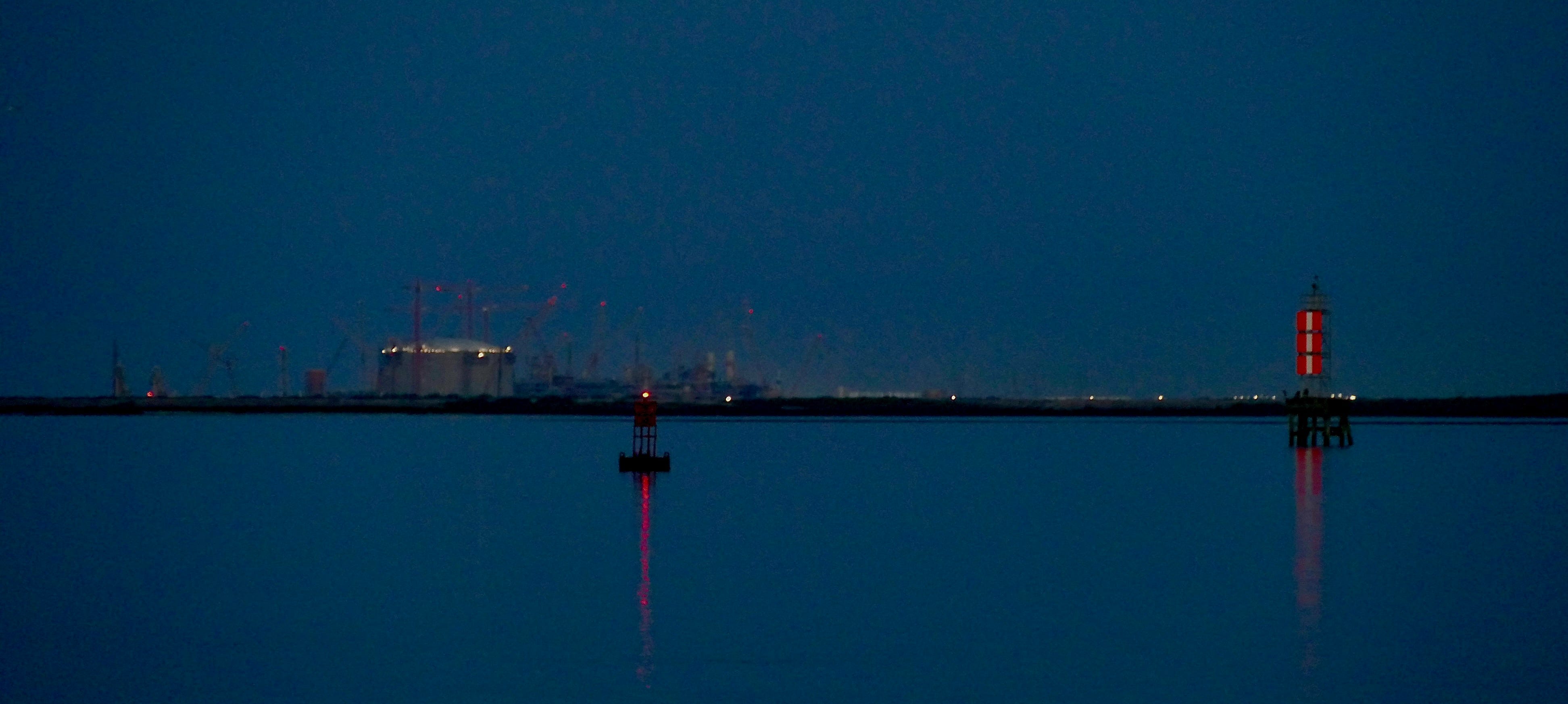
It takes almost an hour to get down there from South Padre, almost as long as it took me to paddle half-way there, mainly because you have to drive the full length of the Brownsville Ship Channel before you can cut back east to the coast. Before sunrise, it’s a surreal landscape of expansive coastal wildlife refuges that sprawl out in the dark, lined at the edges with intensely illuminated industrial infrastructure: petrochemical ports, container yards, ship breaking facilities, and the massive new LNG plant under construction. You pass briefly through the east end of Brownsville, and then make a left onto the southernmost highway in the state.
That stretch of road is where they last confirmed the presence of a jaguarundi in Texas, back in 1986. You have to read deeply to find out it wasn’t a living specimen, but roadkill. I had wondered if we might get lucky and see something like that. But what we saw, the minute we turned onto Highway 4, was a steady stream of Cybertrucks coming the other direction, still before daylight, on a highway that used to be the road to nowhere, but was now in the process of being widened. A partial explanation would later be found in footnote 18 to the consolidated financial statements included in the IPO prospectus:
“The Company also obtained $131 million of Cybertrucks at manufacturer’s suggested retail price from Tesla recorded in Property, plant, and equipment, net in the consolidated balance sheets during the year ended December 31, 2025.”
The hundreds of Cybertrucks we saw on the move were company cars. We guessed they were all mobilized at such an unlikely hour due to a shift change; the ones we saw headed back toward Brownsville must have been workers headed home after working the Friday night shift. We saw big tankers and semis in the mix, too, returning to base after dropping off their loads.
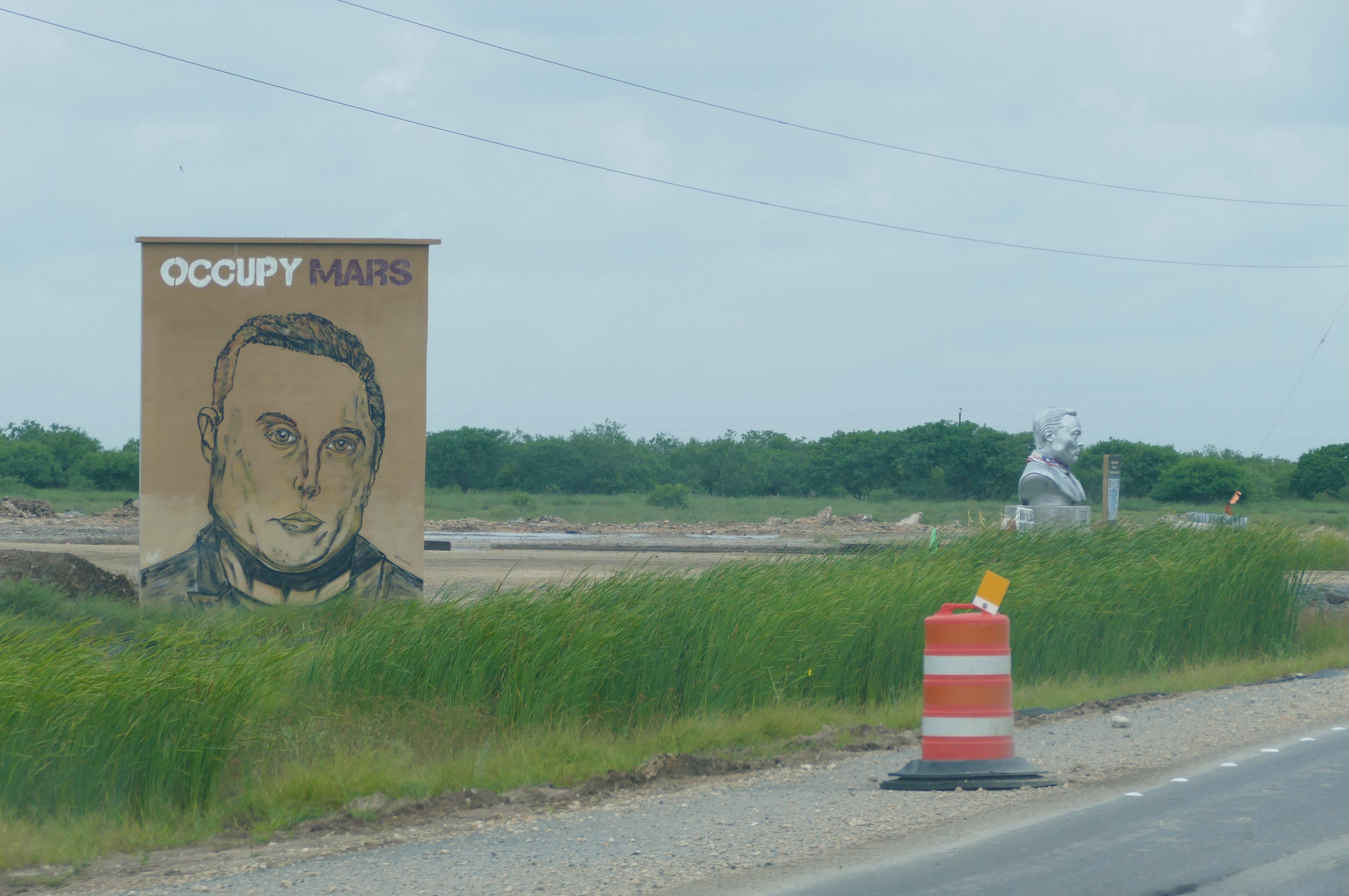
The landscape around us was even more minimalist than on the north side of the channel: coastal flats packed with low foliage and the occasional sabal palm; most of the land set aside as refuges, preserves and parks designed to protect the remarkable pockets of tropical ecosystem that historically marked the far northern range of many species that have native habitats from Mexico deep into South America. But the energy was that of the industrial activity, radiating out from its source. Only later, headed back in daylight, did we see the infamous bust of the Founder.
We were about 15 miles into the 20-mile drive when we came upon the first new planned corporate community—a gated complex of modern apartment homes that looked to have been lifted from some affluent corner of Austin, Dallas or Houston. Other new developments, commercial and residential, were underway as we continued. First light was seeping in when we finally saw the outlines of Starbase, the monolithic rocket factory and office complex that rises above the highway. We rolled by slow, ogling the Starships you could see under construction within, unexpectedly close to vignettes of tech company office space momentarily light on occupants.
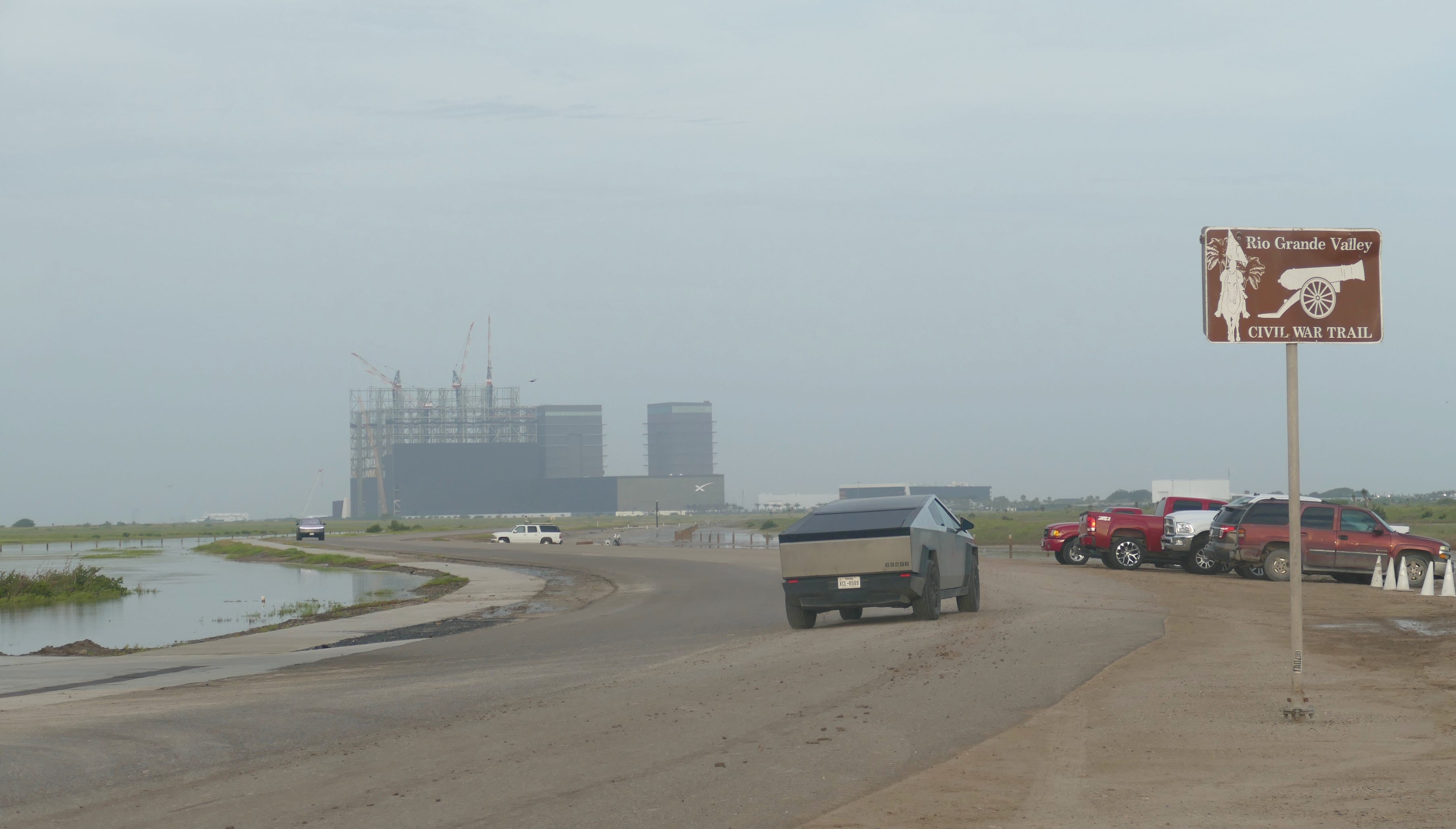
It’s two more miles before you get to the end: the launchpads, which are located right where the highway abruptly terminates, turns into sand, and opens up onto miles of unimproved sandy seashore that stretches from the Rio Grande two-and-a-half miles south to the pass five miles north. You can see the two gantries from miles away, but only when you drive there can you experience how they occupy that zone, coming right up to the edge of the highway right of way on the south side, with infrastructure at one end to receive the offloading of liquid propellants and a driveway wide enough to deliver a spaceship at the other.
Vehicles lined both sides of the highway, workers’ personal vehicles and company cars, and dudes in PPE were coming and going from the job site. We found literally the last spot open to parallel park right where the asphalt turns to sand, next to a dude in an old Nissan with Massachusetts plates zonked out on his back seat, feet hanging out the door. On the other side of the road sat a woman watching videos on her phone in the back seat of a dualie attached to a horse trailer that looked to be doing double duty for the humans, probably hanging out while her guy worked his shift. I wondered how far some of these folks drove to work these jobs, and where their real homes were.
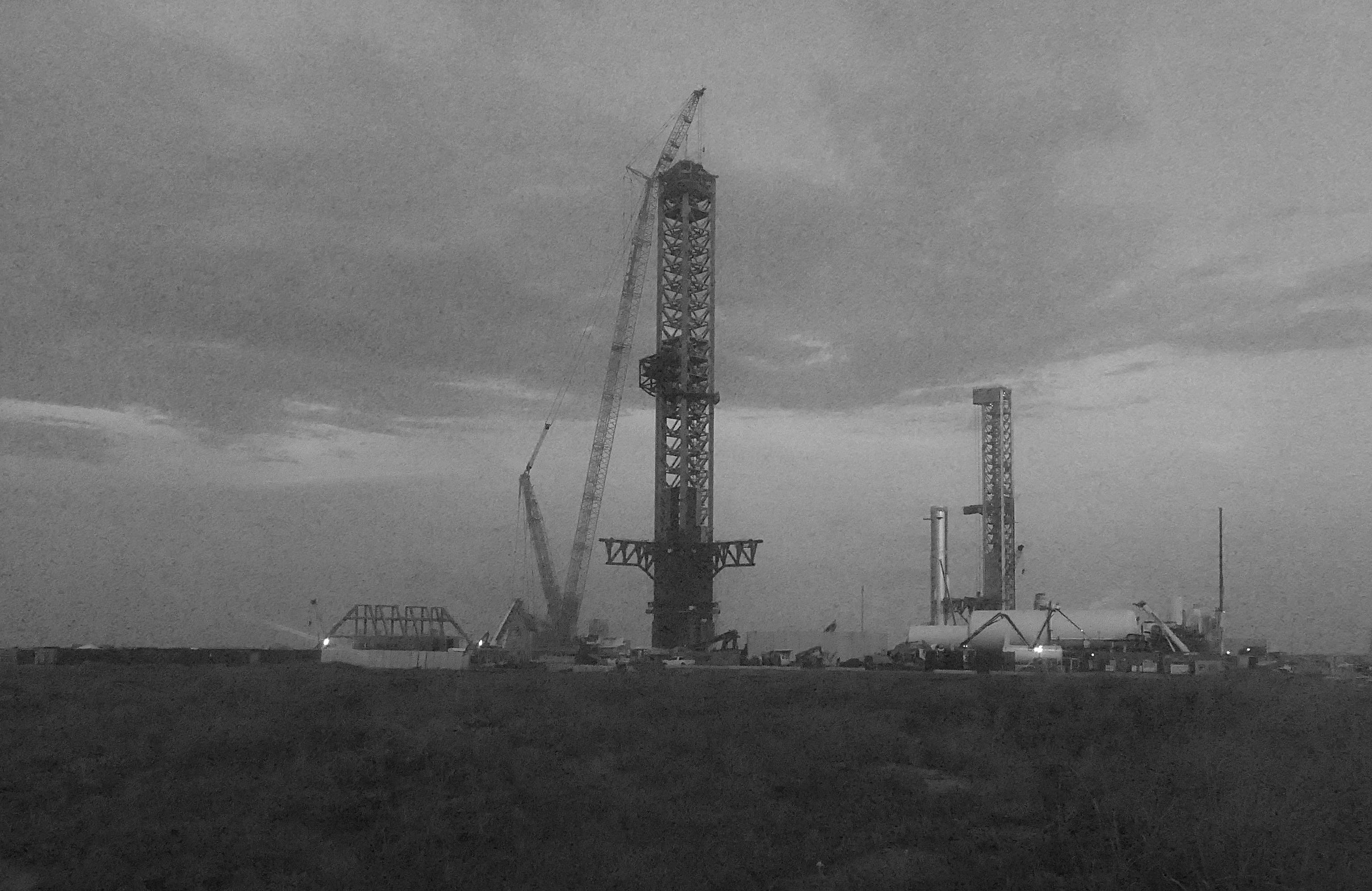
We got out and walked up onto the dunes, on trails made by others, and watched rosy-fingered dawn bathe the launchpad in her softening light. We took in the extreme dissonance of the landscape: a multi-billion-dollar futuristic platform to launch missiles into Earth’s orbit and beyond planted right in the middle of a coastal wilderness. Private property signs and warnings of industrial danger on one side, boundary markers of state parks and national wildlife refuges on the other.
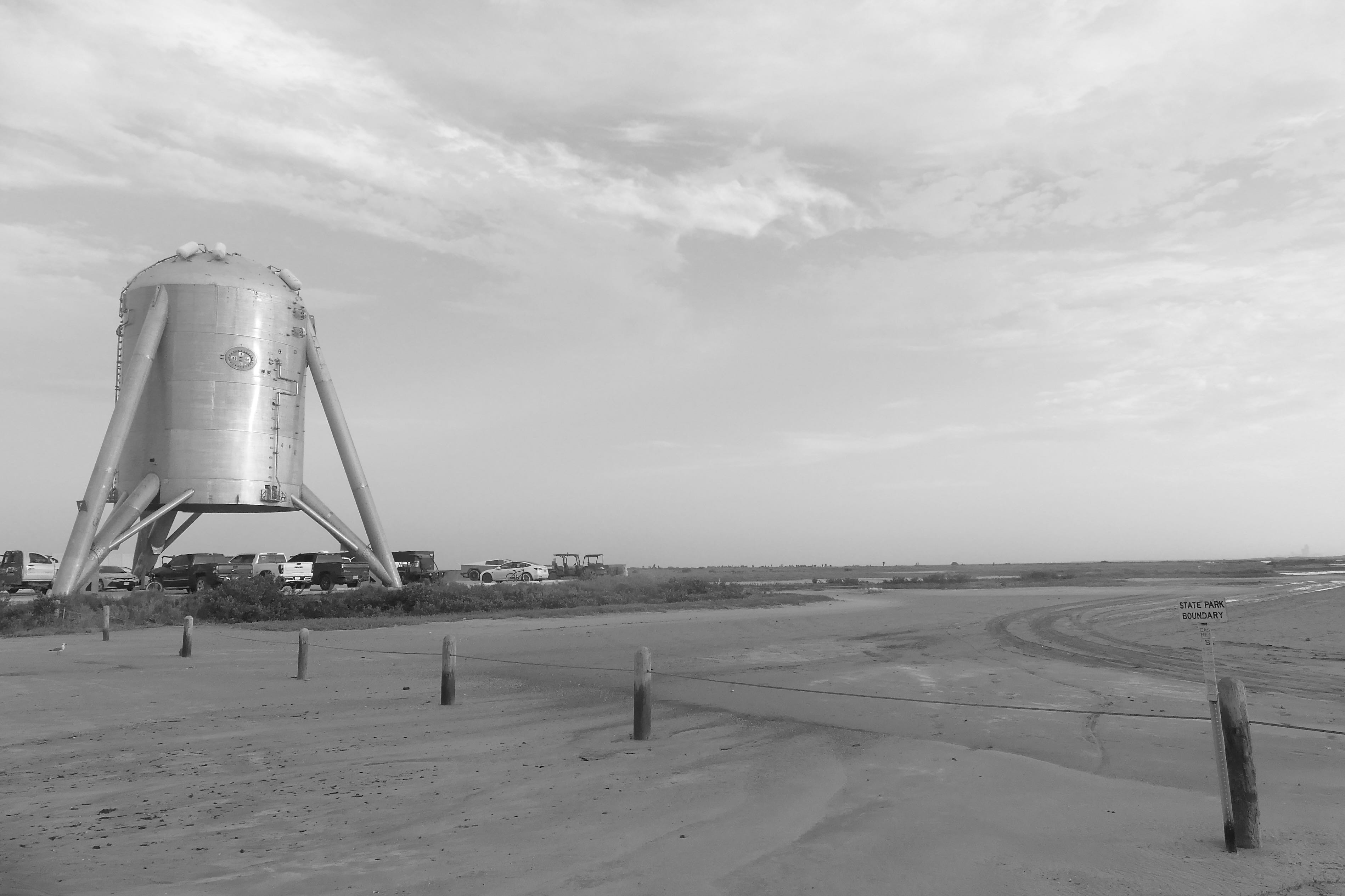
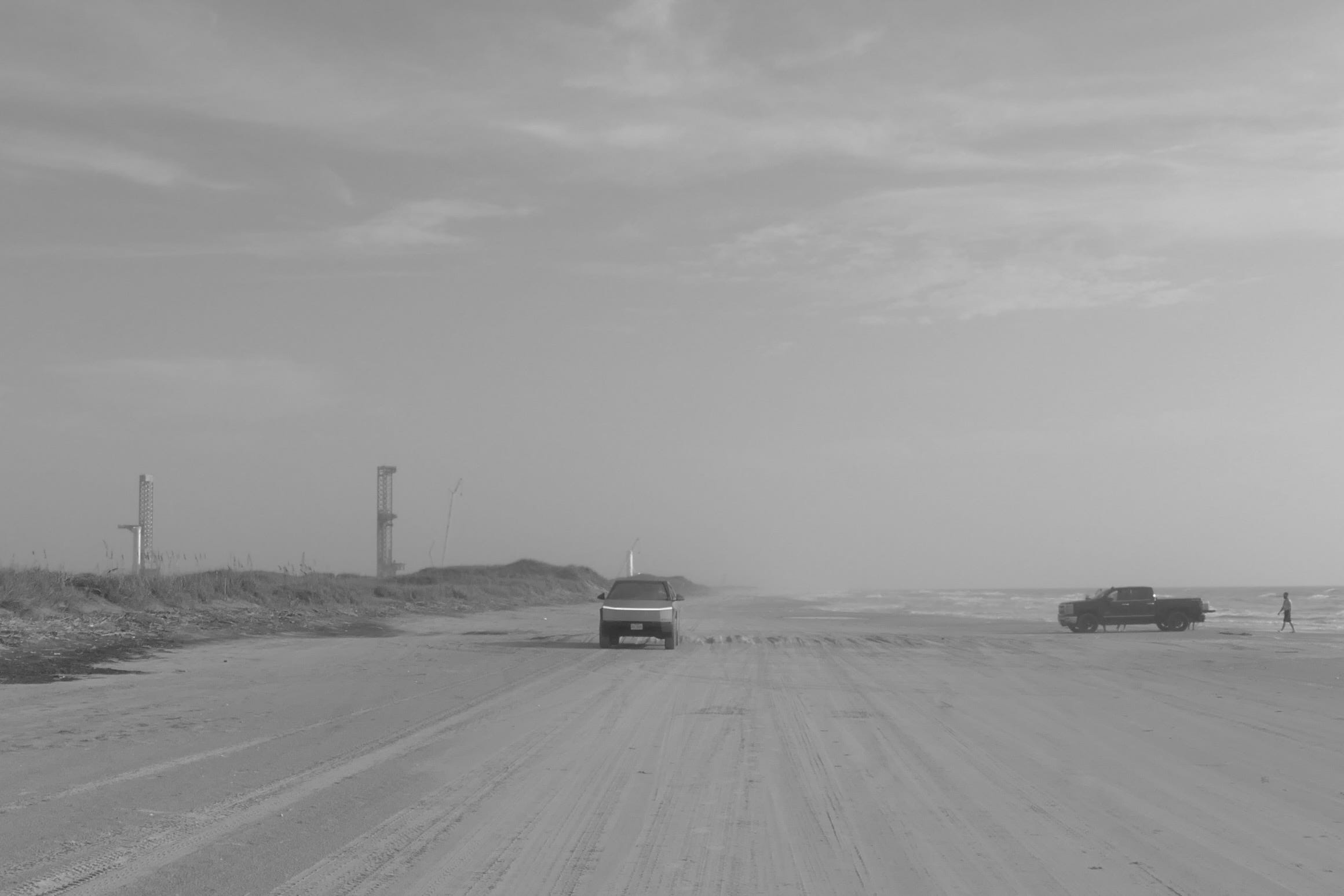
We walked back inland along the highway, checking out the facility. The Starhopper lander surrounded by Texas pickups. The liquid oxygen tanker delivering its load for the rocket test to come, like the one we had heard the day before while chasing kids on the beach. The windows into what looked to be some kind of mission control center. The frenetic activity of all the personnel and all the machines, fueled by the insane quantities of capital and will being injected into the work. The way something so primitively industrial, almost improvised, was implemented through a strict, subtly-branded design aesthetic, with a palette of matte blacks, whites, and graytones. Even the security guard we saw keeping an eye on us, rolling slow in a silver Cybertruck with the windows down, revealing his black uniform complete with black American flag shoulder patch, as if that were who he worked for. The main signs of other life were grackles and gulls scavenging around the parked cars.
Troy and I decided to walk down the beach to see the mouth of the Rio Grande before we headed back. The beach was almost entirely abandoned, just a couple of trucks pulled up to the tidelines by locals fishing in the surf. Never in my life have I seen such an abundance of seashells. The distance was about three times what we expected, and quickly we were all alone, the gantries returning to background—until the SpaceX security guy rolled by again, headed for the border.
We were alone again when we came upon a strange carcass. I saw some bluish large intestines in the sand first, and then saw the beached black thing, four or five feet long, half buried in the beach by the tide. It looked to be furred, not scaled or bare-skinned, with what looked to be a whale-style tail and no sign of a dorsal fin. And no sign of a head that would have given us a better clue—perhaps it was buried in the sand, but it looked more likely that the creature was a victim of an unplanned encounter with a large boat prop the night before.
We caught up with the security guard, where he was chatting with some fisherman who was probably one of his in-laws. We saw more cars ahead, and a small lighthouse, indicating we were close to the rivermouth.
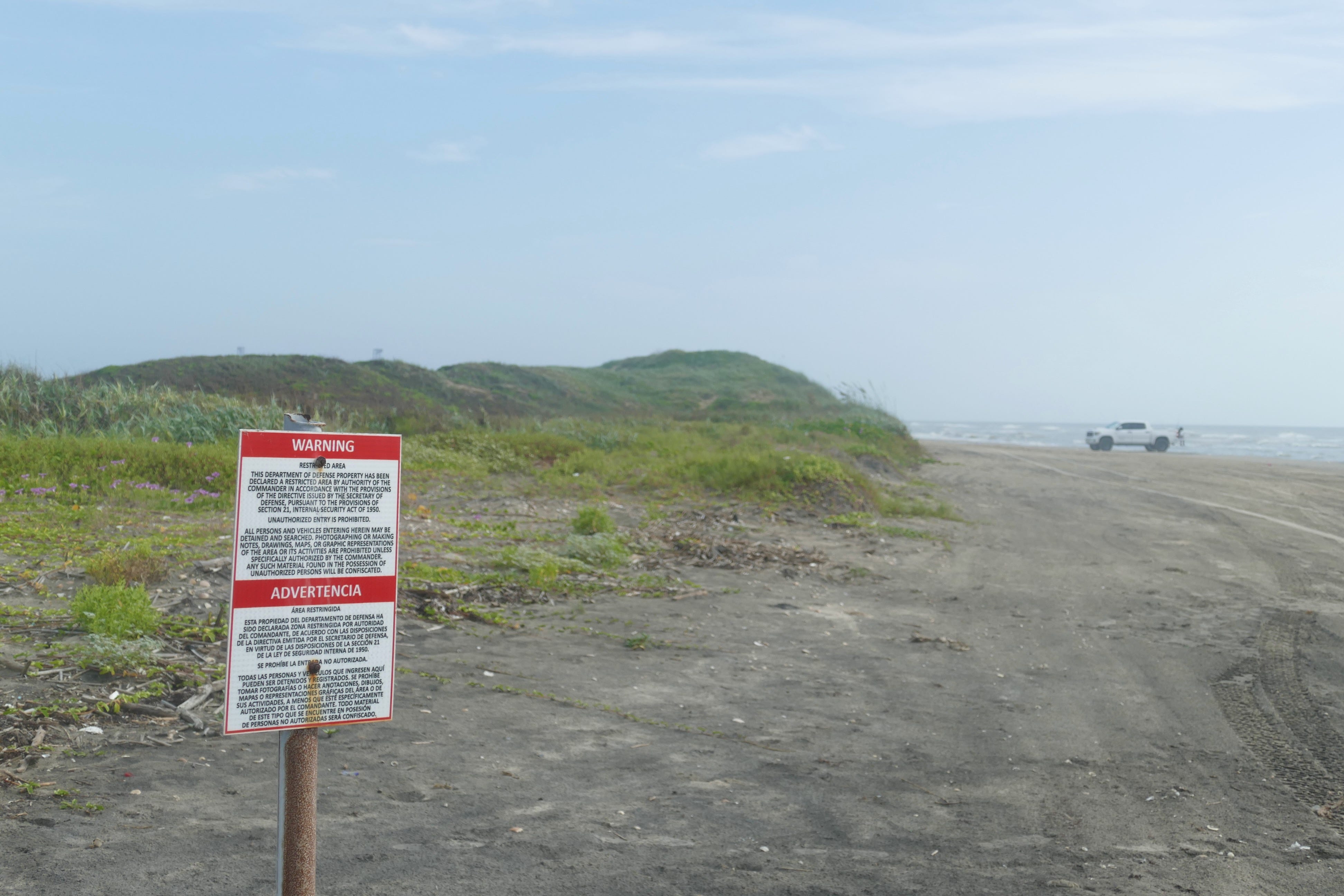
The mouth of the Rio, when we finally found it, was simultaneously awesome and unremarkable. Meandering but fast, blue but milky, shallow but wild. There were no signs of border fortification, just a small sign posted by the dunes warning that this was a restricted area controlled by the Defense Department and photography was prohibited. I walked past the sign to climb the dunes and get a better vantage, while Troy went to check out the crowd of fishermen, almost all from the Mexican side, taking advantage of this marine ecotone to catch some good shit, some wading in the river, others out in the surf.
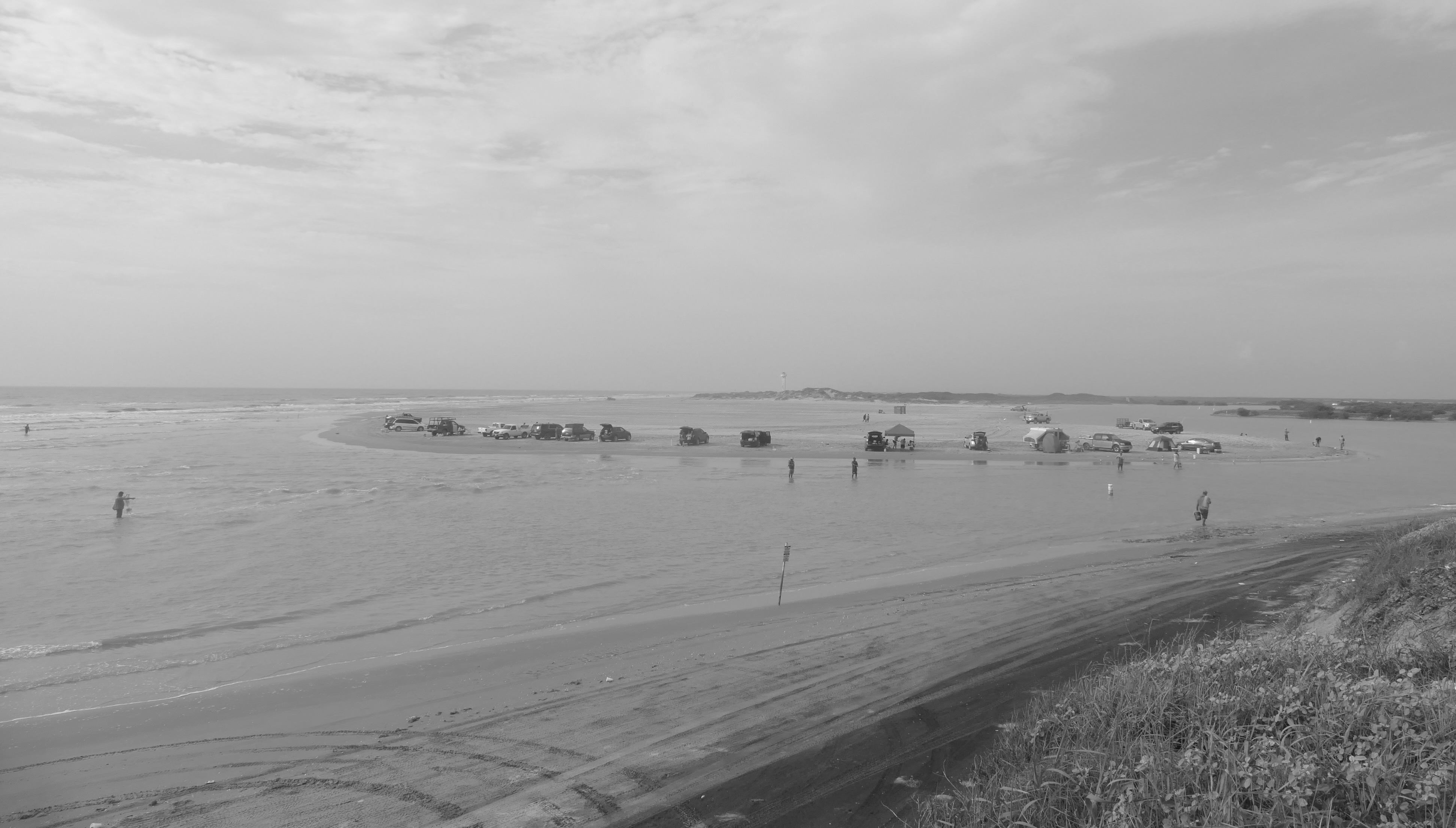
When I got up there, I got the view I wanted. The expanse of the wildlife refuge, the long meander of the river, the open ocean, and the Starbase in the distance. There was one Border Patrol vehicle in there, with a single officer, who later would get out of the car to come ask what we were up to and give me more than one once over as he noticed that I carried not one big camera but two (one digital, one film) there in the no photos zone. After he got done asking us questions and we peppered him with a few of ours, he told us the SpaceX security guard had just come down to tell him they were planning to close the beach off for some tests in a couple of hours. So we headed back to the truck, walking a little faster this time, stopping only once to take another gander at the beached cryptid.
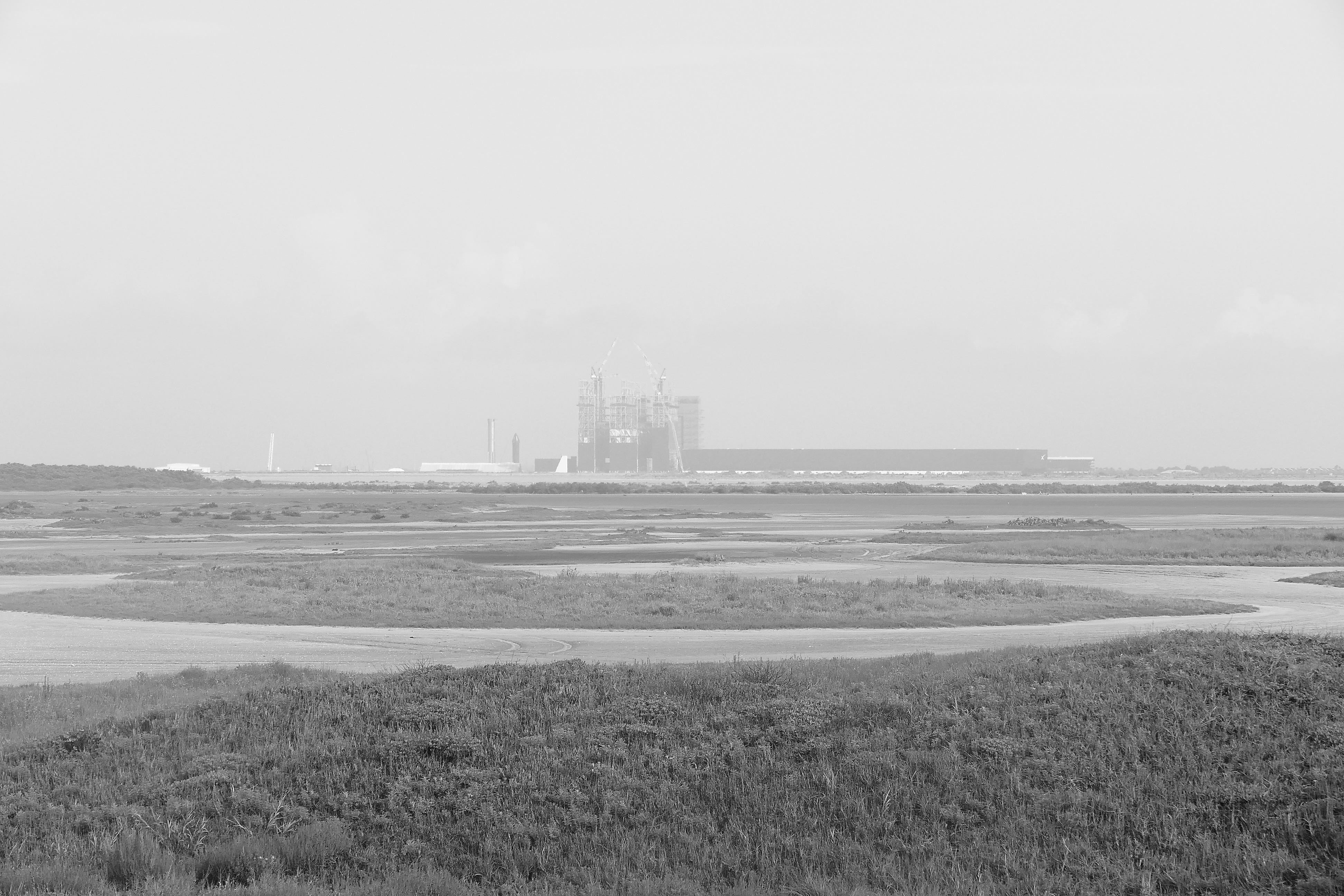
Driving back, we traded notes on how likely it felt that the entire zone down there will soon be inaccessible to the public, completely overtaken by the company and its people, or both. The power and capital on display, concentrated in one young company and its stakeholders, boggled the mind. Reading the IPO prospectus later, I saw how they had just given the founder-CEO a huge new equity award that would only vest “upon the Company’s establishment of a permanent human colony on Mars with at least one million inhabitants,” indicating how serious they take themselves on that idea, and how secondary must be any concern about the life on Earth they will disrupt on their way there.
That afternoon I went to see some friends in Padre, Ed and Elaine, who were hosting a little World Cup viewing party. Elaine volunteers at the Birding & Nature Center, which is also an alligator rescue. She told me that she had recently learned through that work about the strange vocalizations of those big native reptiles: an infrasonic bellow, from deep within, which they emit rarely, but one of the times they do is when they sense a threat. The day before, she was working when the test went off, the same one we had heard, which sounded like thunder until it kept going for a few minutes. When they heard it, the gators bellowed back in an eerie chorus. Warning, she said, of the predator that was coming.
Further Reading
What’s going on in Brownsville is mirrored by what’s going on in Austin. This week, the City Council approved the Tax Increment Refinancing Zone that will use public funds to finance redevelopment of the area of old gravel pits along the otherwise undeveloped natural corridor of the Colorado known as the “Dog’s Head,” a few weeks after the Council approved the annexation and development agreement that would allow 100% impervious cover, no height limits other than what the FAA requires, unregulated modification of the floodplain, no environmental assessment, and permitted uses that include data centers and autonomous boat testing, and the anchor tenant of which was revealed to be an Amazon robotics center. I was heartened to see how many folks have become more aware of the natural bounty of this stretch of the river, even as it was hard to listen to the condescension of the Council members in their remarks to the concerned community members who turned out for the hearing.
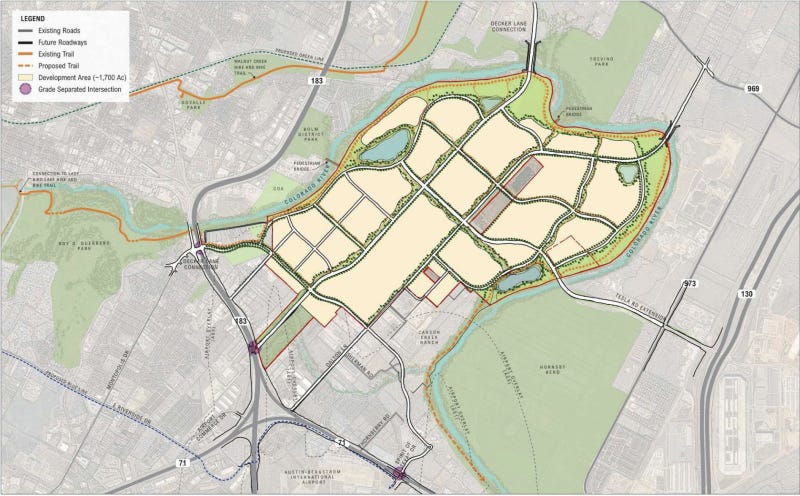
There’s also a plan to build two new bridges, one to connect the area with the Tesla Gigafactory across the road, the construction of which beginning in 2020 is what really drew the attention of developers to this area. The approval came despite the non-binding unanimous vote of the Council’s own Environmental Commission to halt further action pending a proper environmental review, and the County Commission’s decline to vote on the matter pending further information and review. If you live here in Travis County, let your Commissioner and our County Judge know what you think.
The marine drone provision of that agreement is no doubt intended for the benefit of Austin’s Saronic, which has been in the news lately for some of its recent deployments and favorable procurement outcomes—and for the announcement that it is building a new drone shipyard on the Brownsville Shipyard to be called “Port Alpha.”
The final IPO prospectus of SpaceX is fascinating reading. Public offering registration statements are weird texts—sales documents for the issuer’s stock designed to comply with all the disclosure requirements of the SEC rules and revised based on comments from the examiners. But they are fascinating works of what J.G. Ballard called “invisible literature,” and a remarkable window into what’s really going on with a company like that.
Here’s the full remastered track of Devo’s 1979 “Space Junk,” from their debut album Are We Not Men?, which I bought at the mall the day after they appeared on SNL and cracked open my junior high brain with their insanely transgressive live TV appearance.
Gutenberg Project has the full text of Ray Bradbury’s 1947 short story “Rocket Summer,” which I read as a tween.
“Nature Walks With Judy” has more on alligator bellows, including a video that lets you hear them:
In suburban Austin, the purple martin parties are back on in the strip mall parking lot across from Dell HQ, after the property owner relented.
In the new LRB, Rebecca Solnit on the Pueblo uprising of 1680.
Archaeologists taking a fresh look at the mummified remains of Egyptian elites from the Middle Kingdom concluded that the weapons buried with the princesses were not ceremonial, but their own regularly used weapons, as evidenced by the muscular attachments on their skeletons.
Congrats to Field Notes friends Pam Colloff on the launch of her instant NYT bestseller, Catch the Devil, Jeff VanderMeer for the major deal announcement on his new Strange Architect series, and Ed Park on his upcoming memoir, Three Tenses.
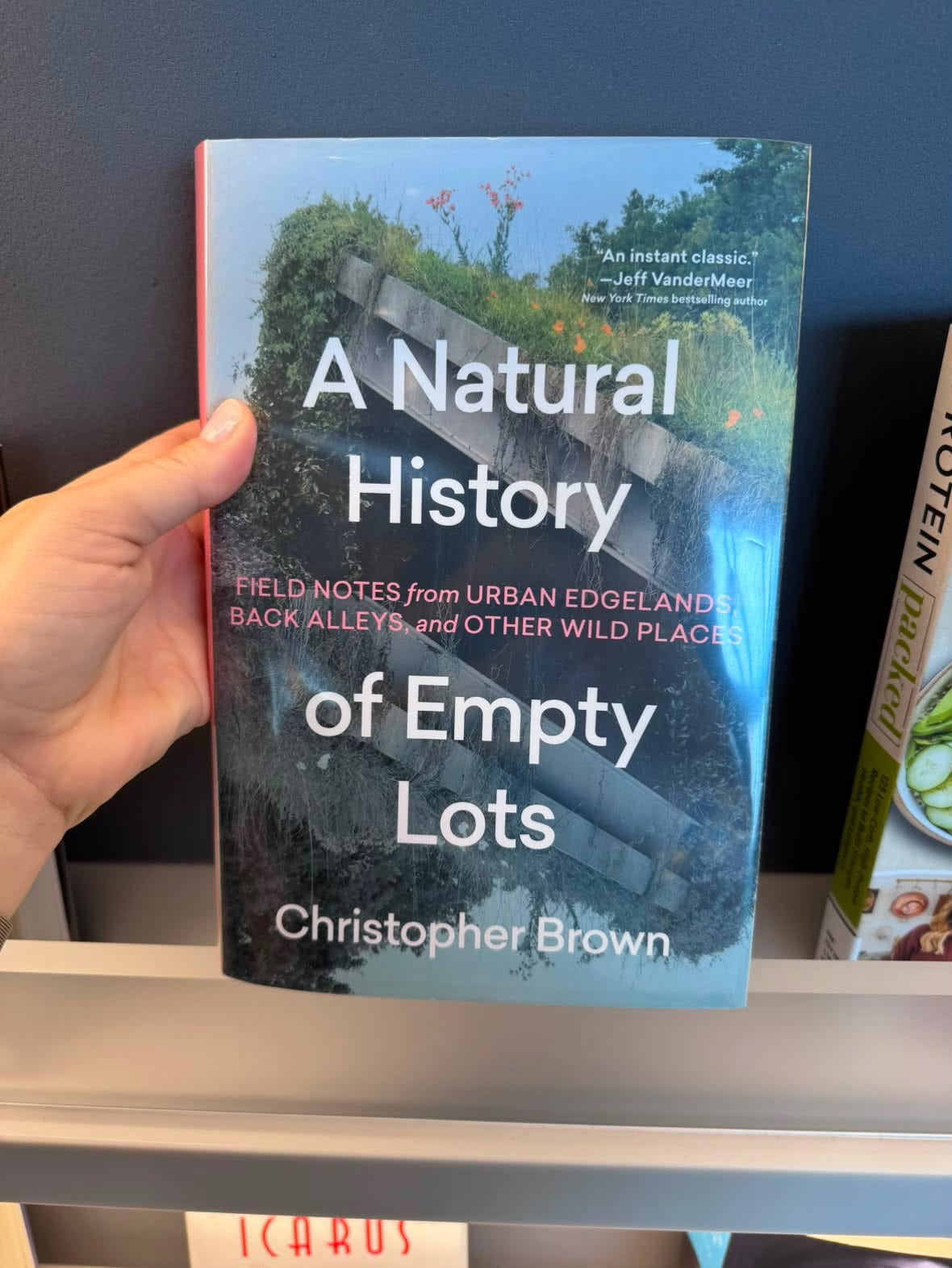
Lastly, thanks to Paloma G. and David T. for the parallel reports that my book A Natural History of Empty Lots was on display last weekend at the Obama Presidential Center’s library:
Have an awesome week, and stay cool.
Good report. It's frustrating to see natural resources like there are in Boca Chica destroyed in the name of a vague and inchoate plan. Everyone else has to justify their actions as rational, useful, and non-harmful. But not Musk. Not anyone with more money than sense who hides behind "the market" is granted an exemption. How many of our tax dollars are being repurposed from the public good to the waste of unconstrained hubris in Texas? A lot. And Republican politicians are proud of that.
Austin, my old home. Thanks for the report on it too. I am one of those who mourns the Austin of the past, specifically, the 1970's. It always seems to be the case that people are attracted to the natural beauty of a place. Then, they are appalled to learn the roads are windy, the weather is hot, the bugs chew you up and there aren't any of the city comforts they were used to. Then, they bulldoze five hundred year old live oaks, build undifferentiated homes on a grid and name the streets after the trees, history and people they displaced.
Love the photos. Memories of mid-20th century sci-fi paperback novel cover art.