

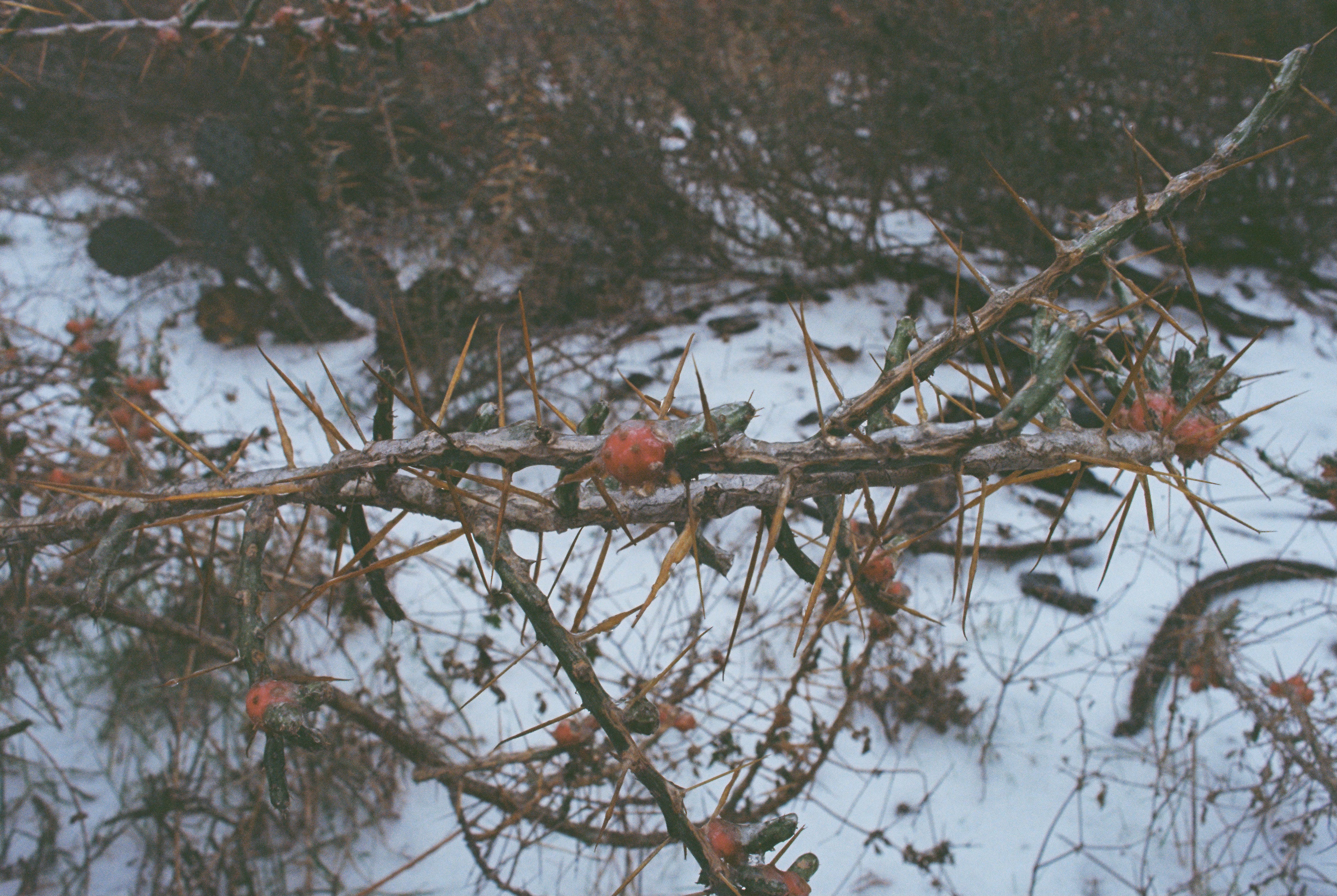
Real winter weather is so rare in this part of Texas that I sometimes forget how essential the occasional long walk in the cold white stillness is to my mental health, maybe even to my personality. Until my mother moved down here a year and a half ago, I would always get my fix visiting her in the remote Iowa woodland she and Dad retired to. Last weekend we were blessed with a wintry mix that arrived on a Saturday, and allowed us time and space to relish it. And in Austin, any real accumulation of snow or ice shuts down the machineries of state and capital almost completely, as the local governments lack both the capacity and will to do anything to remove it. So this week, after a mix of freezing rain and sleet coated the city overnight on Saturday, all they did was tell everyone to stay home and do nothing until it melts. Typically that would happen the next day, but this time it really wasn’t until Wednesday that the bridges were clear, and Thursday that it got genuinely warm.
That the sleet storm was accompanied by thunder and lightning added an apocalyptic frisson to the event. In the morning the season’s first flock of waxwings had come through, filling the high boughs of our fruit-filled hackberries a little earlier than usual.
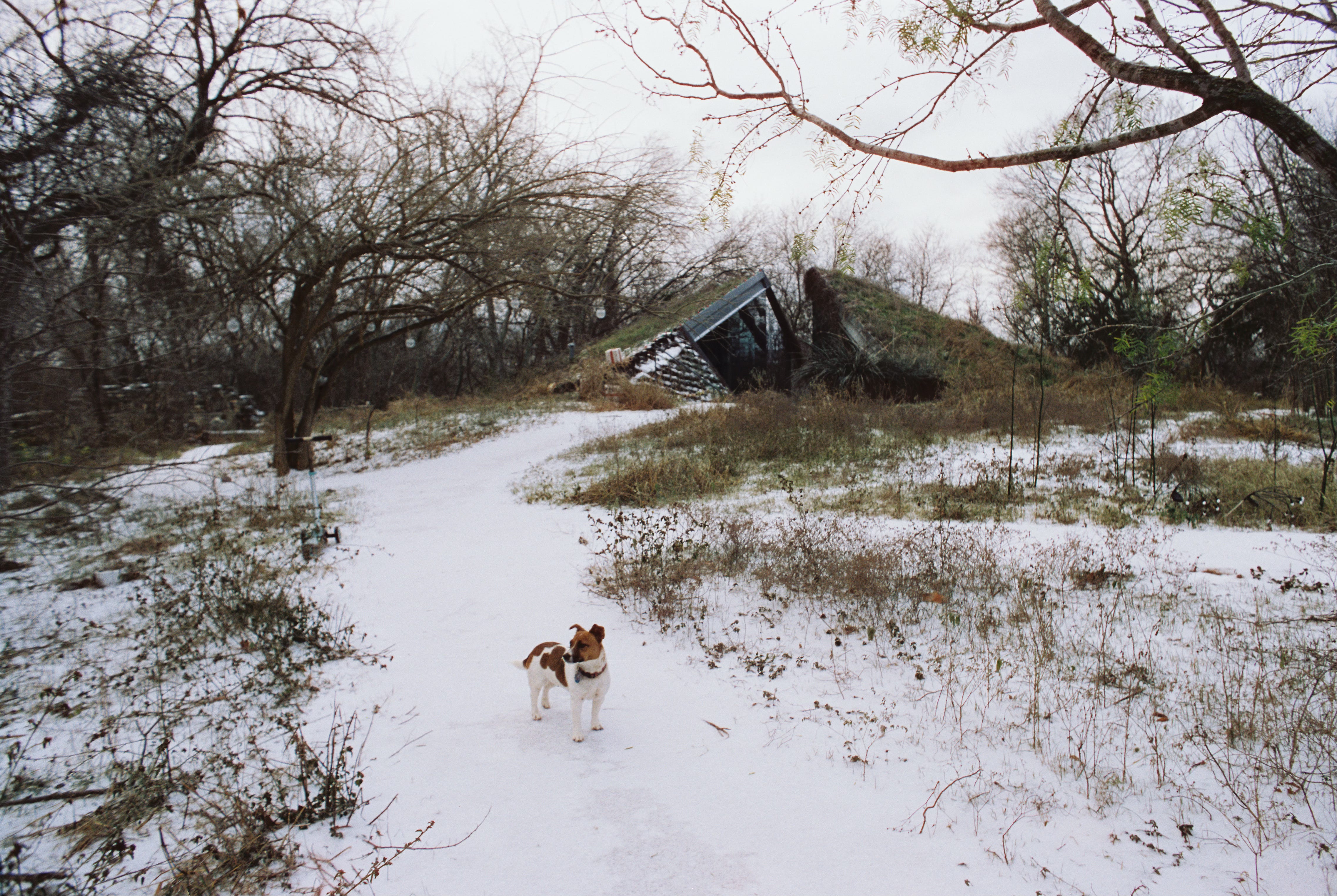
The cold snap hit right on schedule, just as we finished setting up my wife’s birthday present in the yard: a huge, old-school canvas tent designed to accommodate a wood stove, the sort of set up designed for cold country elk hunters that we aim to experiment with in this warmer clime. By mid-afternoon the cousins were already over making s’mores on the stovetop with Octavia. The only member of the household who wasn’t excited about the arrival of real winter was our 16-year-old hound, Lupe. Lupe’s hips had begun to really fail her last summer, and it was evident that the sudden cold amped up her discomfort to the point where she couldn’t get up or lay down without assistance. Thankfully the floors under her bed are heated, and we had developed an easily changed set up that let us keep it clean and comfortable.
Our house is designed such that the bedrooms and living room/kitchen, which are the only rooms we have, are divided by an uncovered patio. So when you get up before sunrise after a winter storm, you open the bedroom door and step right out into it. Not enough accumulation this time to leave a drift at the door, but thick sheets of ice dusted with just enough powder that you might think it was snow until your feet went out from under you. The kind of cold that also brings the quiet, the comforting silence when the machine of the city shuts down for a few hours, no one else is out, and even the animals are hunkered in whatever warm shelters they can find.
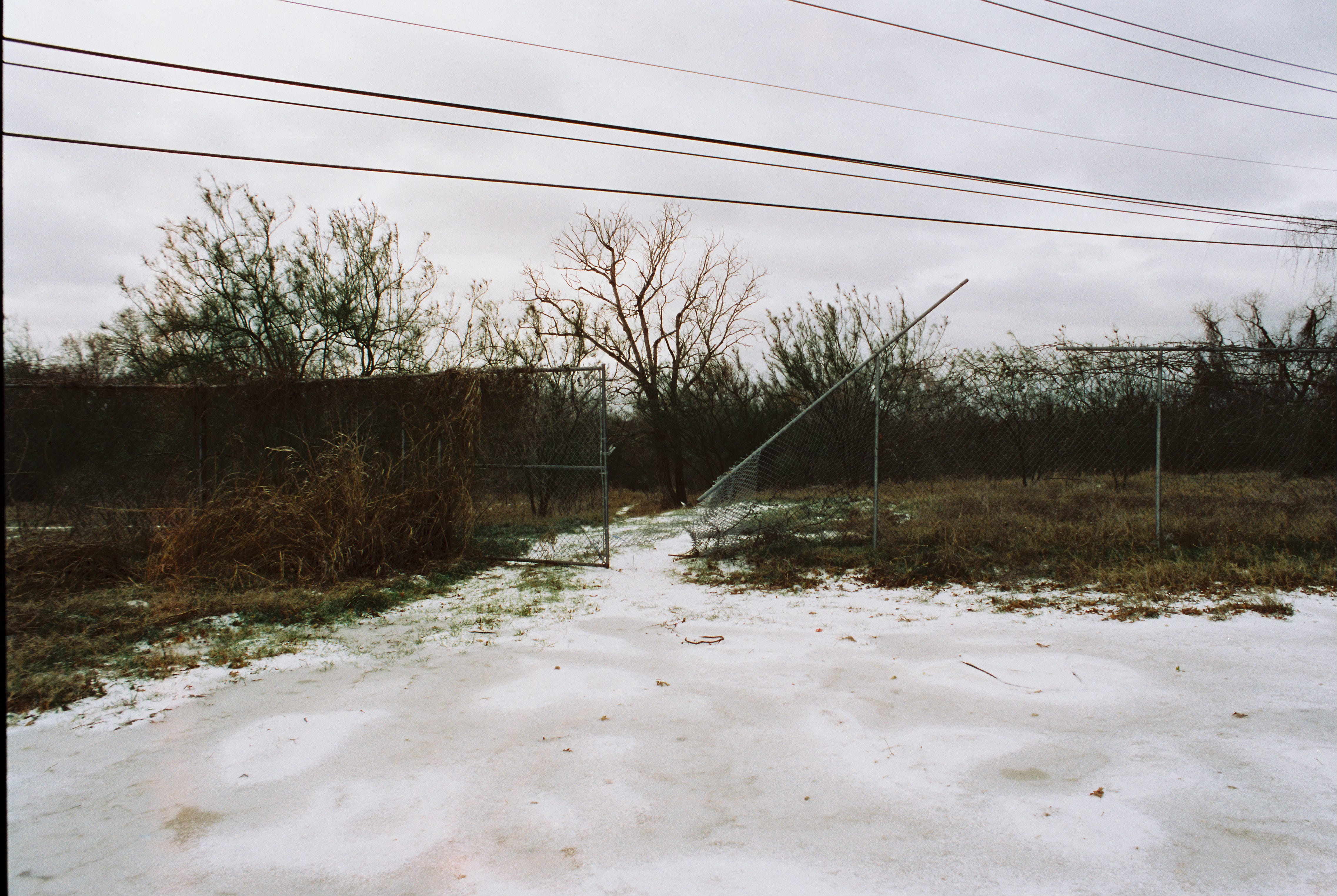
The padlock on our back gate was frozen, so rather than open it with the shovel the terrier puppy and I headed out on the icy street and walked toward the base of the tollway onramp, past the abandoned milk plant, and down one of the cul de sacs in the industrial park designed for the semis to turn around, where we found a less official access point to the urban woods, pictured above. The zone on the other side of the chainlink is a mix of private and public land, but the boundaries between the two are not marked, and pathways do not recognize them. In the snow the animal trails and tire paths through the foliage stood out in high relief, like a network map suddenly lit up on the board.
We took advantage of that to explore trails we had not taken before. One took us into a clearing where we encountered two young bucks staring back at us, another into a recently abandoned camp deep in the viney woods that had been shielded with a wall of cut bamboo. Further in from there, we came upon a tight-looking tent made from a big tarp and other found materials, which seemed a picturesque tableau until we heard a dog growl at the sound of the shutter on my dad’s old Canon F-1, and I was reminded that most tents do not have fancy little stoves.
Monday the city was still closed down, so we decided to go further and explore the gnarlier industrial lots being slowly cleared to make room for a mixed-use development that will profoundly transform this little pocket of Tarkovsky Park. The ferality we found when we moved here sixteen years ago has been bleeding out bit by bit every season, sometimes rebounding. Fewer coyotes, more cool birds, the curiosity of Capital and its commission-chasing young brokers ebbing and flowing with the interest and occupancy rates. A good winter storm lets you see what wildlife is still out there from the tracks they leave in the snow, and get windows through time, into memory, and into the variant futures that leave other signs on the land, and sometimes in the light that shimmers.
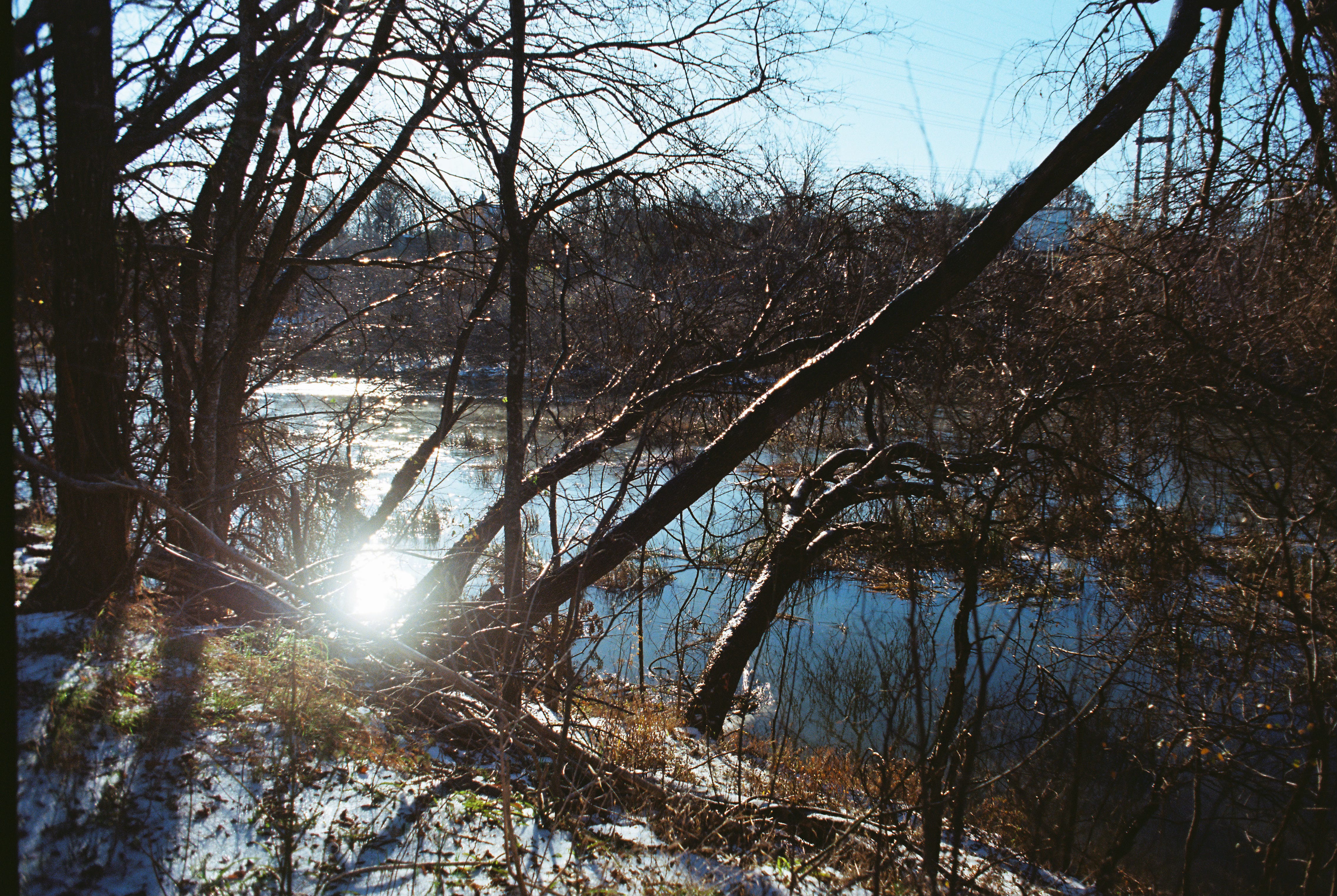
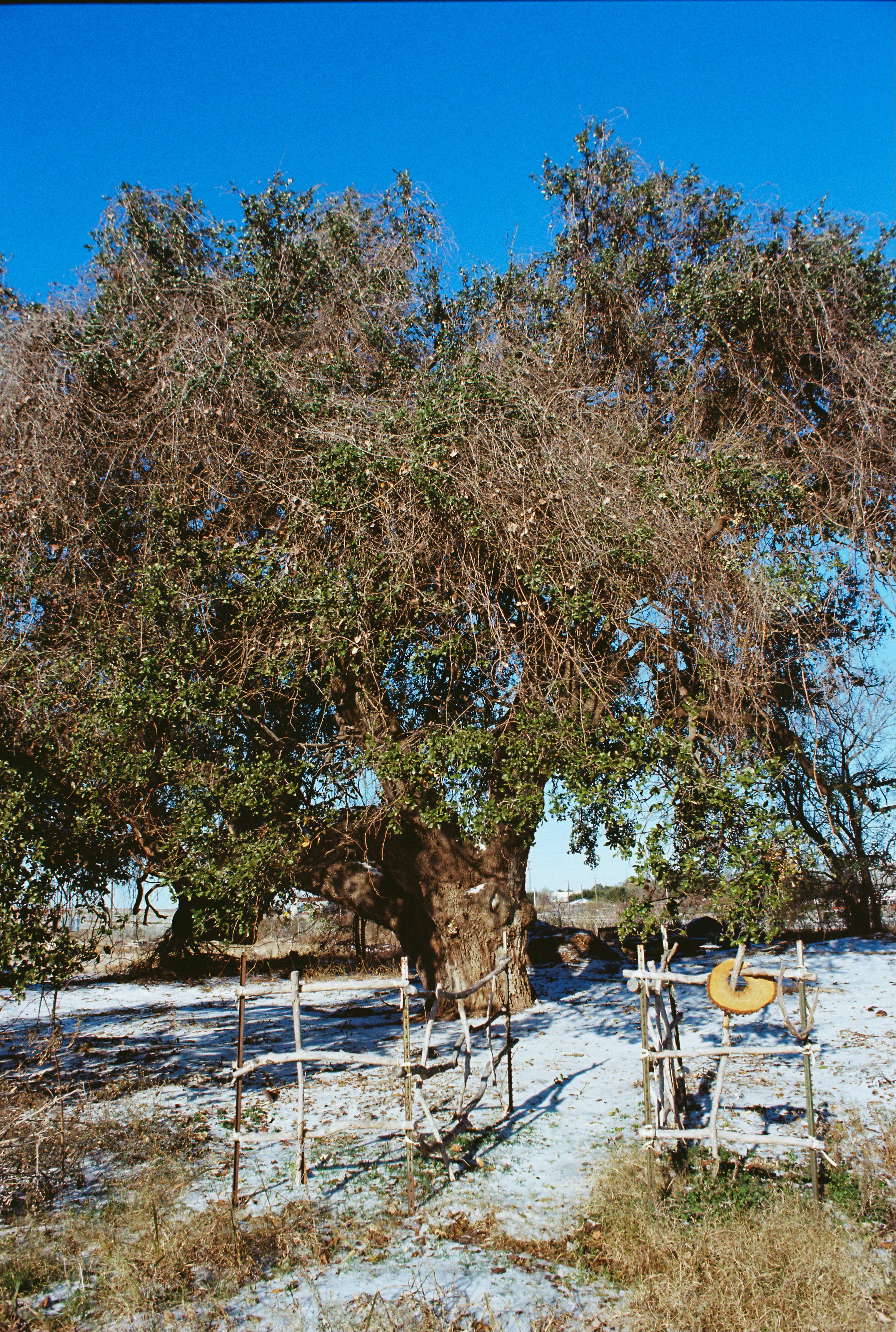
At the spot where the frontage road loops under the tollway bridge, we found a little trail that led past another tall fence into the sliver of woods on the north bank of the river. The ice crunched under every step, and the big herons and egrets telegraphed our passage with loud skronks. We walked under the power pylons, and eventually the trail left the woods and entered the weird plain that leads to the mountain of asphalt millings. I stepped up onto a high berm, to take in the wider vantage. I could see where they had recently demolished the old building a guy I know had squatted in for years, under the canopy of the largest circumference tree in Travis County, and decided to see how it was doing.
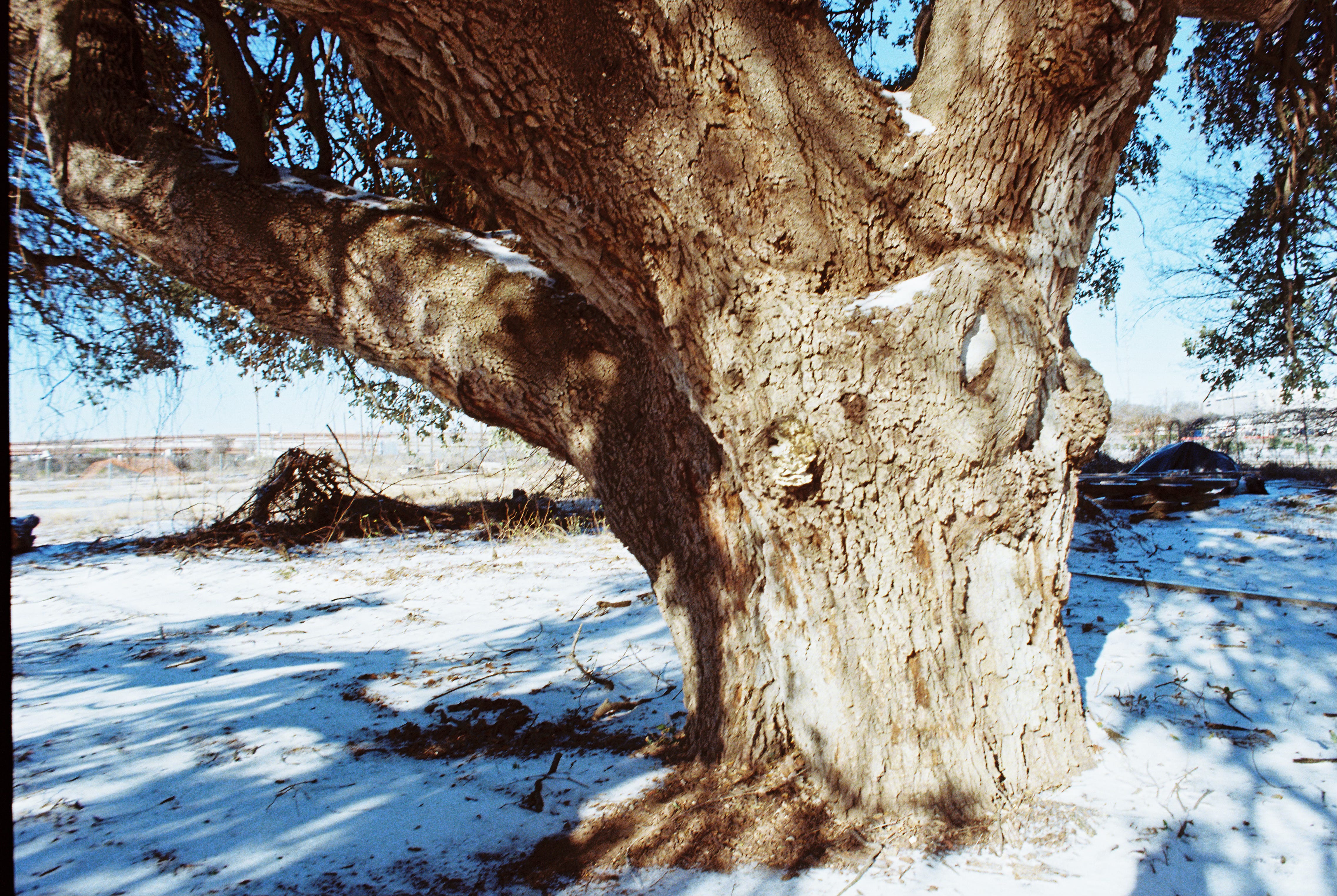
Those ancient oaks, centuries old, often can be found near old highways, most of which follow more ancient pathways. They’re more common near two-lane highways in less-traveled parts of the state, but sometimes you’ll find a tough old Ent that’s holding out as two lanes become four, and now eight, and the pavement and traffic get ever closer. A few years ago I saw the rendering where the developers showcased that tree as the entry landmark for their planned redevelopment. A nice idea, but I can’t help but want to imagine how it will look in another few hundred years, when it outlasts our ruin. Monday morning, it didn’t look that far off.
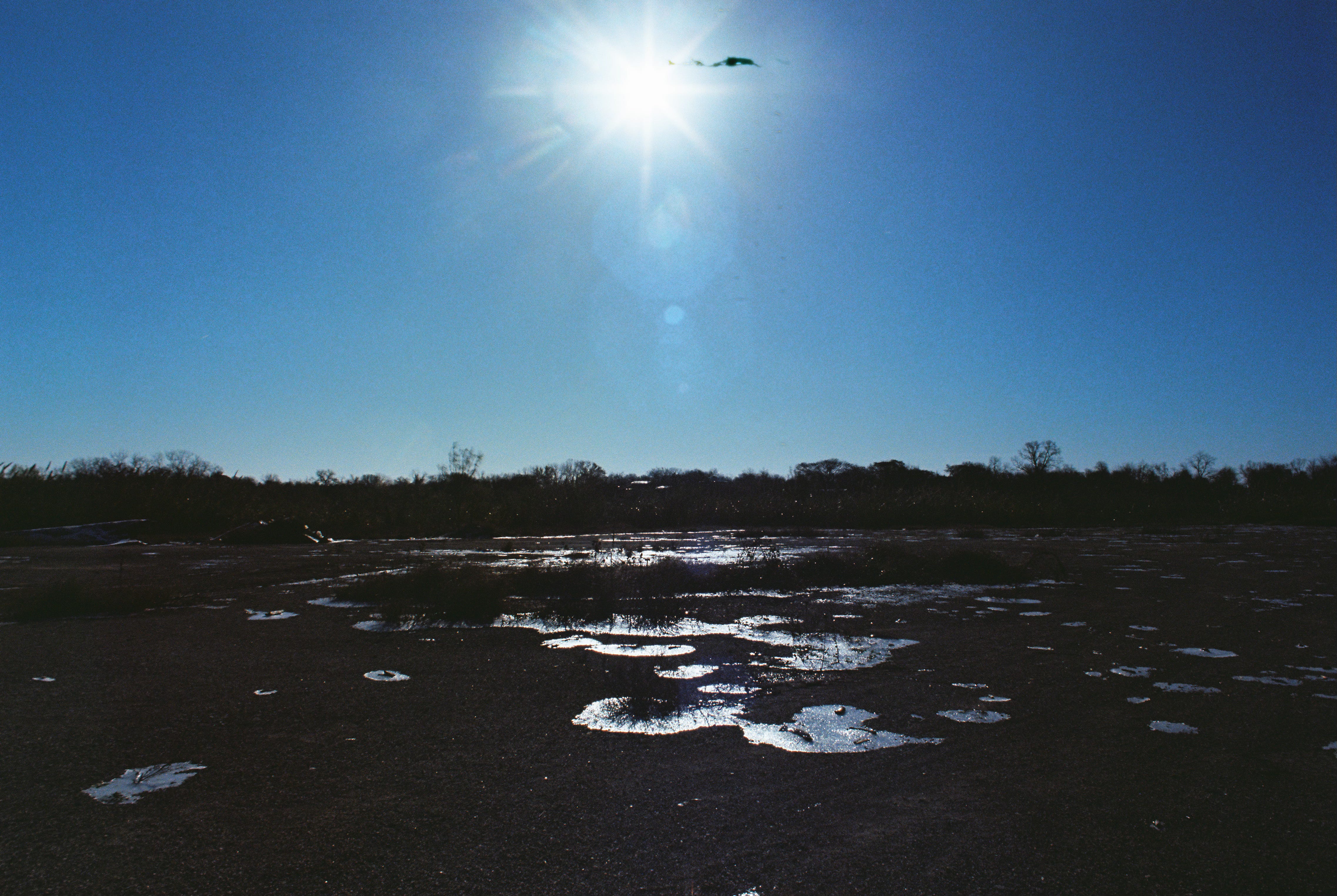
We worked our way back from there, across expansive sheets of ice that gave the industrial wastes a beauty they had not earned, tracing a new path through a savanna of frozen retama until we found the main trail. At one spot we came upon some discarded objects that included a trio of stuffed animals face-down in the snow, and a massively warped vinyl record whose label had become illegible. I picked it up and turned it over to look at the other side, and could just make it out: The Legendary Josh White. Half of a two-disc compilation, I later learned, from 1982, by a remarkable artist I had never heard of, who bridged the blues into political folk in the mid-twentieth century until he was blacklisted in the early 50s for advocating conceptions of freedom and community not founded on private property rights.
Tuesday morning the schools and offices were still closed, but the back lock had finally de-iced, so Fifi (so named by our six-year-old, and an apt choice) and I walked down to the river around 8:30. We hadn’t gotten far when we saw motion in the near distance. A pair of coyotes on the rocky bank, ducking into the woods when they saw us. We followed, slowly, wanting to see them but also wanting to give them space.
Winter makes it easier to see wildlife in the middle distance, and if you track the line where the horizon would be, you always have a good chance of spotting whatever’s around. The coyotes had split just a little bit to go in slightly different directions, probably a smart strategy. But both stopped when we stepped from the riverbank into the woods, and watched us back as we stood there. Their coats were thick and autumnal, a lush orangey brown like the color of old Carhartts tinged with goldenrod. They looked healthy and big, and I wondered if they might be a Central Texas variant of the ghost wolves, the coyotes who are partly descended from our native and otherwise exterminated red wolves. I also thought about how often coyotes encountered in the early morning seem unwary, maybe exhausted or engorged from the long night’s hunt.
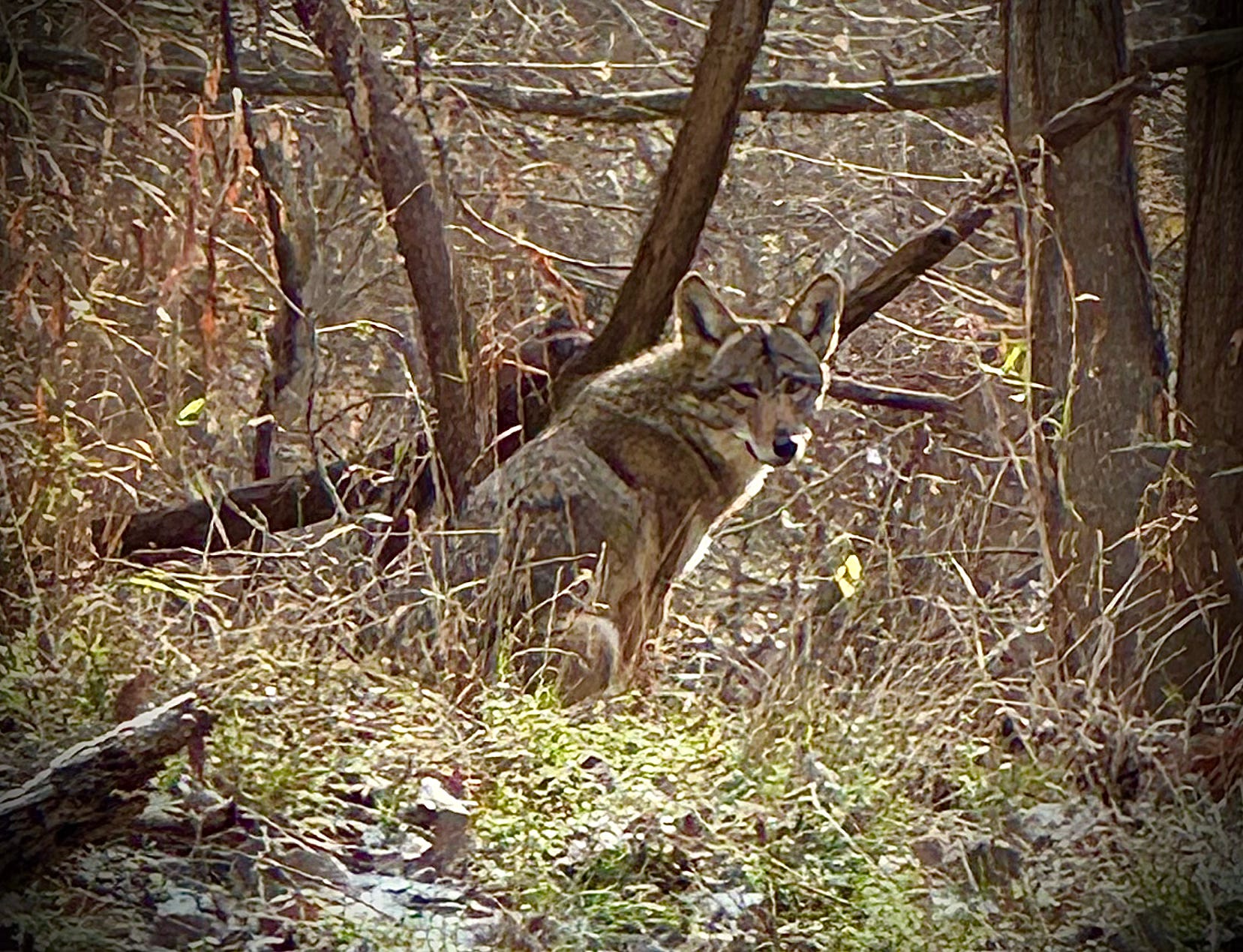
The coyotes only moseyed when we did. They sauntered slowly back deeper into the woods, headed downriver. Or so it appeared.
When we worked our way back to the house fifteen minutes later, they were there. One right at our back gate. The other on the rise nearby, just inside the edge of our unmarked property line.
I remembered how, when Lupe and our other dog Katsu were younger, right after we built the house and rewilded the lot, the coyotes would often come to the fence to visit, as if luring our dogs out.
That afternoon we dropped our snow day daughter off at grandma’s and took pain-stricken Lupe to the veterinarian for an assessment. We talked through her progression and status since the last visit, and all sat with her there on the floor. When we began to conclude that maybe it was time, she gave us eerily comprehensible expressions of enthusiastic concurrence.
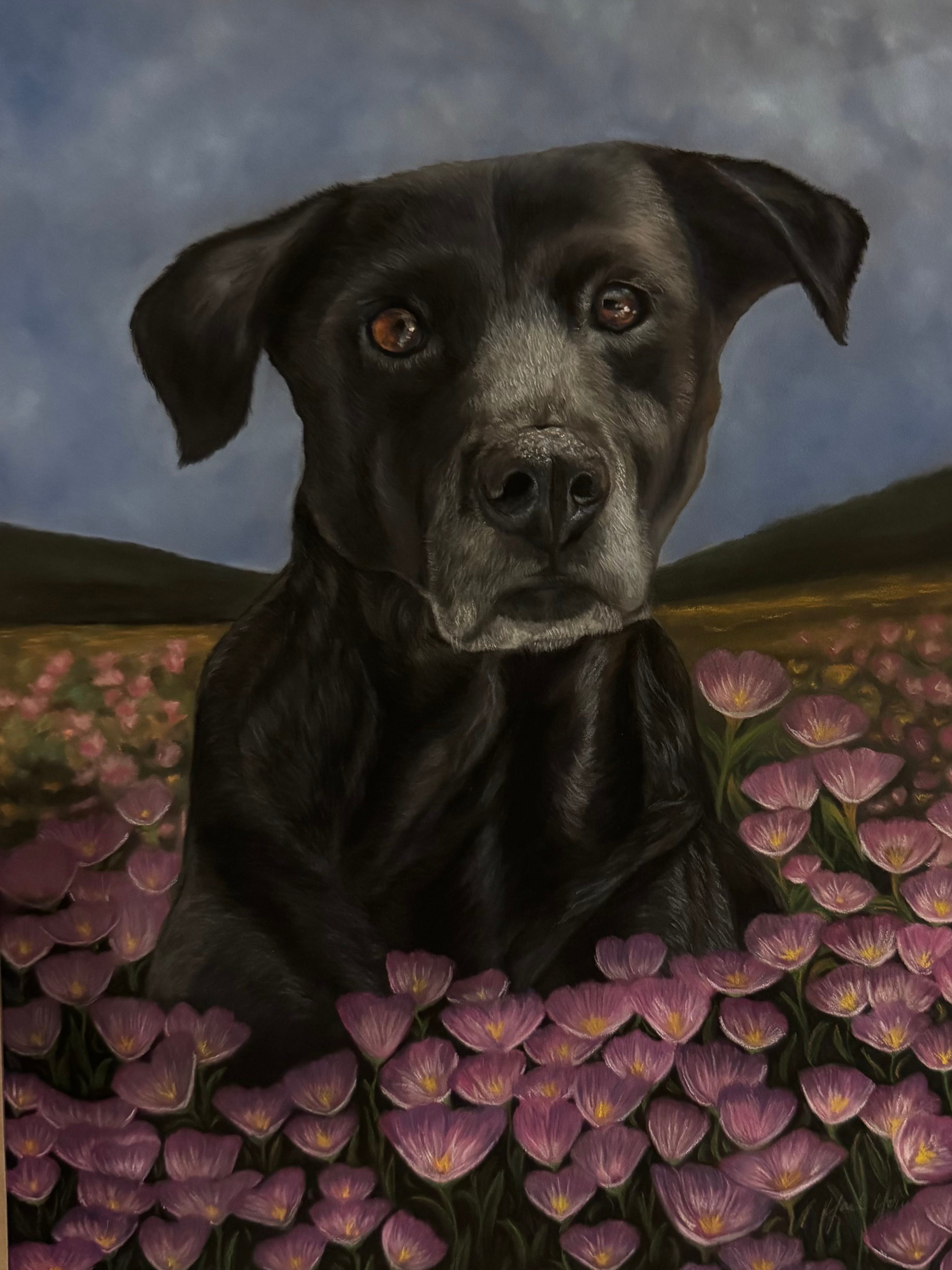
Living in a place like this, I’ve come to see how dogs often embody many of the dark aspects of our domestication of animals, in the way we have bred dogs to instinctively try to kill or chase off any living creature that enters our domain and is not human or canine. Lupe’s 10-year companion Katsu, a fierce hunter from a breed raised to chase down the wild boars of Kishu, was very much that way. Lupe was different.
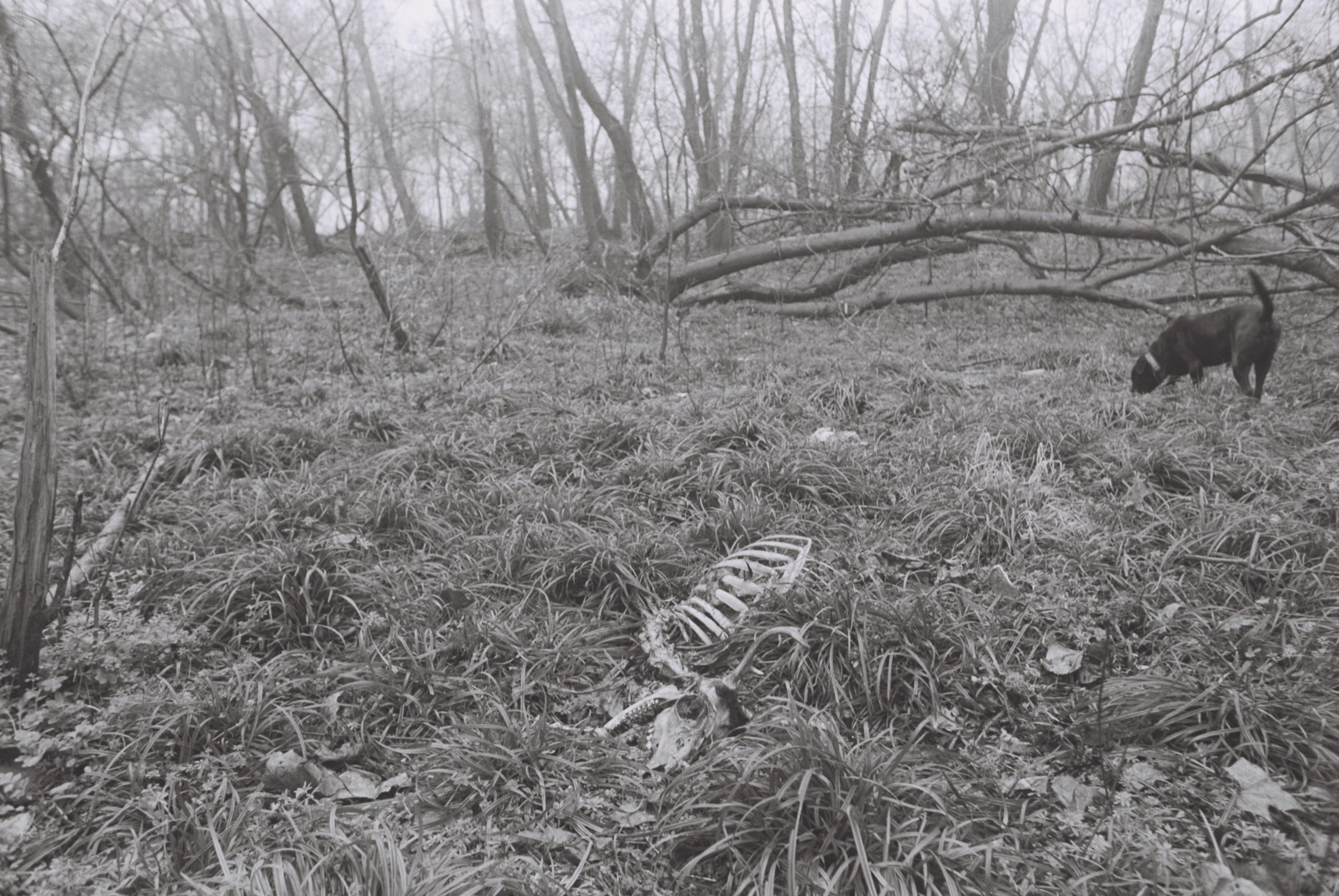
She appeared down the street from us as a puppy right after we moved into a rented little cottage next to our then-empty lot, abandoned and living on an old sofa dumped behind the diner with her sister. Our neighbors adopted the sister, who they named Lucy, and we adopted Lupe. She was all black in color, mostly blackmouth cur in breeding but with a mix of other traits, and native to this place, where the riparian woods hide in a secret pocket of wildness behind the factories at the edge of town, a landscape she had learned to survive in. She was an incredible tracker, a stealthy ninja, wary of humans, and super tough, but also strangely gentle—able to protect the home while also managing to co-exist with the other life around her. I had to earn her trust, and was rewarded with a glimpse at how she experienced the world, and her subtle way of teaching me lessons in how to live in the world.
Only later, as we headed home, did I mention to Agustina the eerie visitation from the coyotes. Like spirits of the forest, who knew where Lupe was going before we did.
Further reading
I also wrote remembrances of Lupe’s sister Lucy here in 2024, and of her companion Katsu here in 2021. For a great read on how free-ranging dogs adapt to urban life, check out Alan Beck’s amazing 1973 study from Baltimore, The Ecology of Stray Dogs.
RIP J. David Bamberger, chicken tycoon turned restoration practitioner and advocate, who died last weekend at 97. My son Hugo spent a lot of time in his childhood summers at nature camp at Bamberger Ranch, where he got deep learning about the ecology of our region and how it can be regenerated and stewarded. Bamberger did much to give that kind of work social and ethical cachet among people with the resources to do land restoration work at the scale of huge acreages, and the welcome he extended to others from across the community over the course of his life was remarkable.
In the long reads department, I enjoyed Adam Shatz’s January lecture and essay for the London Review of Books, “Visions of America,” which provides an interesting perspective on the current moment and where we could be going, at the same time as it made me frustrated with its absolutely urbanist and metropolitan focus. I don’t think it’s possible to understand the dark power dynamics and profound inequalities that hide behind our exceptionalist and egalitarian mythology without seeing how rooted they are in our damaged relationship with the land on which we live. But I still recommend the talk, even if (spoiler alert) what you get at the end of an 8,000-word survey heavy on pessimism is a little dose of giddiness about Mamdani as messiah. Print version here, and lecture video here.
For another perspective on the real American, read about the remarkable life of the legendary Josh White.
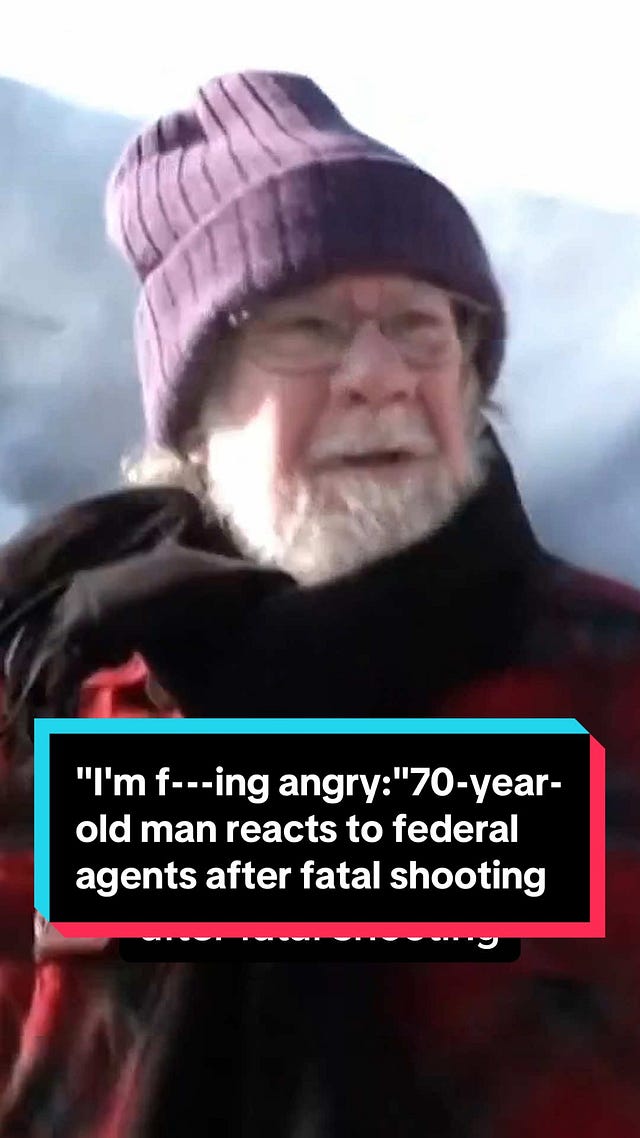
And thanks to Rick Klaw for tipping me off to the amazing story of Minneapolis indie bookseller Greg Ketter, owner of DreamHaven Books and Comics, going viral with the images of him facing down the federal troops even as the clouds of tear gas swarm around his unmasked face.
 Tiktok failed to load.
Enable 3rd party cookies or use another browser
Here’s a wider shot of the largest circumference oak tree in the county, holding out between the asphalt dump and the tollway.
Stay warm and have a safe week.
unusually written with a brittle layer of ice. then becomes apparent it is covering sadness then being cracked with a slow upheave of grief. what remains to carry you, the coyote beauty of awareness and the oaks great longevity. we always keep loving and missing those old animal companions. i weep a bit with you
Beautiful. Thank you.