

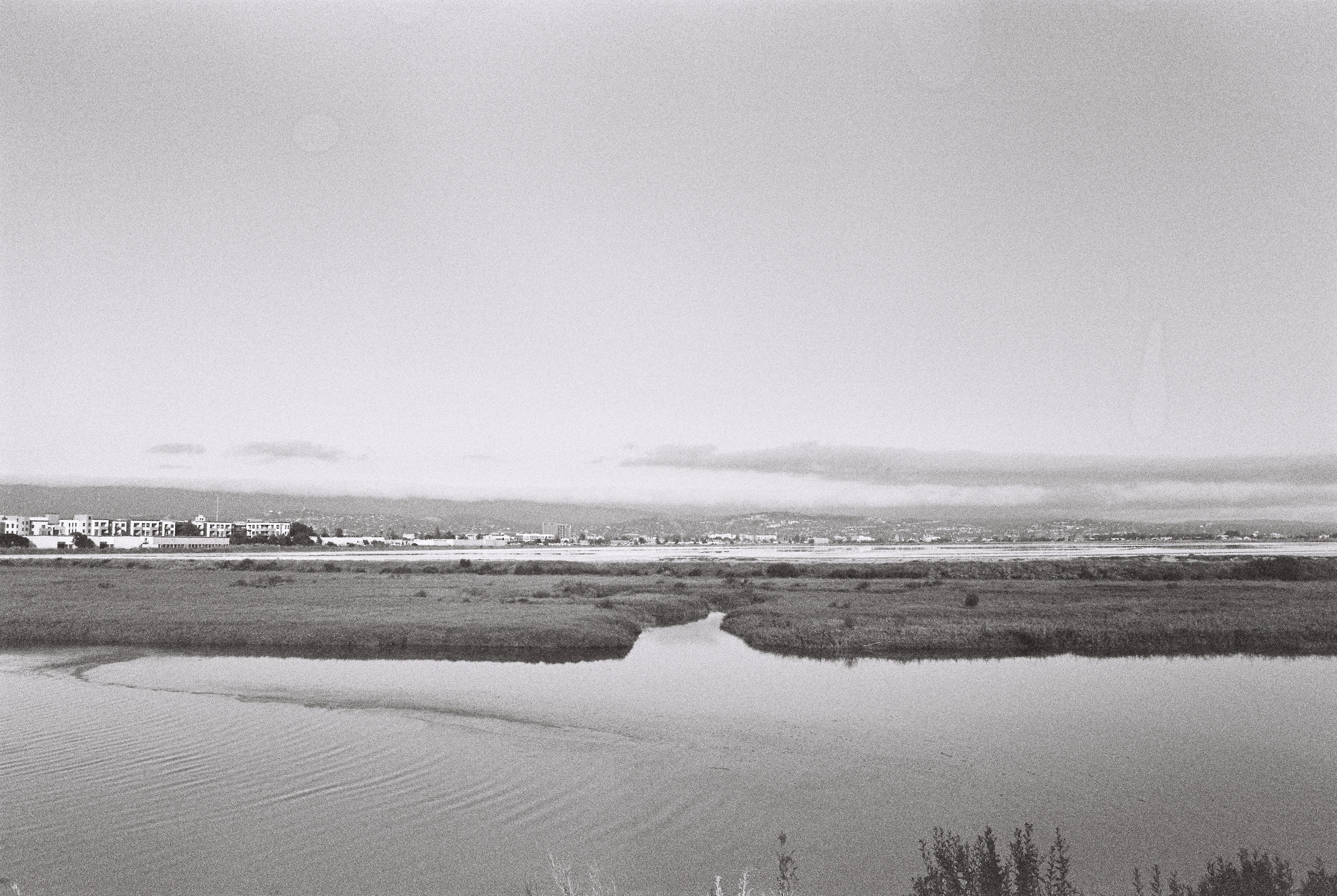
The source of the Metaverse, it turns out, is also the source of a delta of skanky urban creeks that carry the runoff from the industrial edges of Redwood City, Menlo Park and East Palo Alto out into the bay. You can see them on the satellite maps, some of them meandering like those moirés you used to be able to run on the early Macs, others engineered with the unnaturally straight lines some engineer drew in his office. On the Sunday before Memorial Day, I put into one of those creeks, looking for a different way to see the place we’ve come to call Silicon Valley. And as soon as I got out there into the flow, I was greeted by a sea lion who was already there, coming to check out my weird blue packraft with what seemed to be equal measures of curiosity and annoyance.
You could almost believe you have escaped the endless urbanity of the Bay Area when you drive down there from the East Bay before sunup on the Sunday morning of a three-day weekend, especially after you get off the 880 to cross the Dumbarton Bridge, which feels like a relic of an age before automobiles really took over. First light on the radomes where the land flattens out, over the water low, then into the warehouse sprawl.
Figuring out where to put in is always challenging in a place you don’t know. The digital maps are helpful for general geography and understanding what’s public and private, and you can usually find some resources from local paddlers and parks departments. But you can only really reckon with your own eyes, especially if you are thinking about going someplace you’re not really supposed to go, way off the sidewalks and into the open water, trying to find other life within the margins of our digital imperium.
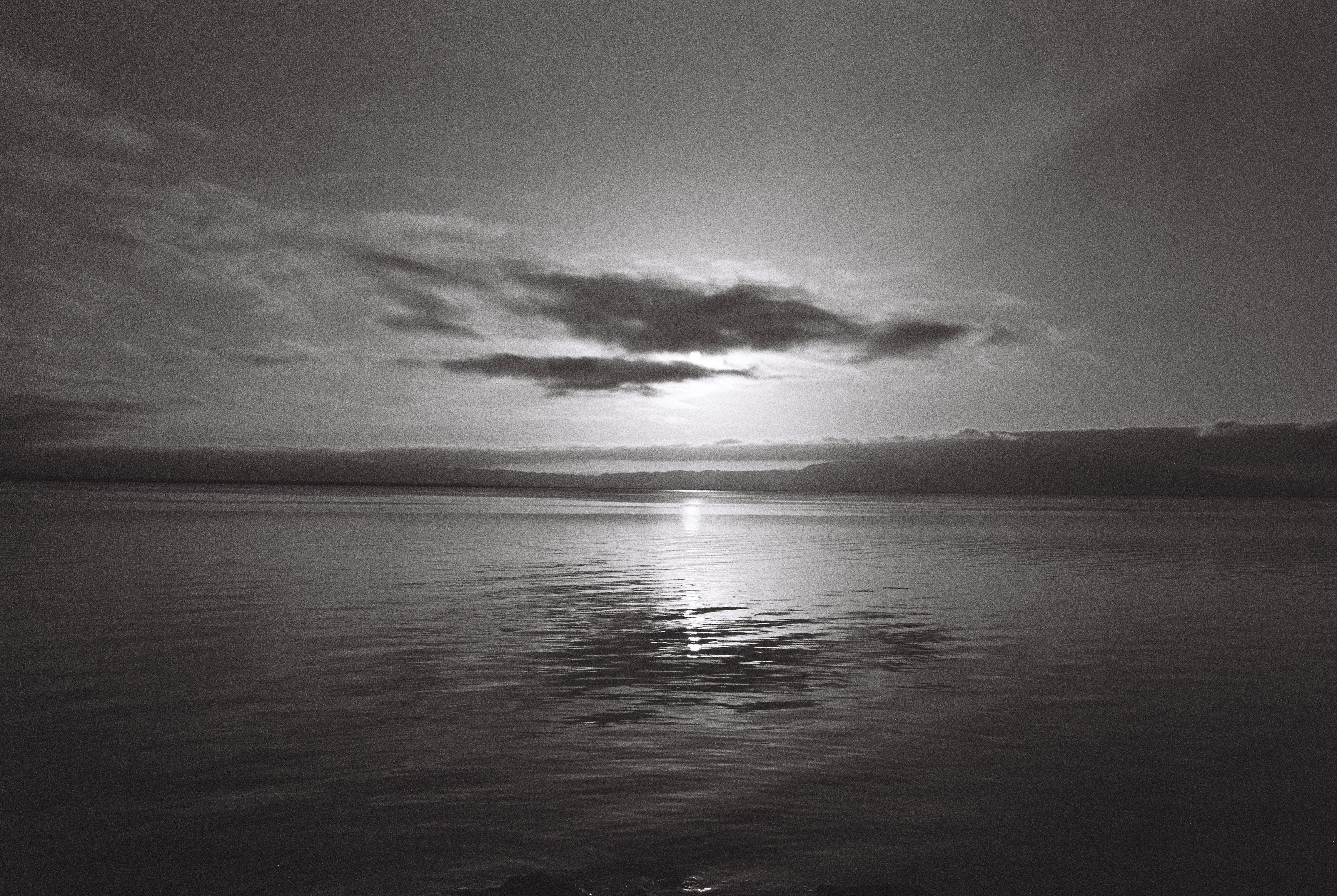
I tried Cooley Landing in East Palo Alto first, thinking I might paddle north from there along and into the Ravenswood coastal preserve. As soon as you step out into that zone down there, you can tell how it is a vast coastal wetland that has been mostly drained, over what’s not really that long a period of time. Cooley Landing was a Gold Rush-era wharf, then a twentieth century landfill that eventually found its true calling as an involuntary park. There’s a tidy new visitors center, and good access to the water, but the distance to where I wanted to paddle looked a lot further than I had been expected. The sun was coming up through low clouds over the Diablos while I walked around, seemingly invisible to the only other visitor, a dude watching the sunrise from the hood of his red Mercedes and looking like he had just driven in from a 1990s Jim Jarmusch film.
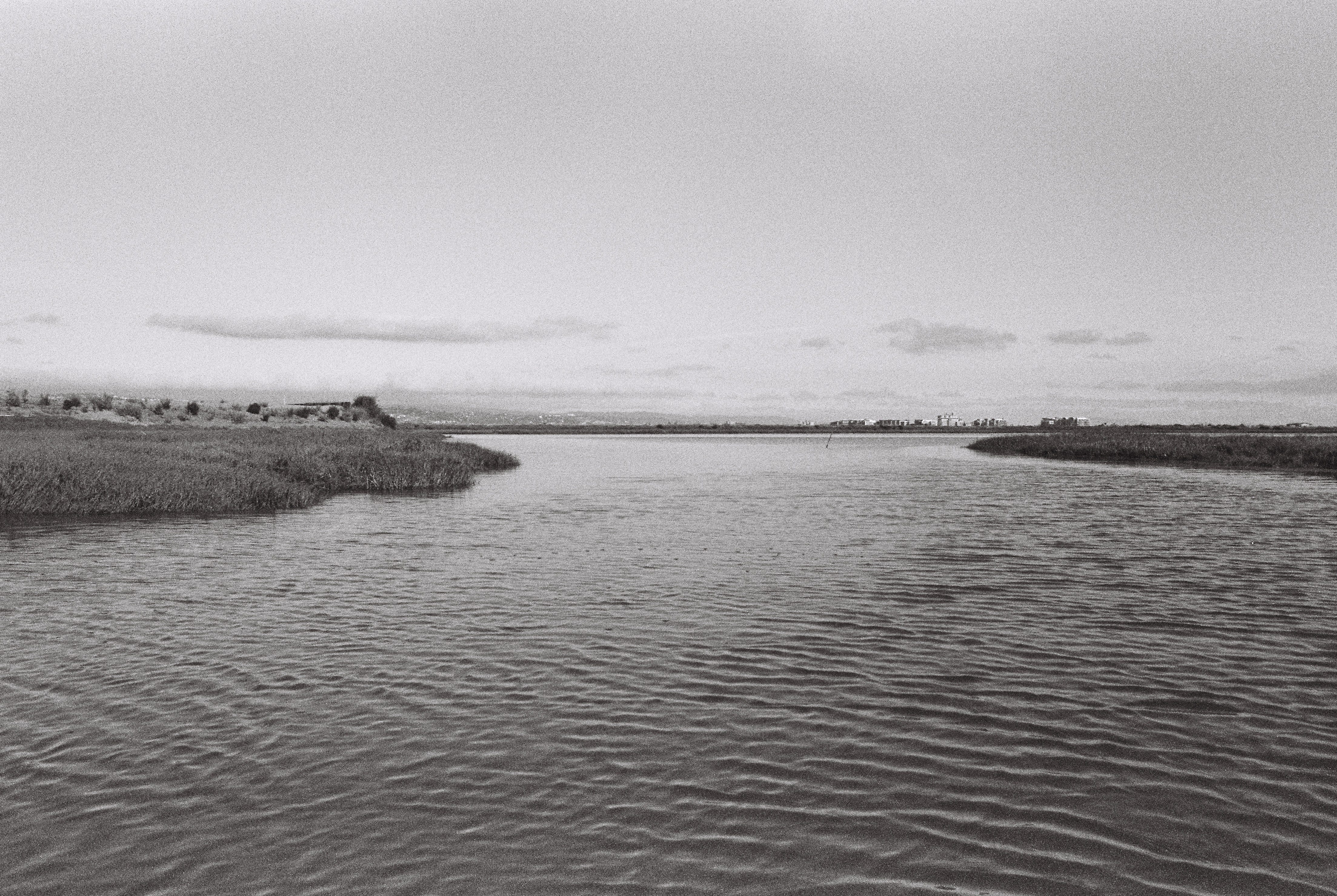
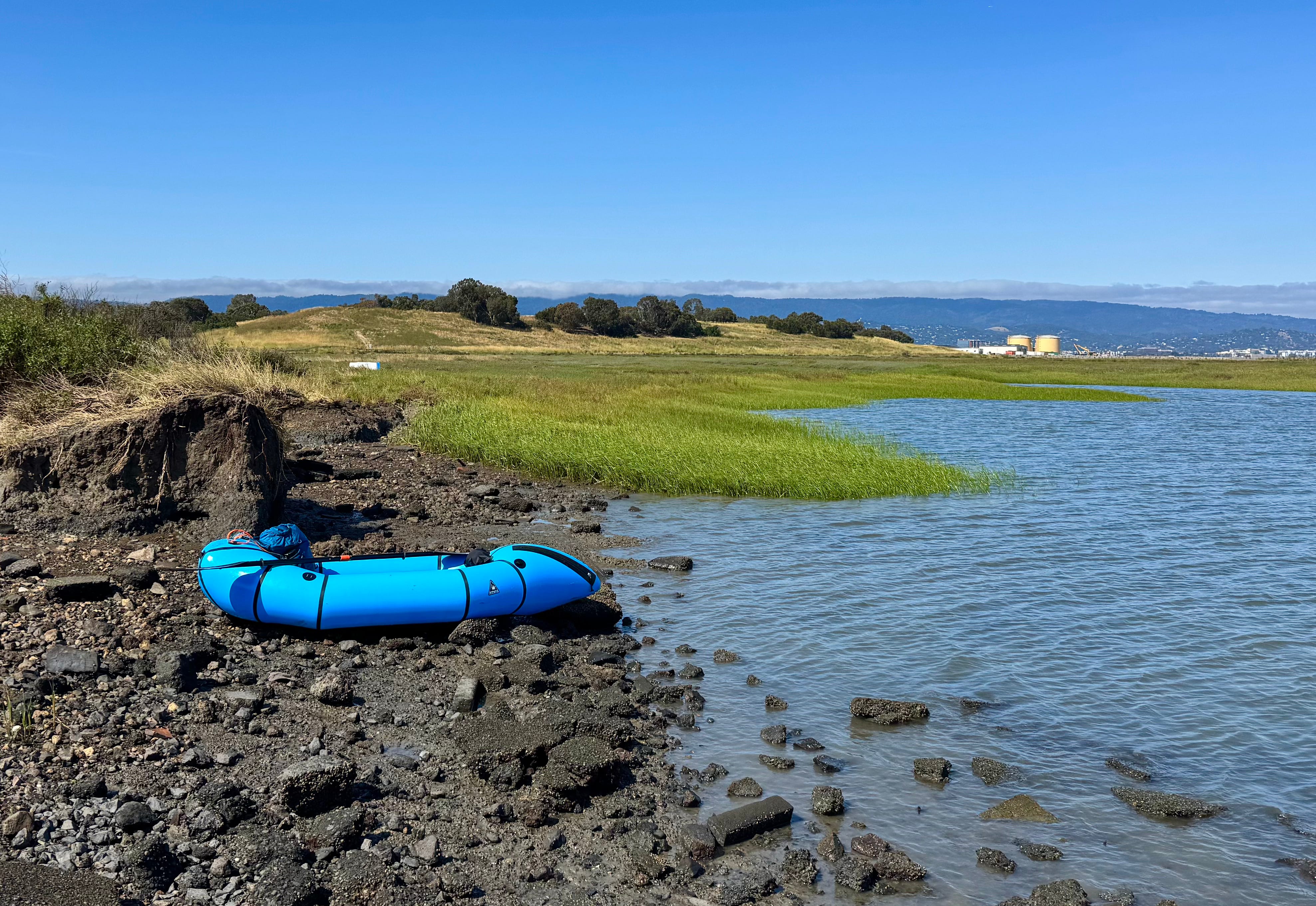
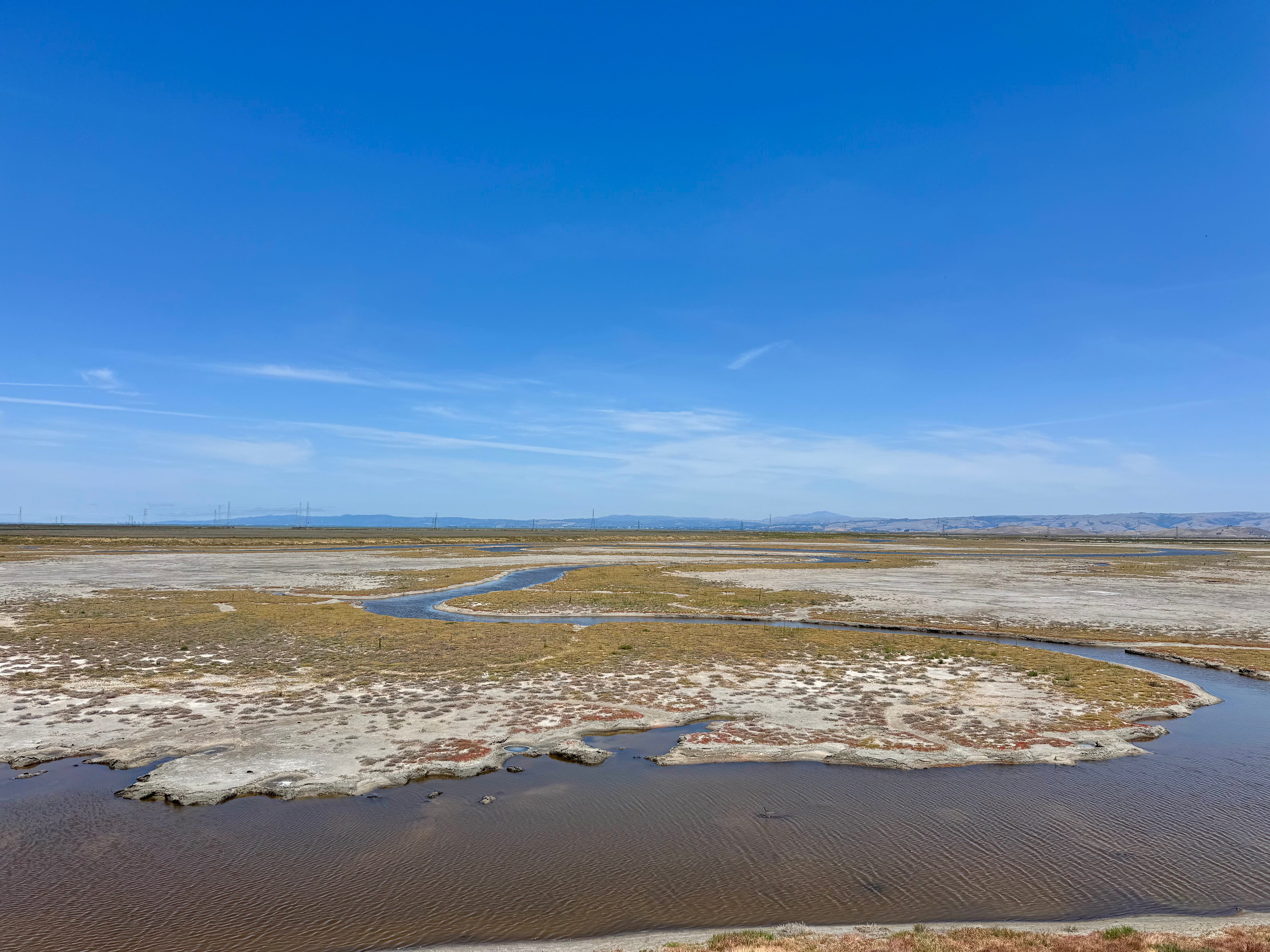
I found my way back to the coastal highway, and headed north a mile or two, past the sprawl of the Meta campus to Bedwell Bayfront Park. The gates were locked, but there was a parking area with restrooms outside the gates, and a creek-like channel that you could see would take you out into the meandering channels that spiral through the remaining wetlands at the edges of the salt ponds. I inflated my raft in the parking lot, popped my paddle together, and walked through the tall grass to a spot where I could put in. It was high tide, which made it easier.
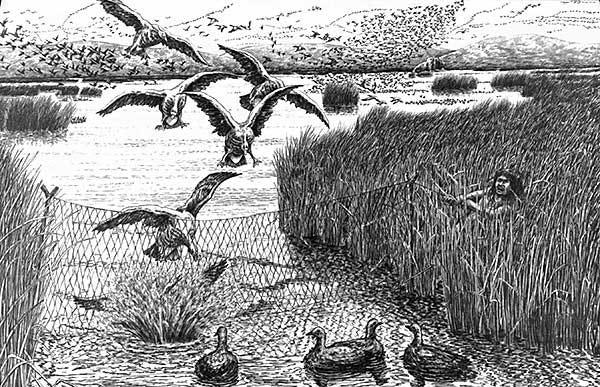
In pre-colonial days, they say there were so many birds in the wetlands of the place we now call Silicon Valley that the Ohlone people would catch them with nets. That abundance is as gone as the habitat, and the water didn’t look especially attractive — green-brown, muddyish, with surface flotsam here and there. Not that bad as urban waters go, but not a place where I would have expected a large mammal to pop up as soon as I got in the water.
In the moment, I took it for a seal. Only later in the summer, at the Central Park Zoo with my daughter watching the keepers feed the sea lions, did I get a proper refresher on the difference between those species, and their habitats. It had the energy of a wild dog, without the sense of predatory menace, and with more of a sense of play. It swam around me, surfacing and diving, whiskers and eyes, flippers and tail, for a long minute before it disappeared.
I paddled out toward the bay, following the straight line of the channel a quarter-mile or so past some petrochemical storage tanks until I found a more naturally meandering stream to the right that would take me into the zone I came for.
Later I found myself thinking about ways in which heading out on a path like that, not really knowing where you’re going or what you’re going to run into, has some similarity to what going online was like back when the Web was new. Flipping the Hypercards, clicking through the links, watching the pages load like watching Polaroids developing. An alternative media to the advertising-based television that dominated the era, one that emerged from universities, research labs, and hobbyists, promulgating experimental new websites like weird new plants coming up after a burn. To have a .com suffix back then was almost a stigma, unless you were one of the companies enabling the revolution. Trawling those data streams was a kind of foraging, full of fresh discovery and wonder.
Who knew that would lead to little TV-computers in our hands, on which we would spend most of our time watching nothing but commercials, disguised as messages from friends.
Fifteen years ago, the U.S. Forest Service ran a national ad campaign designed to get people to unplug from their devices and experience nature. They did so with ads that featured human hands holding a smartphone on one side and a digitally rendered animal on the other. The first one I saw, on a billboard in our neighborhood, was a cute little cartoon frog. Maybe they thought the real one would be too strange or scary for people who’d only ever seen simulacrums. Or maybe there weren’t any real ones left.
I was working my way out there, to a different vantage on the Metaverse, when the creature knocked the bottom of my boat. It hit hard, and suddenly, from the subsurface without revealing itself. The packraft is just a little rubber inflatable, one in which the paddler sits right on the bottom with little ability to see into the water, and the marine creatures that might want to mess with you have the element of surprise to work with. I wondered what it was. And if it wanted to warn me, eat me, or get me to play.
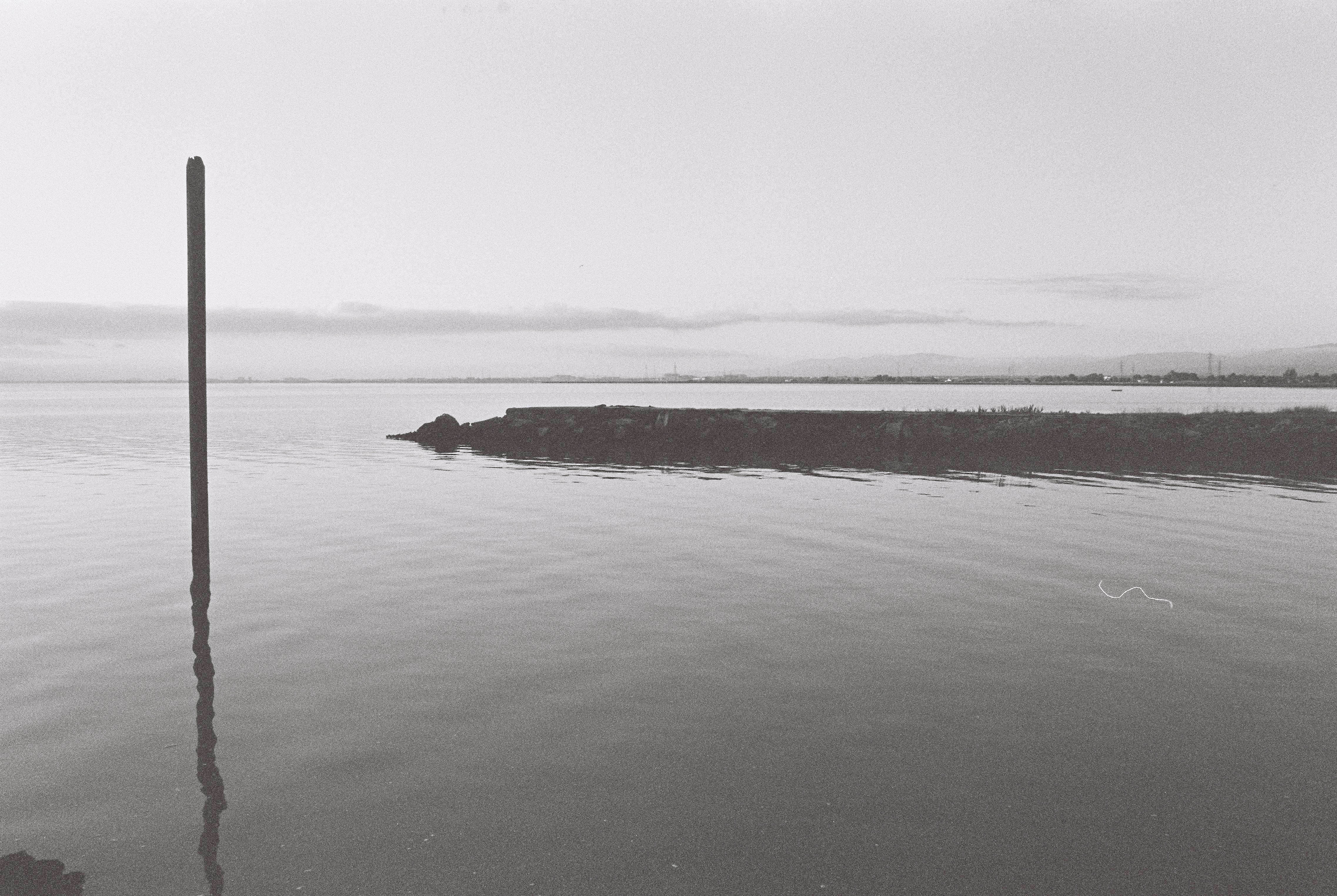
I reached the opening into the bay, along the edge of a long jetty that harbored some flats. There was a tiny peninsula poking out at one point, with a good spot to put in, so I did and took advantage of the opportunity to take a break, stretch my legs, and get a different vantage on where I was. The little beach was littered with black rocks, but with enough room to safely stow the boat, and then clamber up into the grass. Signs of life: spring wildflowers, butterflies, songbirds, scat, and an old bottle of booze with the label long gone.
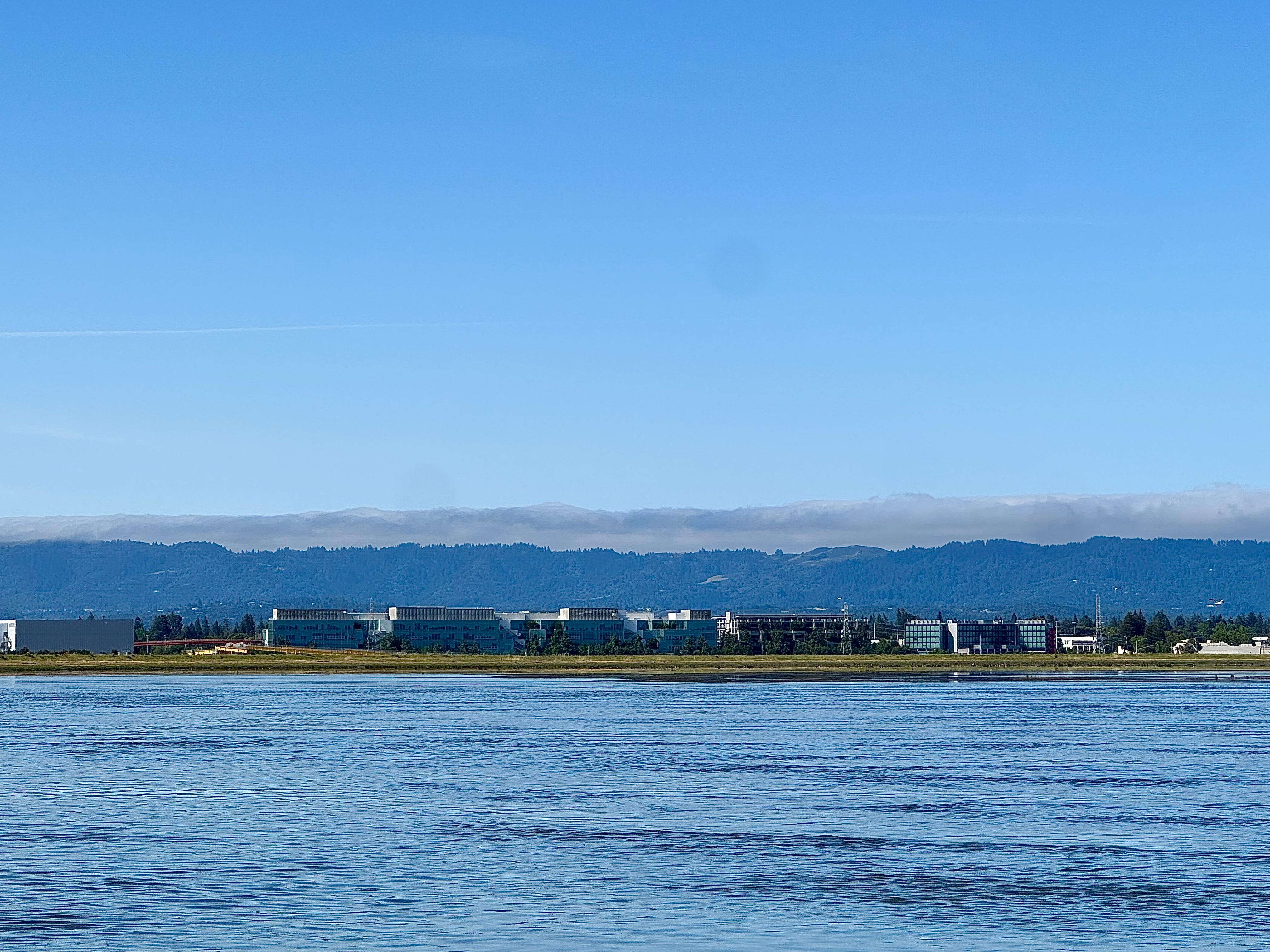
I walked a ways, to the inland side, and looked out over the flats. The tide was still high, and the lagoon was full. On the far shore you could see both Meta campuses —the old one, which once housed Sun Microsystems, a company I navigated a David vs. Goliath fight with during the early days of Java, and the new one, which sprawls along a half-mile of right-of-way between the highway and an abandoned railway line, with a form more like a generation ship than a corporate campus. One segment is covered in hanging vines, as if cosplaying its future ruins. On the original campus, they just flipped the Sun sign out front, painted their own logo on the backside-turned-streetside, and kept the Sun logo there in the shade for the employees to see when they head home. “[A] reminder,” per the company’s 2011 Little Red Book, “that if we fail, someday someone might replace us.”
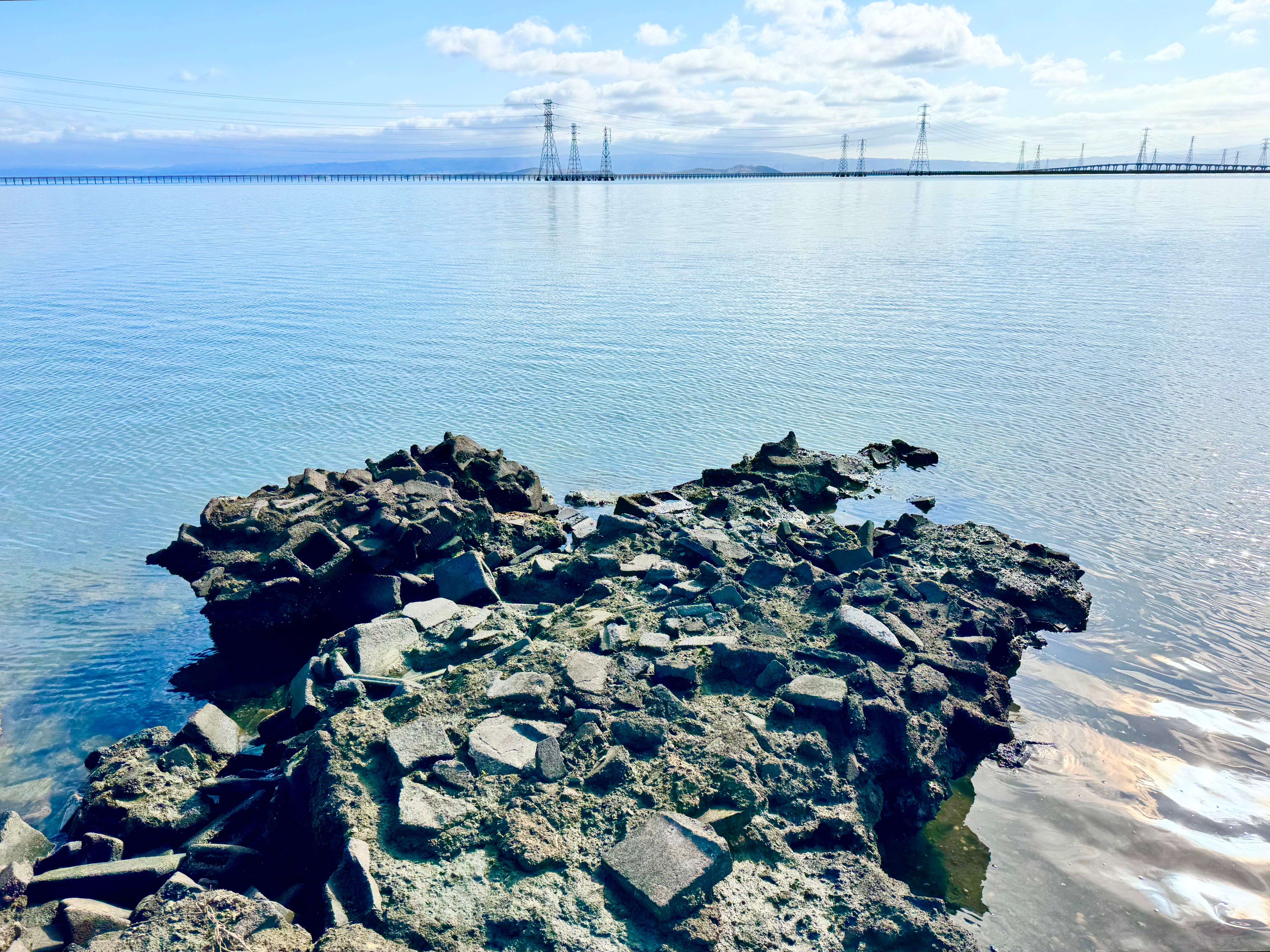
When I walked back to my boat, I noticed that all the black rocks weren’t rocks at all, but chunks of old cinder block deeply stained with the inky color of the bay mud, covered with barnacles, and weathered by the gentle breakers. The jetty, and the whole peninsular park it appended, was a rewilded landfill. The age of which became apparent when I noticed a little bottle of clear glass shimmering on the sand between some of the blocks. It was shaped like a tiny lamp, and inside was some red material, terra cotta-colored, a liquid that had hardened like paint. On the bottom was embossed a United States Patent Number, 110034, which the technologies built in those suburban offices sprawled in every direction across these former Ohlone wetlands let me immediately search for and find was a Dura-Gloss nail polish dispenser from sometime between 1938 and 1949.
I pocketed it in my PFD, and paddled on, looking back to admire the unlikely beauty of that Anthropocene landform assembling and becoming geology before my eyes.
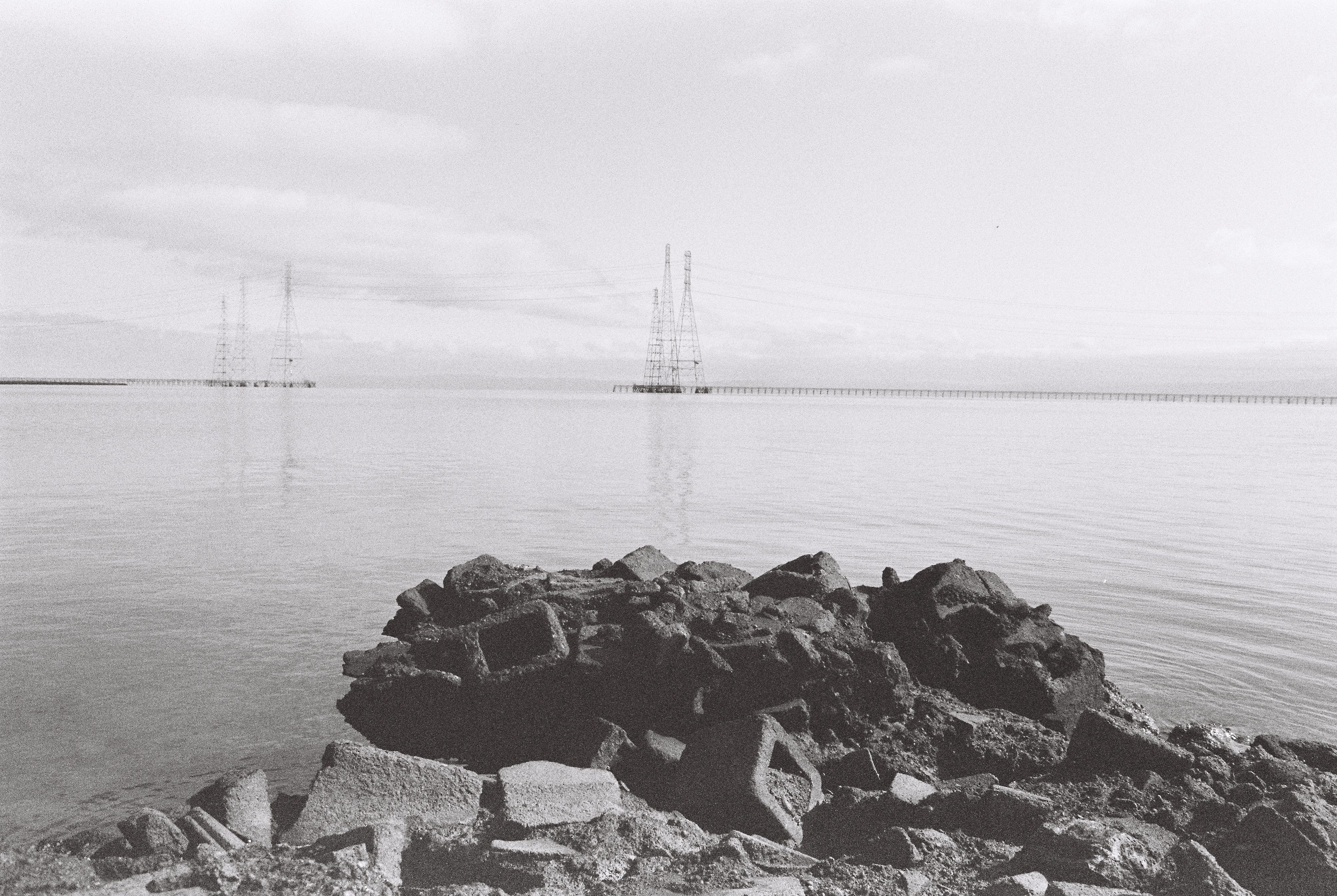
The expanse of the bay is more evident when you are out on it in a little boat, and you can see the engineered forms we have imposed upon it. The bridges for cars and rails, the power lines, what looked like some 20th century aqueduct, the paths for ship traffic. The tide was coming out now, and you could really feel it at the point where the jetty ended. The freshwater was pushing out from the flats opposite Meta HQ, gushing into the saltwater at a high speed, carrying urban effluent visible on the surface and who knows what beneath it. That’s where all the birds were, right at the chaotic confluence, looking to see what showed up for second breakfast. You could feel the energy—the forces in motion, and the weird cyborg ecology. It was a little tricky to navigate my way through and in, and more so when the cryptid swam up to play.
Two triangles of flesh appeared just off my bow, around 11 o’clock, like waxy hairless brown cat ears. They were there for a long moment, then disappeared.
A moment later, a single fleshy prominence emerged from the swirl, like a periscope the size of a big straw.
In the moment, it was baffling, alien, and unidentifiable. Even as, thinking back on it over the summer, I suspect it may have been the same sea lion at every point, messing with me in a knowing and playful way. Not everything needs to be identified.
Mark Zuckerberg and I went to the same high school. I know this only because they had him wear a T-shirt from our school in the opening scene of The Social Network, which I loved for the soundtrack and the fact that they told the story from deposition transcripts. I wonder if we both had the same biology teacher, Mr. Aaronian, who really loved to identify and name birds, but did not bring much of that wonder and joy into his classroom teaching the mysteries of osmosis.
I should have understood the connection earlier, from the name of the site, which I first started an account on when invited in connection with a reunion of my high school class. “The Facebook” was what students at Exeter called the Student Directory, a little paperback they gave every student at the beginning of the fall semester that had an entry for each student with a black-and-white thumbnail photo, name, year, dorm, and hometown home address. And of course one of its main uses became the group objectification of our school mates, most notably through the practice passed down every year in the boys’ dorms of sitting around and annotating it in ball point pen, rating the girls and defacing the competition. When Zuck got to Harvard, he made an online version. And here we are.
The water was more calm once you punched through the chokepoint, and I could float for a minute without spinning off. I identified the birds I didn’t know with another phone app, this one a nonprofit audio AI database from the ornithology nerds at Cornell, which I guess makes it a little better. The Forster’s terns were the coolest, and their dives confirmed how much marine life there was in those flats, even as the water was emptying out of the lagoon, and I started to notice bits of the brown foam I associate with freshwaters befouled.
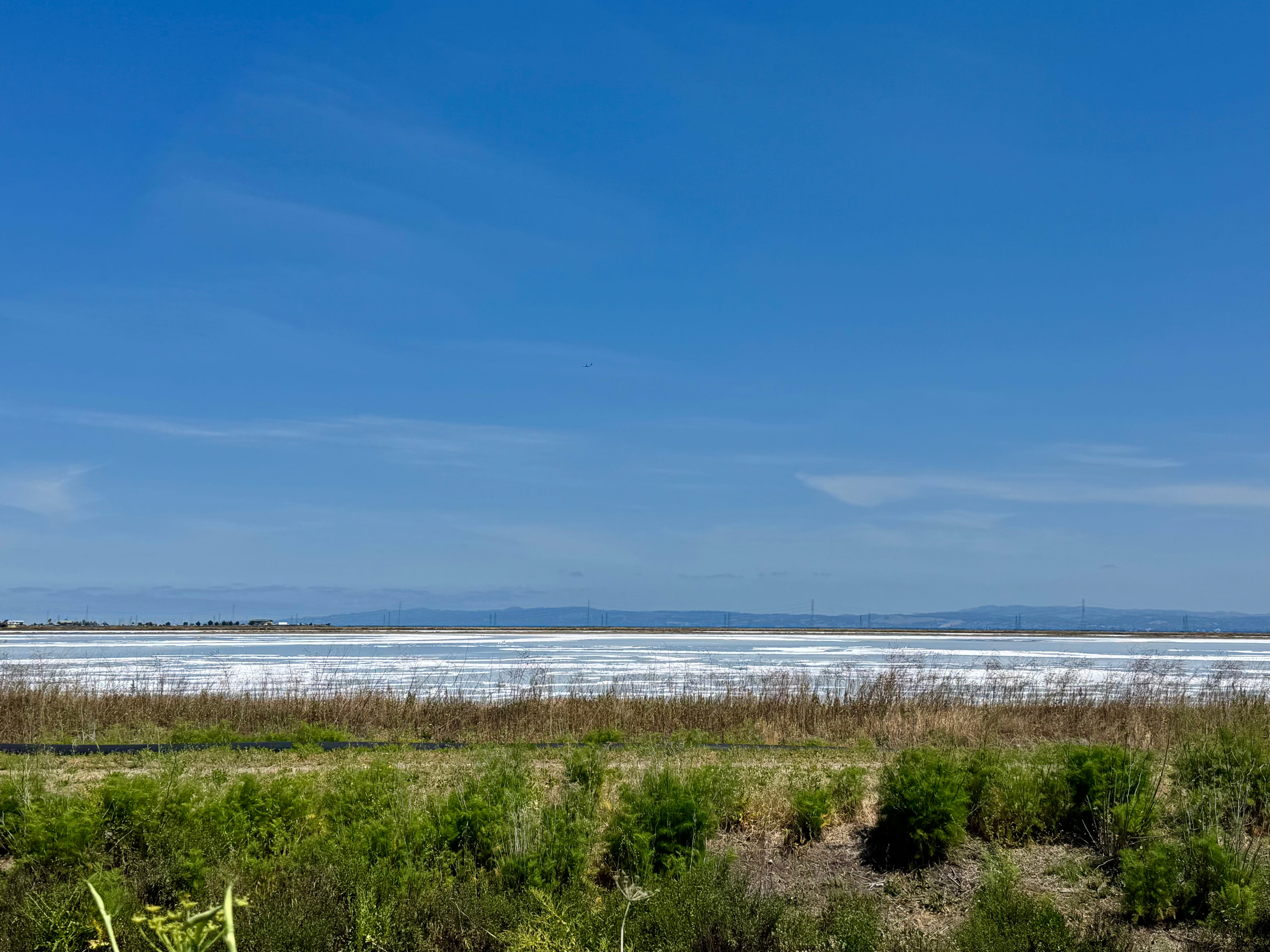
The sun had gotten higher, and the sky clear, the only clouds gathered at the mountain ridges that protected the Valley from the coast. It was quiet, the Sunday morning of a three-day weekend that marks the beginning of summer, and the main sound was the water lapping on the shore. You could see the jets coming and going from SFO to the north, but the only plane I heard was a low-flying single prop. The San Francisco skyline was clearly visible in the far distance, especially the Salesforce tower. The buildings closer by shimmered, getting their mirage on. There weren’t as many waterbirds as I had hoped, but there were some, including geese and ducks perhaps working their way north. Sitting there in that coastal estuary, in the middle of a zone of expansive marginal refuges made from the leftovers of our post-colonial industrial abuse, it was easy to imagine how much more space like that we could make, and how much more biodiverse we could make it if we really got to work on taking better care of the waters we share with other species.
As I paddled back out, I saw a dude sitting out there on the train causeway or whatever it was. Out like way way out, feet hanging over the water. I didn’t see a fishing rod. It looked like a good way to kill a Sunday.
When I got to the car, after I cleaned up, and before I went to explore Meta Park, of course I posted a story to Instagram: a video of the seal that was not a seal.
I wonder which networks are more polluted.
Further Reading
The Ohlone Way by Malcolm Margolin from 1978 has some pretty great illustrations that look like they were borrowed from some stoner comics of the era, including this one of bird netting in the wetlands:
More on the Facebook “Little Red Book” here from its designer.
For more on the “Discover the Forest” campaign, here’s a vintage post I wrote back in 2011 for a group blog I used to participate in back in the days when every SF writer wanted to have their own Boing Boing. The post is also an early exploration of the idea of “edgelands,” written not long after I first encountered the term on a trip to the UK. Warning: lots of the original linked photos are now blanked out.
Boyce Upholt at Southlands hosted a great panel discussion Friday about SpaceX’s existing operations in South Texas and plans for Vermilion Parish, Louisiana, with writers Joseph Bullington, Alex Lubben, and Dean Boudreaux. It should be available soon for viewing by subscribers on the Southlands site; in the meantime, check out this amazing dispatch Bullington wrote for The Baffler.
Thanks to Valerie Menard from the Colorado River Conservancy for this fascinating paper on the links between multiuse trails and gentrification.
At the NYT, an interesting piece about experiments using air traffic control to mitigate the adverse climate impacts of jet contrails.
Thanks
This is the 200th installment of this newsletter. I started it in February 2020, right after turning in the last round of edits of my novel Failed State*, keen to play with the newsletter format and experiment with my own take on nature writing. My timing, three weeks before Covid lockdown and the “nature is healing” memes, proved good. Deep thanks to all of you who have read and subscribed and told your friends.
I kept up a rigorous weekly schedule for the first few years, until the newsletter spawned a new nonfiction book project, what became A Natural History of Empty Lots, and it became biweekly (and often longer depending on available time and material, which feels right in a saturated media landscape). I aim to reach at least 365 issues, and am generating a lot of new material as I work on the new book (as evidenced by this summer’s less frequent but more wide-ranging posts).
I have never turned on the subscription button, even though I know doing so would make the algorithm foreground the work. This newsletter has always had the ethos of writing a letter to friends you don’t know, and I guess I am an Internet utopian at heart, however cynical I may have become.
Here’s a different view of the Meta HQ, from the edgeland I found across the road, which was flush with wildflowers, butterflies, towhees, and trash:
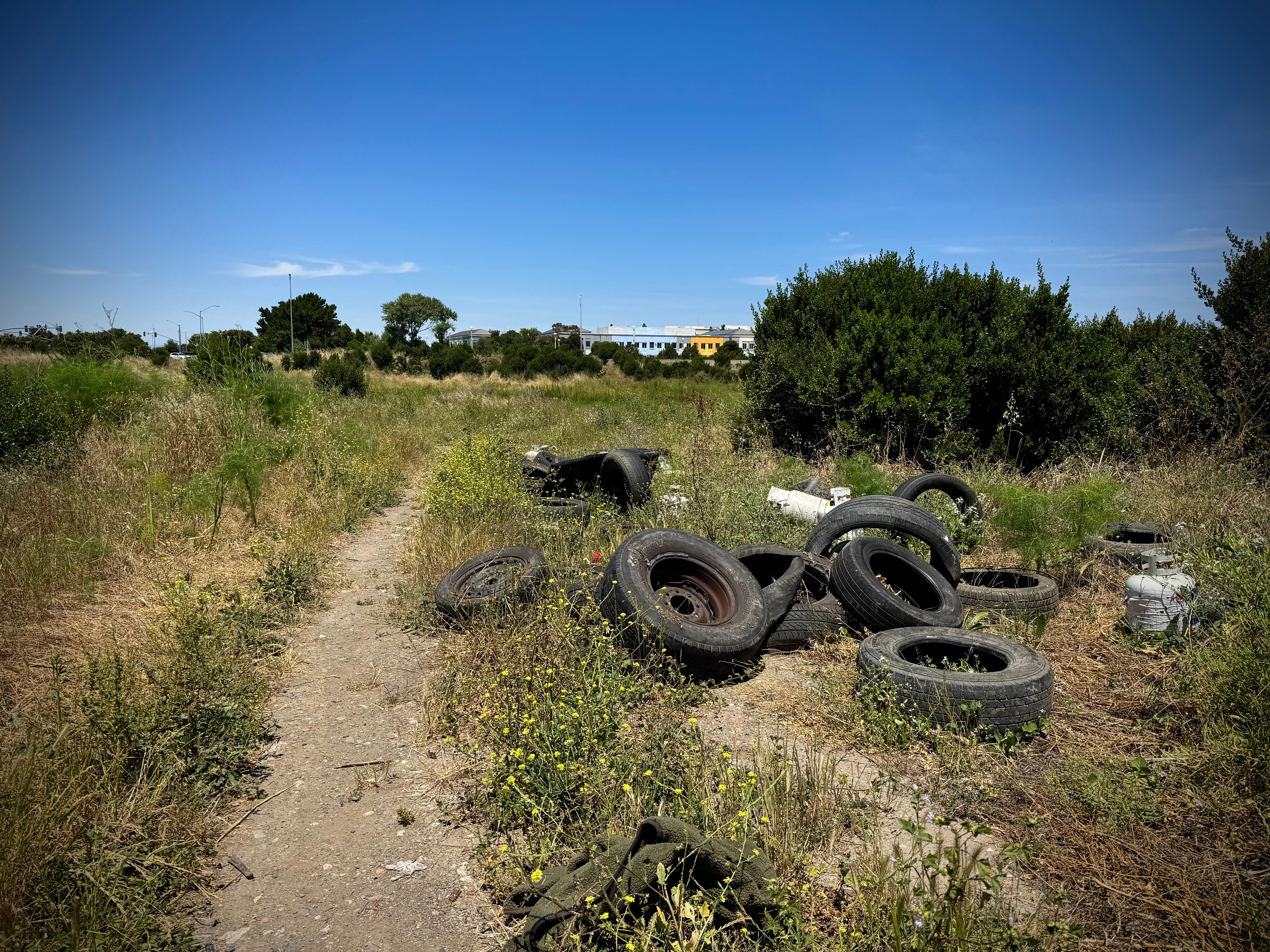
(*Failed State imagined a post-revolutionary truth and reconciliation commission seeking reparations for the destruction of the American wilderness, which would be paid by the inheritors of the wealth that had resulted from that destruction. My editor loved it, and it was shortlisted for the Philip K. Dick Award, but it came out during the summer of Covid lockdown, closed bookstores, the elections, and didn’t sell well. I bet you can find some bargain copies out there. The new book aims to explore some similar territory through a nonfiction lens.)
Have a great week out there.
What a wonderful read, I probably found you just after covid, and your insight and view of the world have moved me greatly, congrats on a 200th post, looking forward to reading many more.
Happy to see the “vintage” post to catch a glimpse of how you got started and lead me to similar origins of edgelands material to read.