

Thursday night after we got our daughter to bed a little on the late side, I stepped out onto our back patio and was surprised to hear screams from the dark woods behind us that sounded every bit like the growl of a death metal singer.
A little farther away, I could hear amplified instruments, too—heavy bass, guitar and drums with the amps turned up to 11, on what you might call the other speaker—another site in our neighborhood that produces sounds that carry long distances. I knew the singer in the woods was not some emo Austin dude soaking up the attention of the crowd on the outdoor stage of the beer hall down the street, where the rest of the band was, but one of the great blue herons that nests in an old sycamore on the urban river a few hundred feet away.
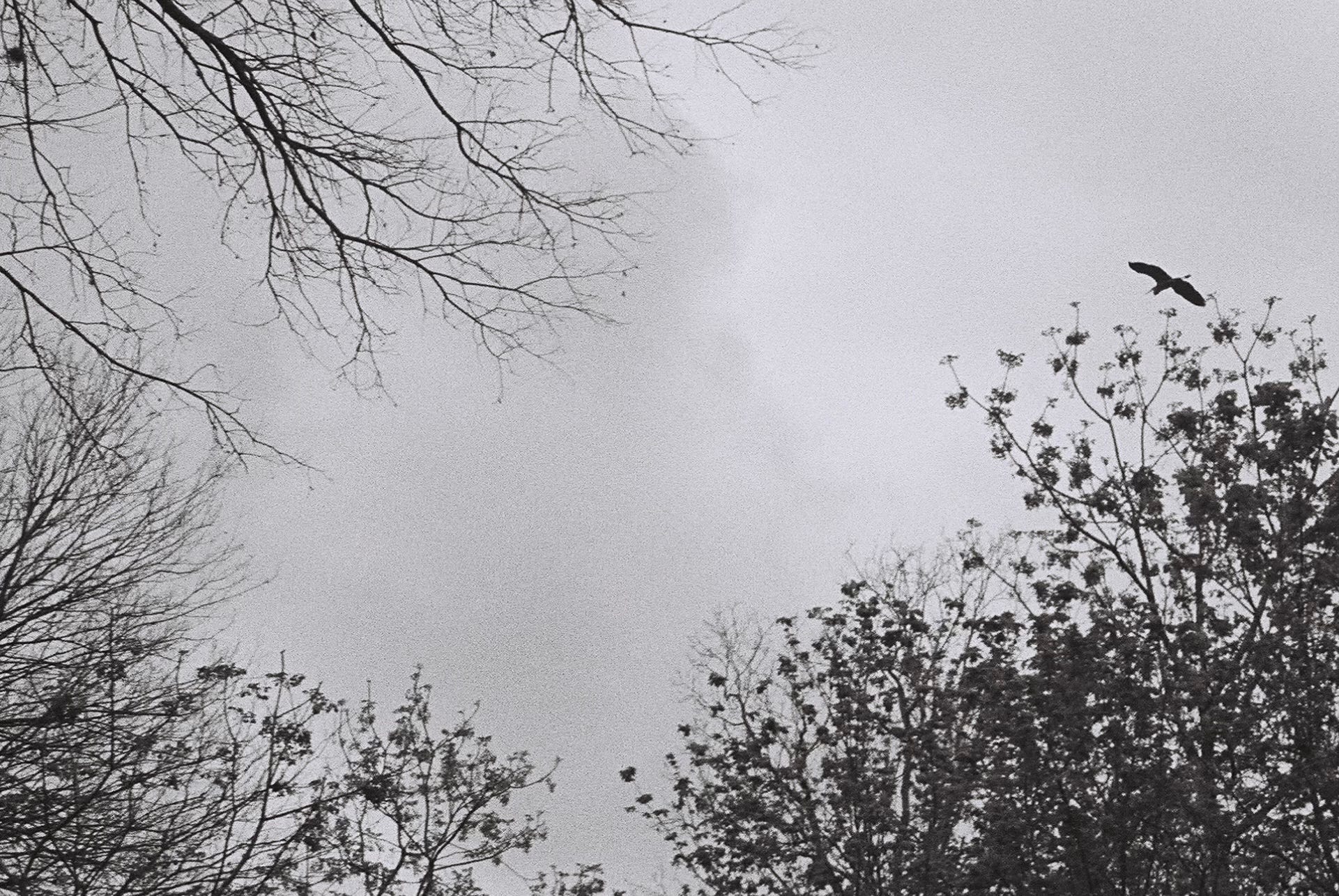
I’d been hearing the chicks in the nests all week, with their tik-tik-tik calls that sound like outboard motors on idle, and I know well the dinosaur skronk of a mature heron taking flight, like the one pictured above flying from that nest to a daytime perch nearby. But I’d never heard this call before, a loud, low-frequency scream in the night repeated over and over, each one two to three seconds long. The closest thing I could think of that I had heard before was the singer for Cannibal Corpse my son and I endured so we could have good seats in the park when Boris took the stage, back when Austin still had Fun Fun Fun.
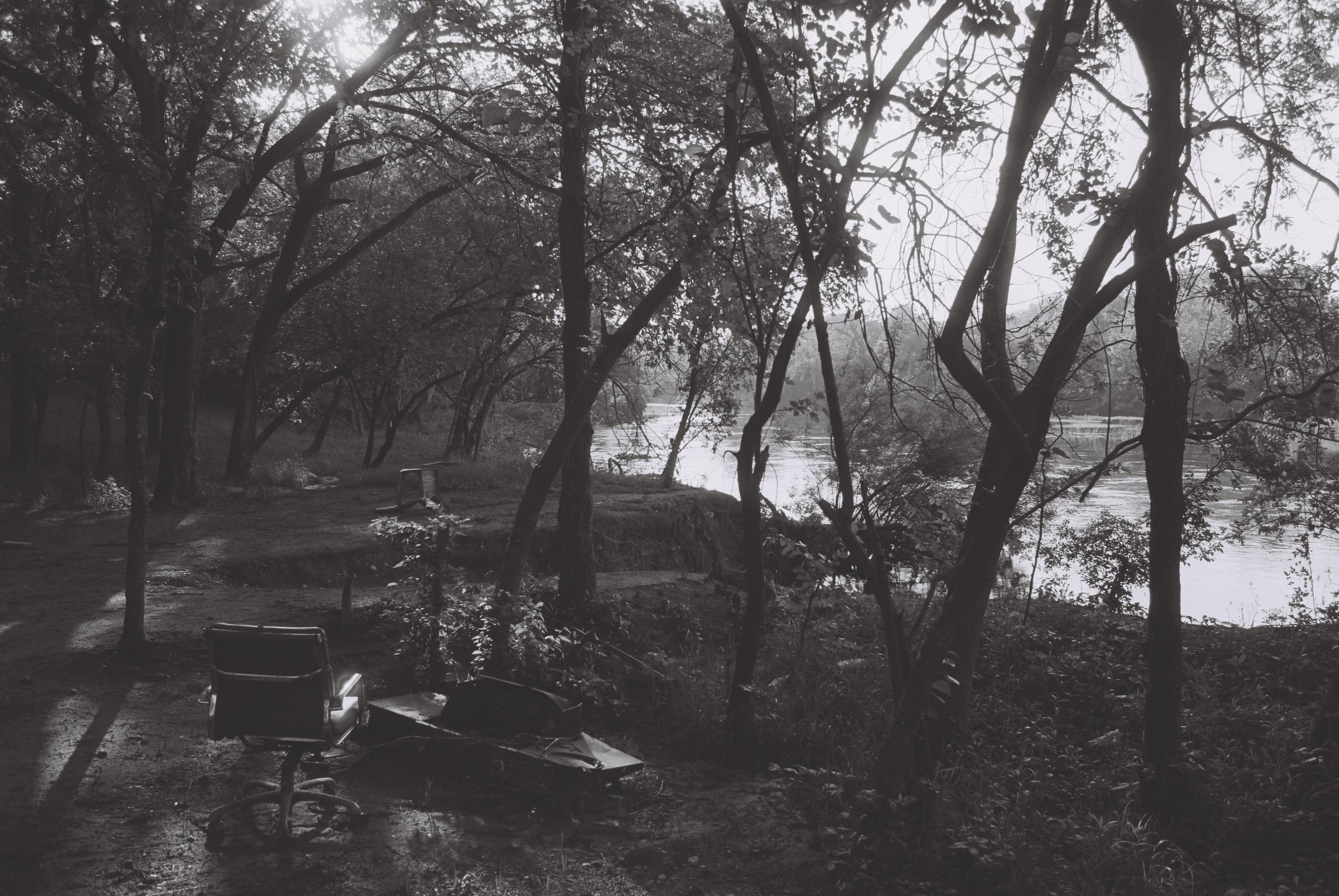
I probably shouldn’t have been surprised, with all the dark pagan energy that was in the air. It was Walpurgisnacht, after all, and thunder, lighting & rain had conquered the supposed “Flower Moon” the almanac apps had promised. I tried to record the sonic tableau with the Voice Memos app on my phone, which sort of worked, but lost the immediacy and volume, and made me realize I could do with some better audio gear to capture the ever-present melange of natural and industrial noises we consider ourselves lucky to be bathed in every day here.
Here’s my recording, with some amateur effort to improve the digital mix. Turns out that heavy bass line you can hear is Austin’s own …And You Will Know Us by the Trail of Dead, which I learned from the dad of one of our daughter’s schoolmates, who was at the show. The song, he added, is “How Near, How Far”:
The guidebooks from the bird nerds at Cornell indicate the vocalization I heard was a threat response. If it was, it went on an awful long time. I wonder if the birds were scared of the storm, dealing with a predator, annoyed with the music, or making their own in conversation with it. I’m just glad they’re there, and I hope they stick around, as this little pocket of urban habitat they found gets increasingly surrounded by human hubbub.
The next morning, it was another May Day, in a country that doesn’t commemorate either variant. Maybe it’s not too late to start.
Some Other Field Recordings
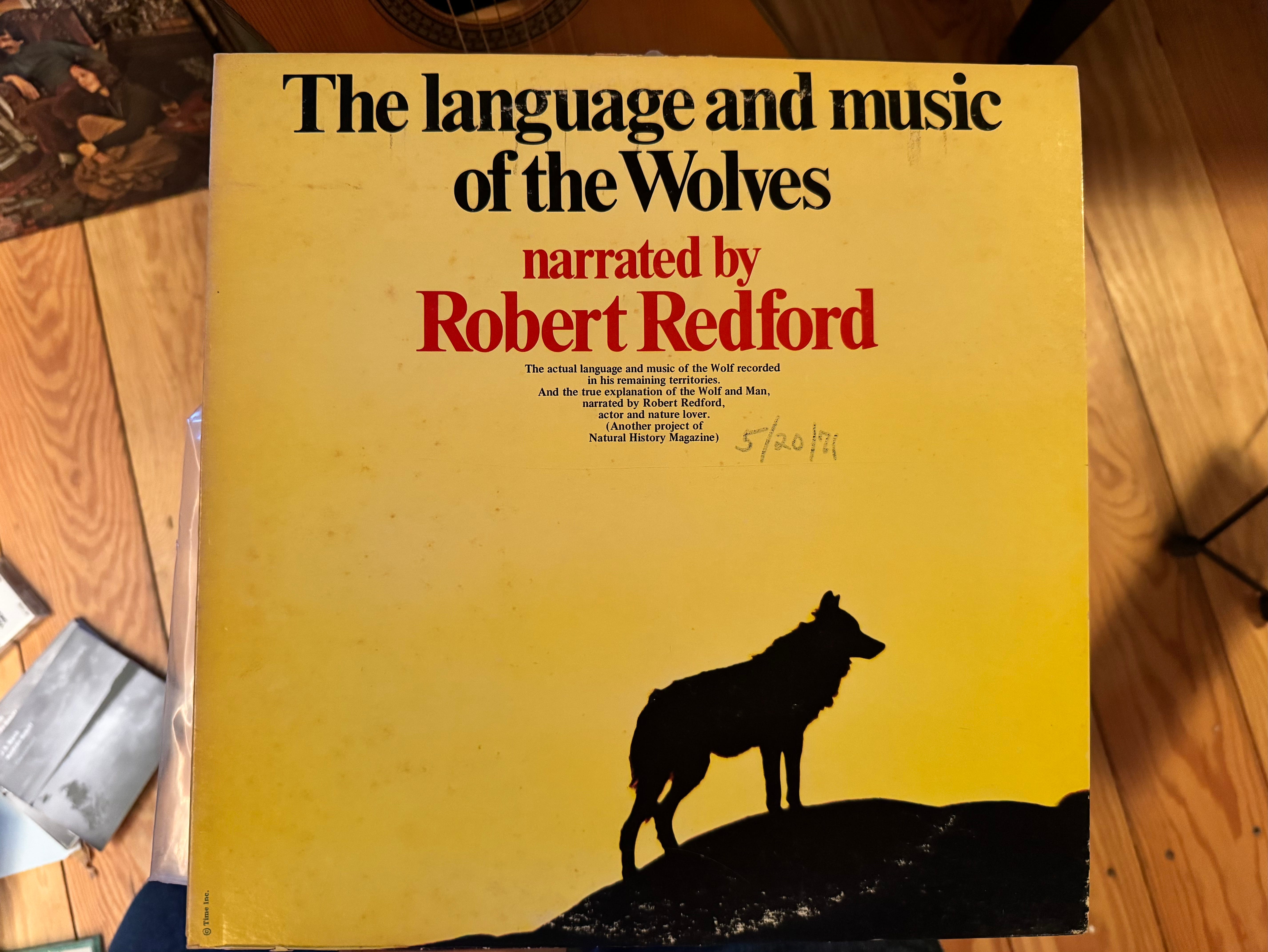
There was a time, when I was around my daughter’s age, that you could buy a commercially released record of field recordings like the one pictured above, manually labeled by its original purchaser as being from May 20, 1971. I bought this the weekend before last, when I stopped into a neighborhood vinyl emporium after finishing the last of my guided nature walks for Fusebox. I’m sorry to report the wolves sound more into it than Robert Redford, who seems to have been phoning that particular gig in, maybe literally. He was a busy guy back then—he spent January through July of 1971 shooting Jeremiah Johnson, and then went right to shooting The Candidate.
I didn’t go into the record store looking for such a disc, but I did go straight to the classical bin in the back, which also had all the unclassifiable ephemera, and ended up walking out with a few other budget bin field recordings records: Jets, Dragsters and Hot Rods Recorded at the Drag Races, Sanford, Maine (1962), the BBC’s British Wild Birds in Stereo (1974) and three of the Environments records from Syntonic Research, Inc. aka Irv Teibel (who spent his last three decades living in Austin) that were popular in the age of multi-platinum whalesong records. Environments 1 includes a warning on the liner notes that Side 2, “Optimum Aviary,” “should only be played at low volume,” and a recommendation that Side 1, “The Psychologically Ultimate Seashore,” be played at 16 ⅔ RPM, a setting my vintage 2004 turntable does not support.
All of this got me thinking about recordings that combine the sounds of wild nature with human music, beyond the beautiful cheese of Martin Denny, who famously realized the bullfrogs around the Shell Bar he was playing in Honolulu made his band sound cooler, so added an entire jungle’s worth of animal song on some of his tracks (aided by the imitative gifts of percussionist Augie Colon) and invented a whole genre of Exotica. The most interesting contemporary artist I am familiar with who uses field recordings as a core instrument for composition is Lawrence English from Brisbane, Australia, who I had the good fortune to hear at No Idea Festival a few years ago—check out his work here.
Wikipedia has a pretty great entry on the metal band death growl, which may lead you to vocal coach Melissa Cross’s instructional video on The Zen of Screaming.

*Thanks to BLK Vinyl on E. 6th for all the great stuff!
Continuing the early 70s theme, last week I checked out a copy of James Dickey’s Deliverance (1970) from APL, research of a sort for a short fiction project, and the opening is so good in its depiction of the comforts and existential ennui of middle class American life under postwar capitalism. A reminder to look for more novels by poets. Now I’m at the part where two of the guys are in the car loaded with gear, talking about what they will do after the collapse of civilization as they drive to the whitewater put-in deep in the hills.
And continuing the heavy metal theme, researchers in Australia this week published their study regarding the remarkable ways in which scorpions have evolved to reinforce the tissues of their bodily weapons—tail stingers and claws—with zinc, manganese and iron. Yes, they titled their paper “Heavy Metal Scorpions.” Hard not to love a paragraph like this monster:
The predominant incorporation of transition metals during sclerotization, even in the earliest stages of life, has been shown as a driver of hardness within the cuticle of chelicerates. Offering improved biomechanical properties, the enhanced material allows for the development of sharper, damage-resistant weapons such as fangs, aculei (needle-like envenoming structure), ovipositors (tube structure to lay eggs) and chelae. Termed ‘heavy element biomaterials’ or HEBs, zinc (Zn), manganese (Mn) and iron (Fe) are the most frequently observed elements appearing in enriched cuticle as metal–ligand coordinated bonds.
This Instagrammer pretty well captures the feeling of encountering heron growls in the wild. For a more conventional set of recordings, here’s what they have at Cornell.
The May 14 issue of The New York Review of Books that arrived in Friday’s mail has an interesting Rosa Lyster piece, “This Bitter Earth,” on Caroline Tracey’s Salt Lakes: An Unnatural History, a new book forthcoming from Norton about the ecological importance of salt lakes and the significance of their worldwide decline.
In Ukraine (thanks to Field Notes friend and human web crawler Bruce Sterling, in what sounds like a detail from one of his Leggy Starlitz stories), they’ve started a campaign to 3-D print trays to catch the condensation from air-conditioning units to provide more water for birds.
They found a coatimundi north of San Antonio Monday, far beyond its normal range, evidently lost.
And speaking of getting lost, if you can believe The New York Times (I say sort of), they’re debating whether it’s safe to walk from the City to Met Life Stadium in Rutherford, NJ to catch a World Cup game. Count me in for pedestrian adventures on turnpike frontage roads through Meadowlands swamps.
Etymological crypto-nugget of the week, via the amazing Etymonline:
1550s, whobub “confused noise,” of uncertain origin; according to OED generally believed to be of Irish origin, perhaps from Gaelic ub!, expression of aversion or contempt, or Old Irish battle cry abu, from buide “victory.”
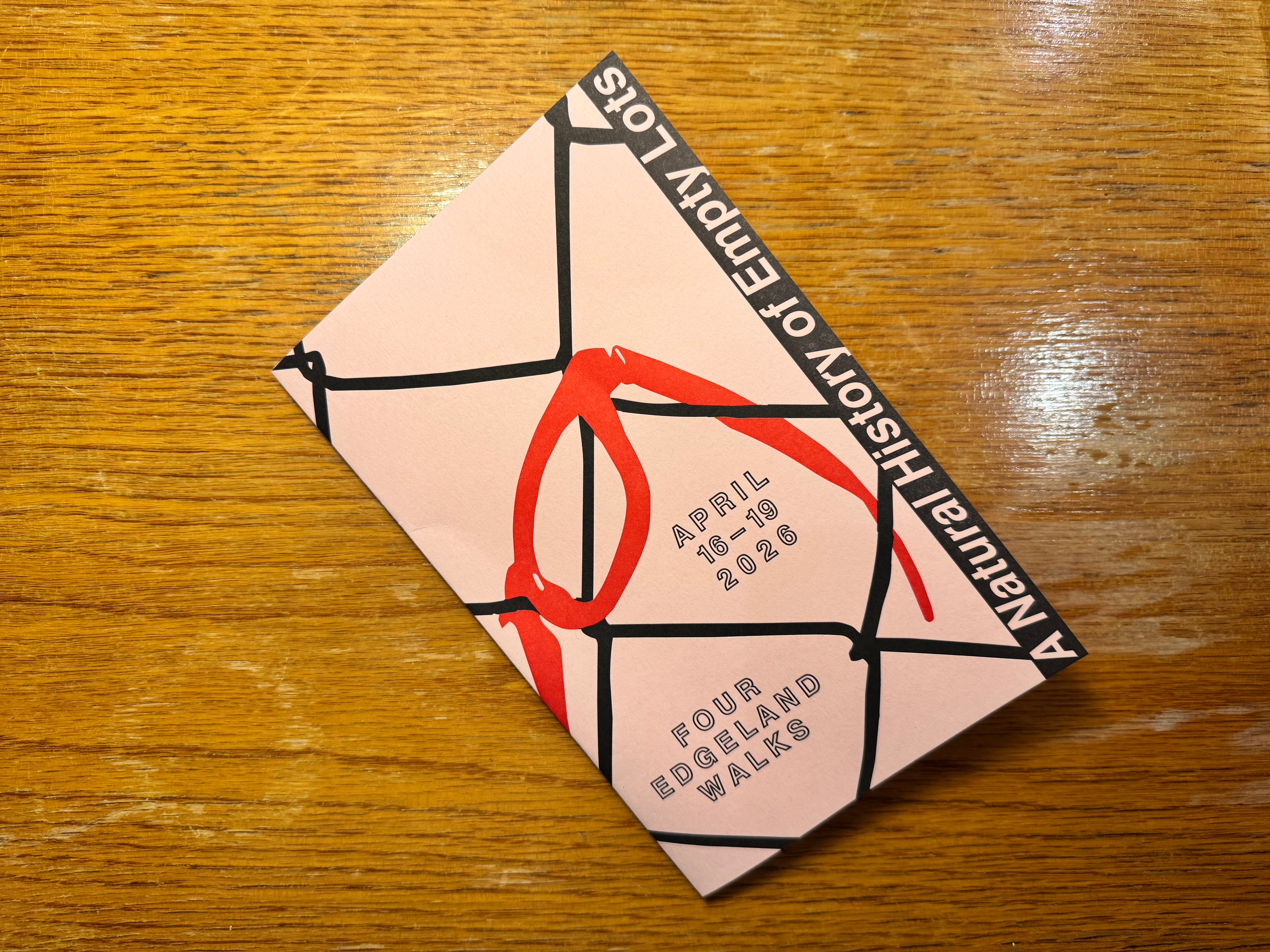
As mentioned last week, I have around three-dozen of the 200 limited edition zines we did for the Texas Book Festival x Fusebox guided edgeland walks leftover, with four photo-illustrated pieces about the sites of the walks in a beautiful letterpress cover printed by Koch Printing in Austin. I am making them available for sale to Field Notes readers for $15, all of the proceeds of which after postage will go as a charitable donation to Fusebox. If you’re interested, email me at chris-at-christopherbrown-dot-com. And if you already emailed me, I have your name on the list and will follow up by reply email with the details shortly.
I also am keeping a running mailing list for the next series of walks, so ping me if you’d like to be added to that.
Thanks for all the rain we got this week in Austin, just in time for May Day. My daughter and I found some juicy-looking eggs on the leaves of our front yard mesquite during one of the dry moments, and have yet to figure out what creature laid them.

Have a great week.
This site is amazing. It has Lawrence English referenced.
https://everynoise.com/engenremap-fieldrecording.html
I'm intrigued by whatever it is you're doing in Houston....I have been looking around the Ship Channel and Pasadena for vantage points, and am working on a photo essay on Brays, Sims, and Buffalo Bayous. Have you run across these folks? Texas Oil: Landscape of an Industry | The Center for Land Use Interpretation