

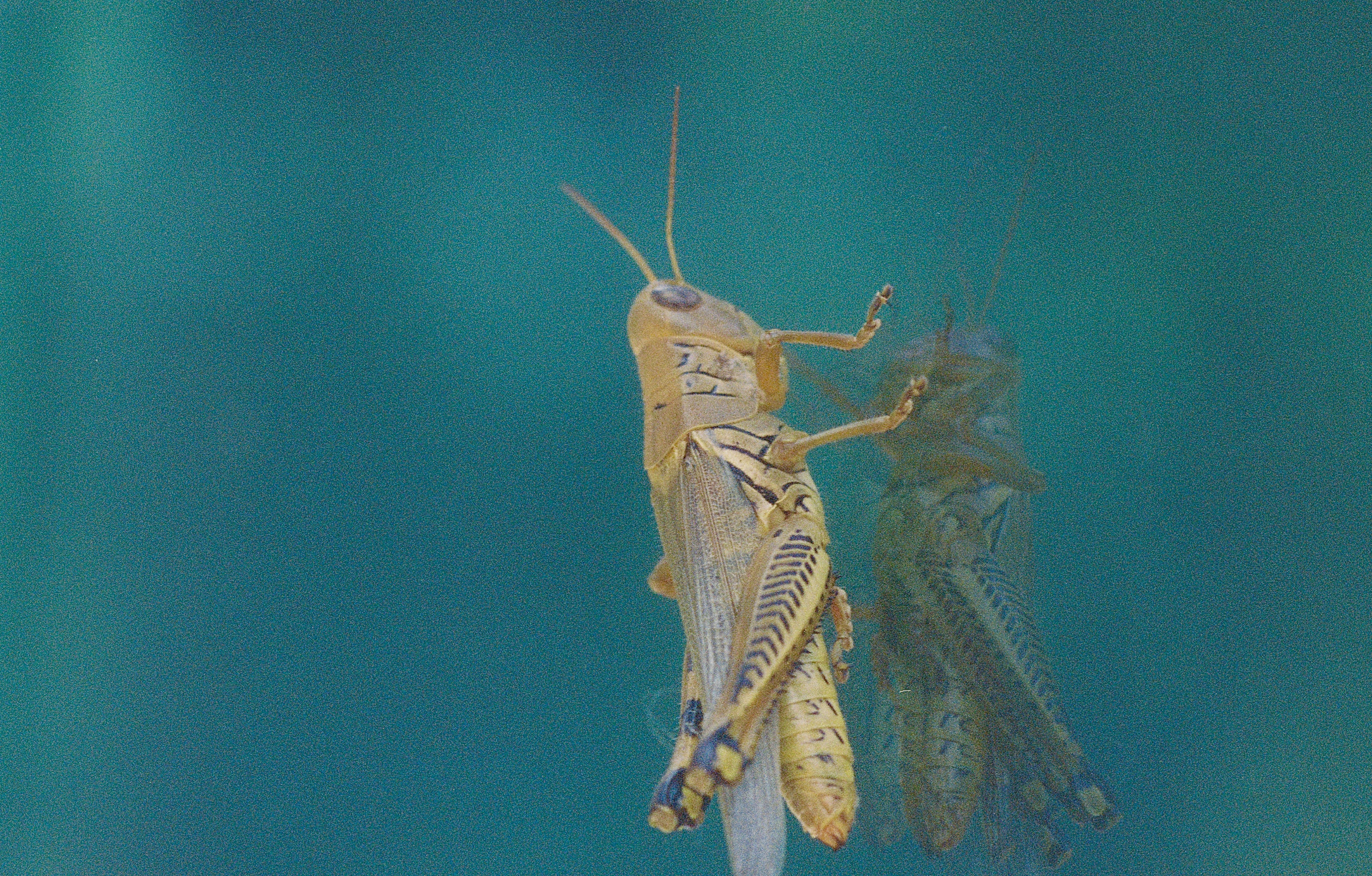
“After the grasshoppers came in 1872, Calvin moved to Missouri.”
I read that all-American sentence early on Independence Day, going through a file of family history material my dad had collected, which I recently discovered while working to clear out my mom’s storage locker. Most of the papers were things Dad had gotten from his mom, and most of those related to her brother’s application for admission to the Sons of the American Revolution. So I ended up starting off the 250th anniversary of the USA unexpectedly reading about a 5x-great grandfather I had never heard of named James McCann, who fought as a 16-year-old private and fifer in the rebellion against the British, seeing action in the Battles of Brooklyn & Brandywine before getting discharged at Valley Forge. But I found myself more curious about the grasshoppers of 1872 that stymied the brother of an ancestor on a different branch.
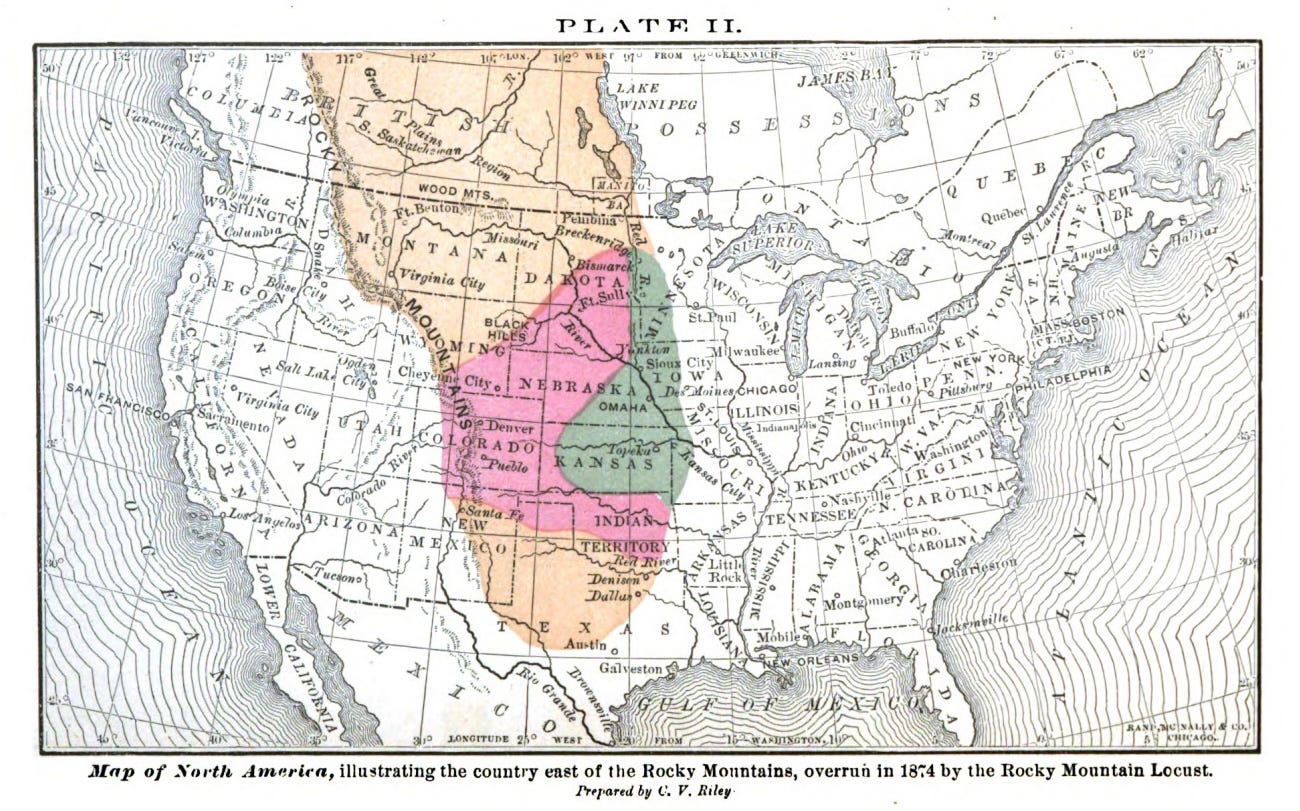
Turns out the 1872 swarm was just a localized warm-up for what would come in 1874, when hordes of locusts swarmed over the Great Plains, blocking out the sun for hours as they flew through, covering the fields in a thick carpet of life when they alighted, and eating everything in sight—not just the crops, but also the wool of the sheep, harnesses on the horses, and paint on the wagons. I don’t know what happened to Calvin, but by the turn of the century in which he was born—basically a single generation of settlement—the native Rocky Mountain locusts that had sent him packing were extinct.
I’ve been thinking about the idea of family history as a species of natural history, exploring the diverse narratives of migration, colonization and settlement that are such an integral but under-considered part of our literary heritage and identities. Those stories often contain rich descriptions of the landscapes and other life people found as they traveled and resettled, and reveal much about our relationship with the natural world, and our own unsettled nature as nomads in our bones. Looking at the past is also an important element of divining emergent futures.
When I visited Central Iowa over Memorial Day weekend to take care of some present-tense family business, I tried to paddle into the past and the future at the same time, on one of the first of the urban wilderness excursions I am doing for the new book, which aims to mix some fresh field research in with library research and personal history. On an earlier trip in March, scouting industrial Houston, I got the idea that the easiest way to invert our normal way of experiencing the most intense parts of our urbanized landscape would be by water. Which got me thinking I had finally found a use for a packraft that would justify me buying one.
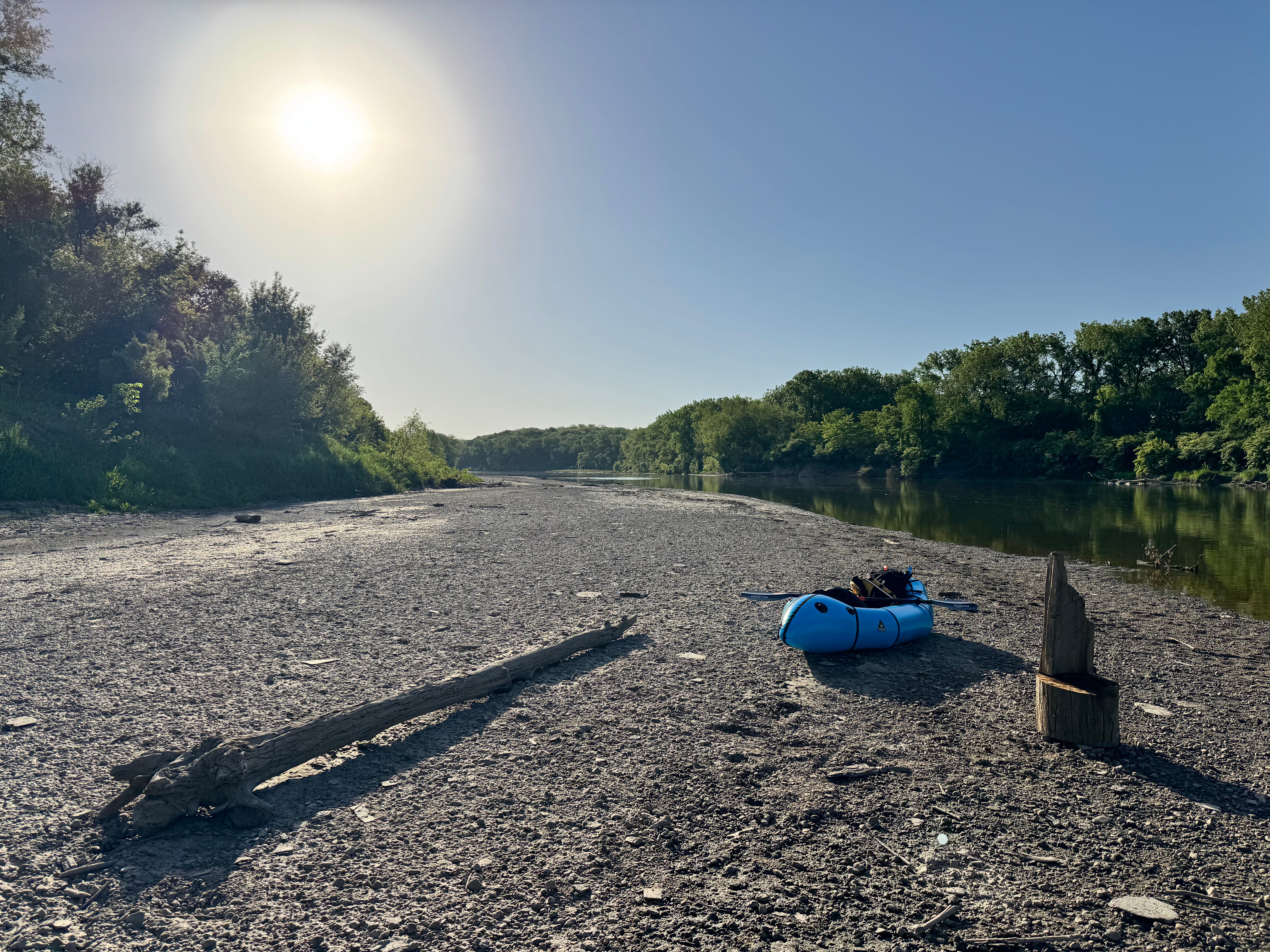
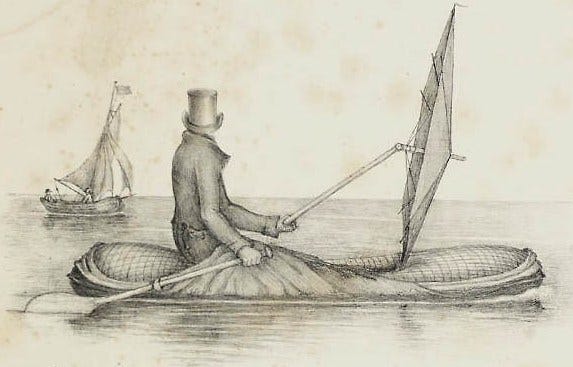
I first learned about packrafts using them in their native habitat: the backcountry of the Northwest. Visiting Denali with my son to celebrate his high school graduation, we worked our way up the Maclaren River on foot with a guide, until we got to the glacier at the base of the mountain, where we inflated the boats we had carried in our packs and paddled back to the lodge. A packraft is a highly portable kayak-style watercraft that packs down smaller than a sleeping roll, weighs less than five pounds, and is easily inflated without a pump. It’s designed for fast water, but does fine on slow. The model I got, the Alpacka Caribou, is designed to let you strap your bike across the bow. It’s a cool tool for changing the way you move through the world, and one with deep roots dating back at least as far as the Halkett boat—an 1840s inflatable made of rubber-impregnated cloth that, when deflated, was designed to be worn as a cloak.
The river I aimed to paddle was not pristine Arctic waters, but one of the nastiest on the continent, and the waterway I grew up next to: the Raccoon River above its urban confluence with the Des Moines, at a point after it has passed more than 750 family farms that fill the watershed with lethal agrichemicals and the filth from hog confinement facilities. The Raccoon is the river that supplies Des Moines’ drinking water, in a state that relies on voluntary action by farmers to prevent pollution. To try to clean it, the Des Moines Water Works built one of the world’s largest nitrate removal facilities at the ratepayers’ expense in 1991, and then doubled its size in 2017. The editors of one of the small town papers upriver won a Pulitzer that year for their investigative editorials on the contamination of the Raccoon and the rest of Iowa’s water table by unregulated row crop production. A decade later, the safety of the water remains uncertain.
As I got ready to get in that water, what had sounded like a cool idea on paper when crafting a book proposal started to feel a little more treacherous. Especially when I realized that the self-bailing design of the boat—with two rows of silver dollar-sized holes on the bottom to keep you buoyant in whitewater—meant the water would soak your butt, as I learned testing it out on the urban Colorado in our current backyard. I called Alpacka, wondering if I might need a different solution, and they gave me the pro tip used by the Minnesota hunters: cover up the self-bailing holes with heavy-duty tape. When I got to my suburban hotel in West Des Moines, and saw there was an REI around the corner, I stopped in to ask if any of the staff had experience paddling the Raccoon, and it was evident they all had better, safer ideas.
The hotel had a coffee table book about crop circles prominently displayed in the lobby lounge, which seemed like a good omen to navigate secret pathways through the Corn Belt.
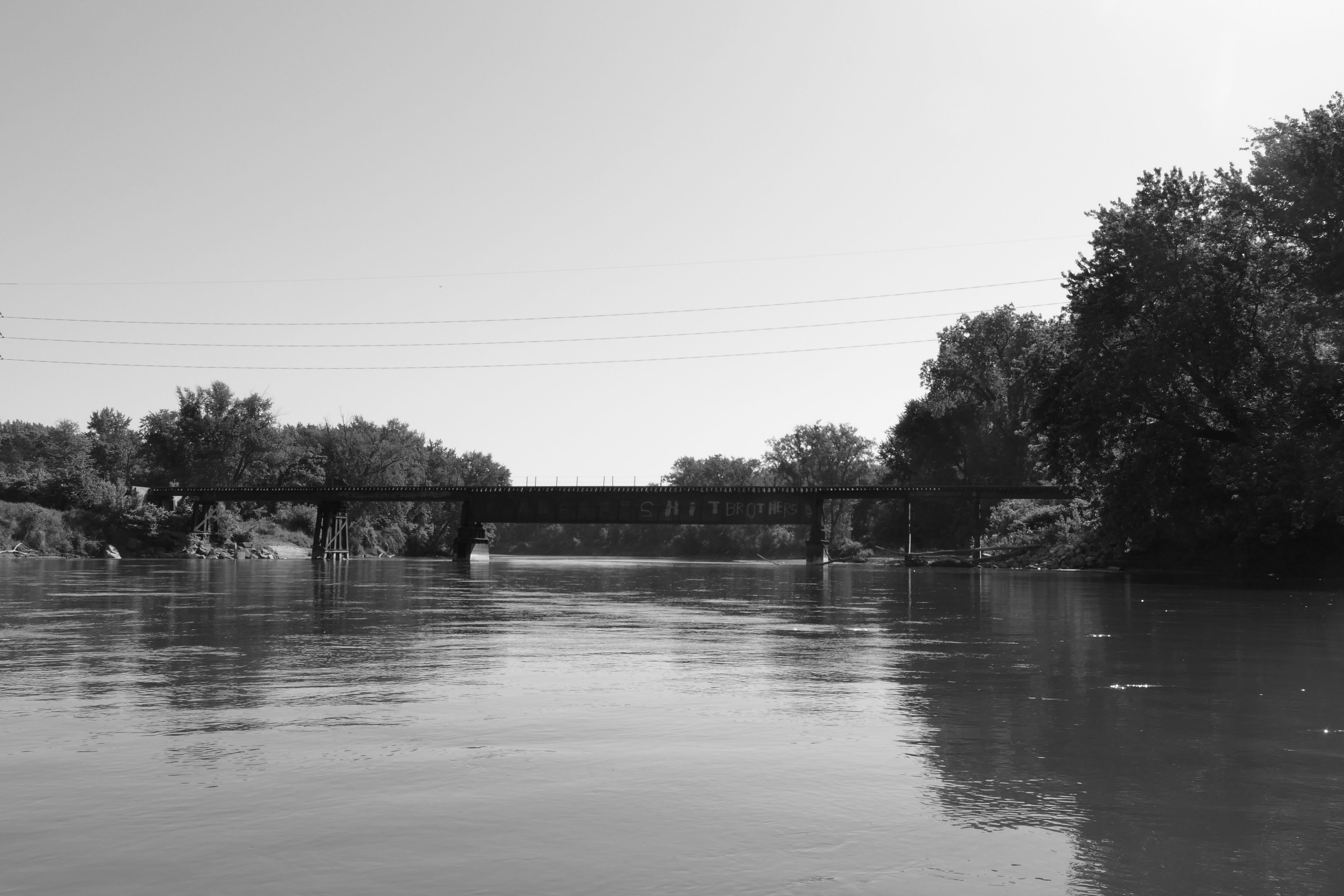
For my put-in, I found a spot by an oxbow lake at the western edge of town that was an industrial site when I was a kid but later acquired as municipal parkland that I explored extensively while living there for a couple of years in my early 30s when it was still raw. The trail around the lake intersected with the river at one spot not too far in. The water looked clean enough to the naked eye, so I inflated my raft while a few joggers and dog walkers passed by, and joined the current.
It was mid-May, late spring, and the river was full. Not dangerously so, but fast enough that if I stopped paddling for even a second (like to take a picture or jot some notes), the current would start the boat spinning in unexpected directions. Only after I got a half-mile in did I start to notice the chunks of brown foam floating on the surface. But there were fish, too, jumping here and there, and herons, egrets, raptors, kingfishers, and huge quantities of geese and tucks with their adorable younglings. I knew exactly where I was, almost block for block, and how intense were some of the nearby land uses as I paddled, but the only real signs of urbanity for the first couple of hours were the low-flying jets on final approach to the municipal airport. The urban stretch of the river, counterintuitively, is the wildest, with several stretches of old growth forest on its banks that have survived intact, including an exceptionally beautiful oak savanna—once the dominant ecosystem of that region, and now one of the world’s rarest.
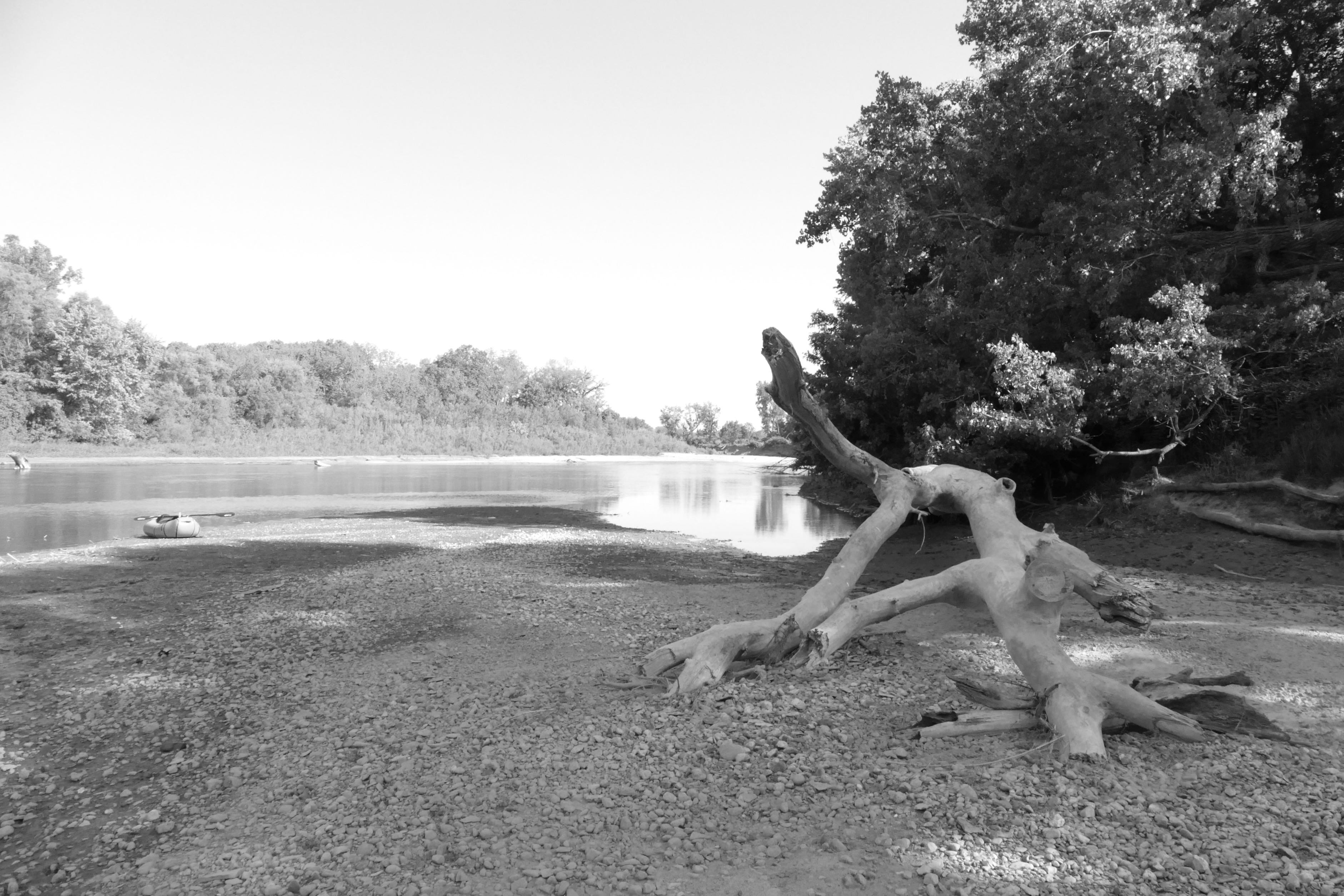
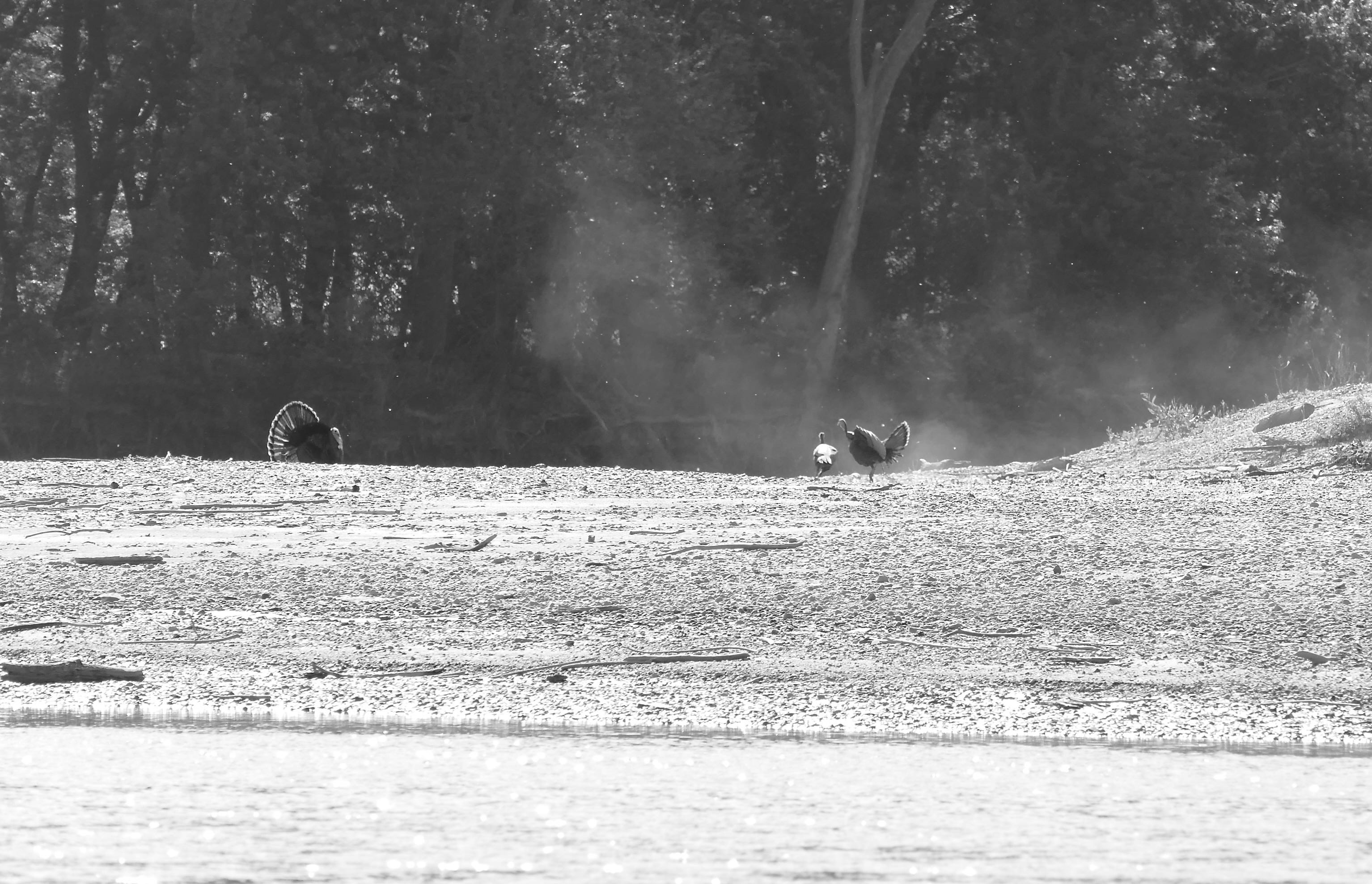
Around the halfway point I came upon a scene of wild turkeys dusting up the beach with what looked to be some kind of courtship behaviors—a big tom with its tail feathers fully fanned while the females seemed to be fighting.
In the spots where the banks were most vertically eroded, the swallows’ nests dotted the clay, and the birds buzzed around beelike. The same was true of the bridge, when I finally made it to 63rd Street, which marks the boundary between Des Moines and West Des Moines, densely colonized with mud nests.
Until I got to the Water Works Park and its popular bike trails, the only other humans I saw were a man and a woman fishing right by that bridge. A half-hour later, within sight of downtown, warnings of non-navigable dams got me to take out a little earlier than I had hoped. The towers of the life, property & casualty insurance companies that dominate the economy up there loomed in the near distance. I wonder if they insure against the dangers of drinking from that river, and if their actuaries are busy mapping new uninsurable zones.

That afternoon, after showering my raft in the hotel room, I drove two counties over to seek out the graves of my ancestors, starting with the grandson of the Revolutionary War fifer who had moved out there from Ohio in the 1840s, staked out the county seat, started a newspaper and a lumber yard, and fought as a Captain for the Union in the Civil War. On the plane up I had found a scan of an old local history book that included a passage about that ancestor crossing the same river I had paddled, right around the bridge where I saw the swallow nests. It was an anecdote of him telling a joke to a friend in the middle of a stressful situation—getting draft animals across that fast water—which gave him more life in my mind than the picture we had of him on the wall growing up, stiffly wearing what we were told was his Civil War uniform but in fact was some weird Masonic outfit.
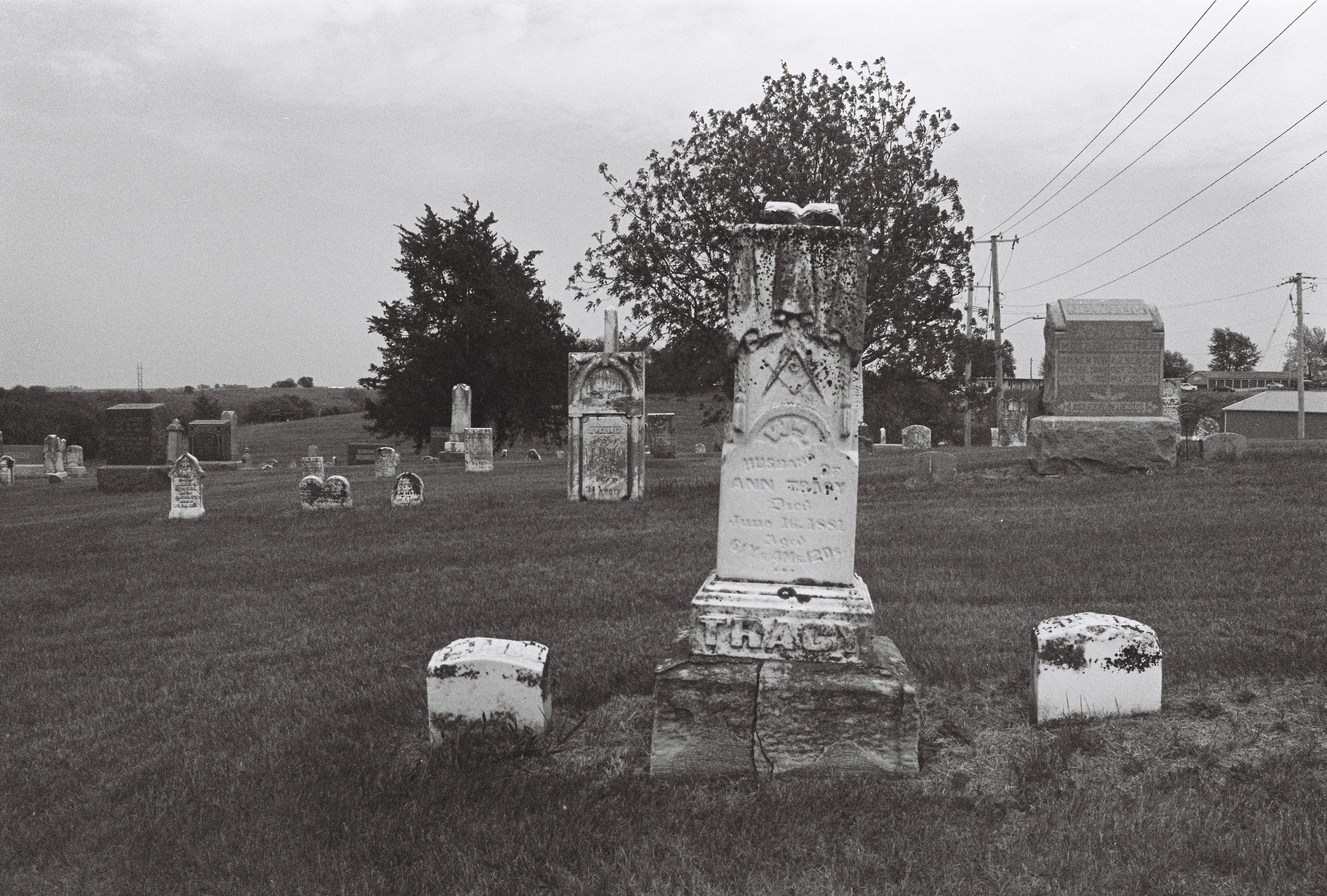
I remembered driving out there as a very young boy with my dad and grandma, over the rolling hills on the two-lane highway, and visiting the gravesites. There’s something primal about those sites of ancestor burial—Fukuyama contends such places are the ritual cores of our polities, which makes sense, even as one considers how much we have lost that connection in the modern era. I spotted it right as I rolled into town, on the hill to the right past a row of cherry pickers for sale. The town itself, like most rural county seats in Iowa these days, seemed past its prime. And the pioneer graveyard, when I found my way up there, was a little creepy. I found my people fairly quickly, without any guide, as if by some internal homing, and was moved by some of the messages the tombstones conveyed—little clues to personality—and surprised by the revelation of just how many dead children there were, taken by disease at tender ages.
Only when I was headed out did I notice how they were erasing the American flag on the side of the water tower with gray primer. I didn’t ask what they were going to replace it with. Maybe one of the witchy barn hexes I saw north of Panora, on a road called Utopia Avenue.
Those old highways really let you see the land, and imagine what it must have looked like before we carved it up. It was interesting to see and think about how three to four generations had made rich lives in that little town from the 1840s to the 1940s, but how anomalous that intergenerational stability was, and how far flung and unknown to each other we are now. Even the name of that progenitor, McCann—a tribal name, “son of the wolf cub,” borne by the descendant of Celts who migrated to the Emerald Isle, and who himself crossed the Atlantic to make a new life as a teen. It made me think about how unsettled we all really are, even as we have grossly erased what was here before.
The waters of the American Heartland are fouled, more than anything, because we figured out how to keep the bugs off the crops. When you stop to think how much life we’ve erased from that fertile region in the 150 years since we first settled it, you might get a different idea who the real swarm is. Even as the wild ecologies holding out in the margins help you see how easy it could be to bring back the balance, with changes as simple as keeping just 10% of the land fallow.
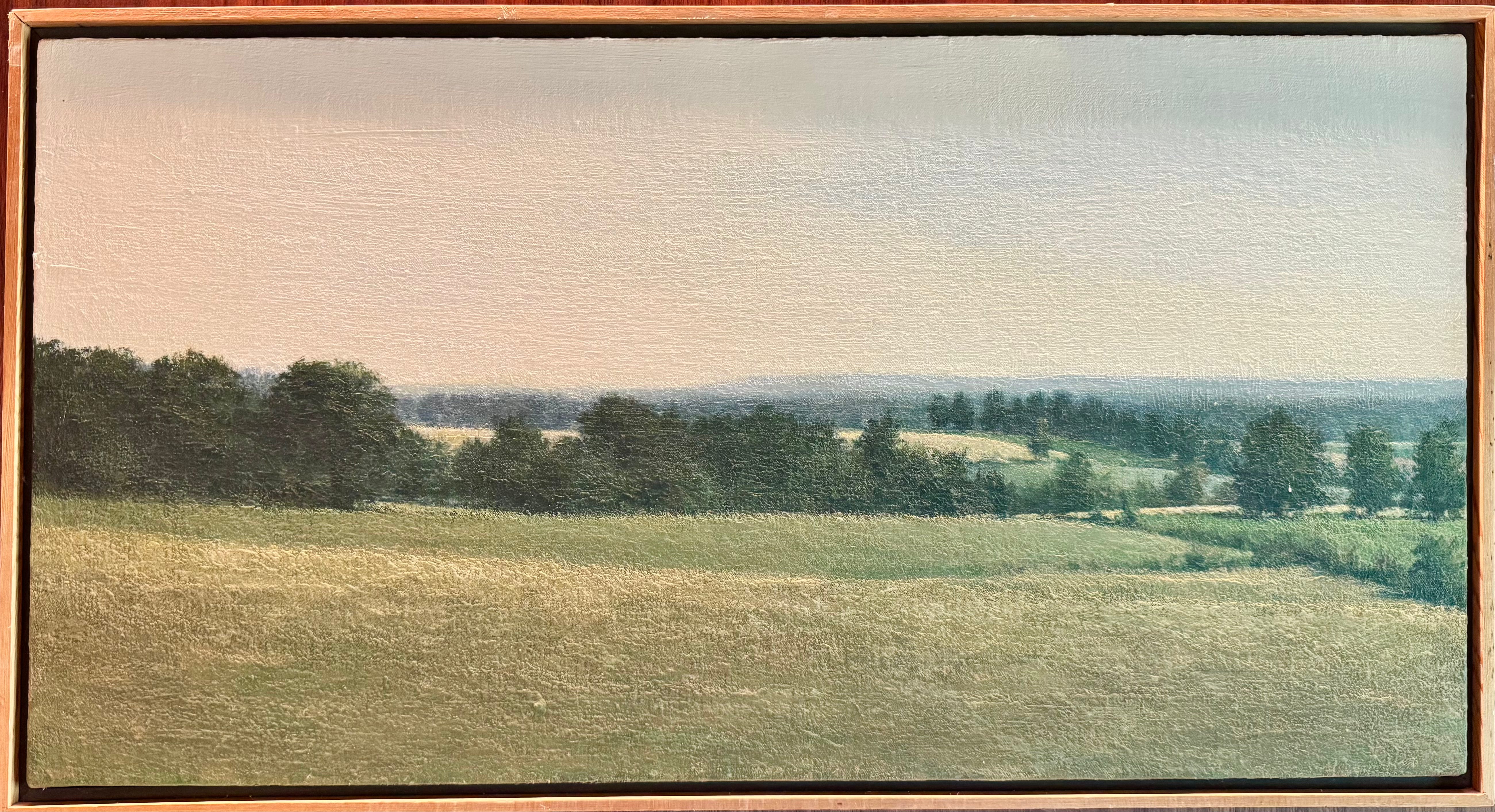
The newest consumers of the waters of the Midwest are a different sort of creature, one that may have a higher tolerance for nitrates. The next morning, a friend and I paid a visit to a data center about to come on line, a fresh addition to the cluster where Microsoft helped incubate and train the early versions of GPT, right there by the Raccoon River and one of the oak savanna preserves. More on that part of the trip in a future installment.
Long weekend roundup
As reported here earlier, our neighbors just downriver are confronting the massive new development planned for the “Dog’s Head” region of Austin’s Eastern Crescent they have made their home—abused industrial lands along the Colorado just past the city limits, now proposed to be annexed in a 45-year tax abatement agreement that already passed the City Council without any prior hearings or discussion. Jim Canning has put together a great video showing what’s at stake in this debate, as the County Commissioners consider whether to support the tax abatement agreement:
More on the Rocky Mountain locust swarms of the 1870s, via Wikipedia:
Compared to previous infestations in the region, the 1874 plague was significantly more damaging. The invasion coincided with a record drought in the Midwest and Great Plains, which induced the grasshoppers (estimated at 120 billion to 12.5 trillion) to not only thrive but also to swarm when local vegetation was decimated. The arriving locusts would pile up to over a foot high and ate crops, trees, leaves, grass, wool off sheep, harnesses on horses, paint from wagons, and pitchfork handles.
The locusts would eat for several days from fields and trees and in some instances also ate food inside the farmers’ homes before they moved on. Carpets and clothes were damaged by the locusts in the process. The locust excrement and carcasses polluted ponds and streams. Train tracks “slick with grasshopper guts” caused trains to lose traction, according to the book It Happened in Nebraska.
A Kansas pioneer was quoted as saying, “They looked like a great, white glistening cloud, for their wings caught the sunshine on them and made them look like a cloud of white vapor.” Another Kansas settler said, “I never saw such a sight before. This morning, as we looked up toward the sun, we could see millions in the air. They looked like snowflakes.” Nebraska historian Addison E. Sheldon described the scene: “In a clear, hot July day a haze came over the sun. The haze deepened into a gray cloud. Suddenly the cloud resolved itself into billions of gray grasshoppers sweeping down upon the earth. The vibration of their wings filled the ear with a roaring sound like a rushing storm. As far as the eye could reach in every direction the air was filled with them. Where they alighted, they covered the ground like a heavy crawling carpet.” Farmers tried killing the locusts with fire and exploding gunpowder, but in one case the mass of locusts smothered the flames. Other unsuccessful efforts to stop the plague included covering fields with sheets and smoking grasshoppers away from crops and into water and oil-filled ditches to drown them. A device called a hopperdozer was invented to fight grasshoppers: its scraper was coated with coal tar and pulled by horses. Dragged against the wind, young locusts would be blown into the tar, but it only worked on flat fields.
You can get your small town muckraking from the Storm Lake Times Pilot and the Cullen family that runs it.
This week’s research reading has been Adam Hanieh’s Crude Capitalism: Oil, Corporate Power, and the Making of the World Market, an excellent history of the global oil business published in 2024 by Verso, which is helping me better understand the deep context of the petrochemical infrastructure we’re surrounded with in Texas, and why we seem to have spent much of my adult life fighting wars to control access to oil.
To see you off, here’s a remarkable vignette of something cool the poet and bookseller C. Rees showed me this week in one of our favorite Austin edgelands: a bee hive made from a gigantic old truck tire left behind by the operators of an abandoned aggregate mine. I need to better learn to identify the species of bees.
Next installment I aim to share some notes from my paddle into the salt marshes of the Metaverse—the waters of south San Francisco Bay near the headquarters of the company formerly known as Facebook. Stay cool, and thanks for reading.
Yup - “When you stop to think how much life we’ve erased from that fertile region in the 150 years since we first settled it, you might get a different idea who the real swarm is.”
I would like more of these paddle excursions, your words flow differently. More languid, in a positively refreshing way. n WASP parallels, i once looked at my mothers expired membership in Daughters of the American Revolution, papers with genealogy; a Wooster in upstate NY served, but over generations marrying in other Scots kin moved west; PA, Ohio, and some branch even to Iowa . Rather rootless, new come looters, already detached from belonging. Dispossessed.