

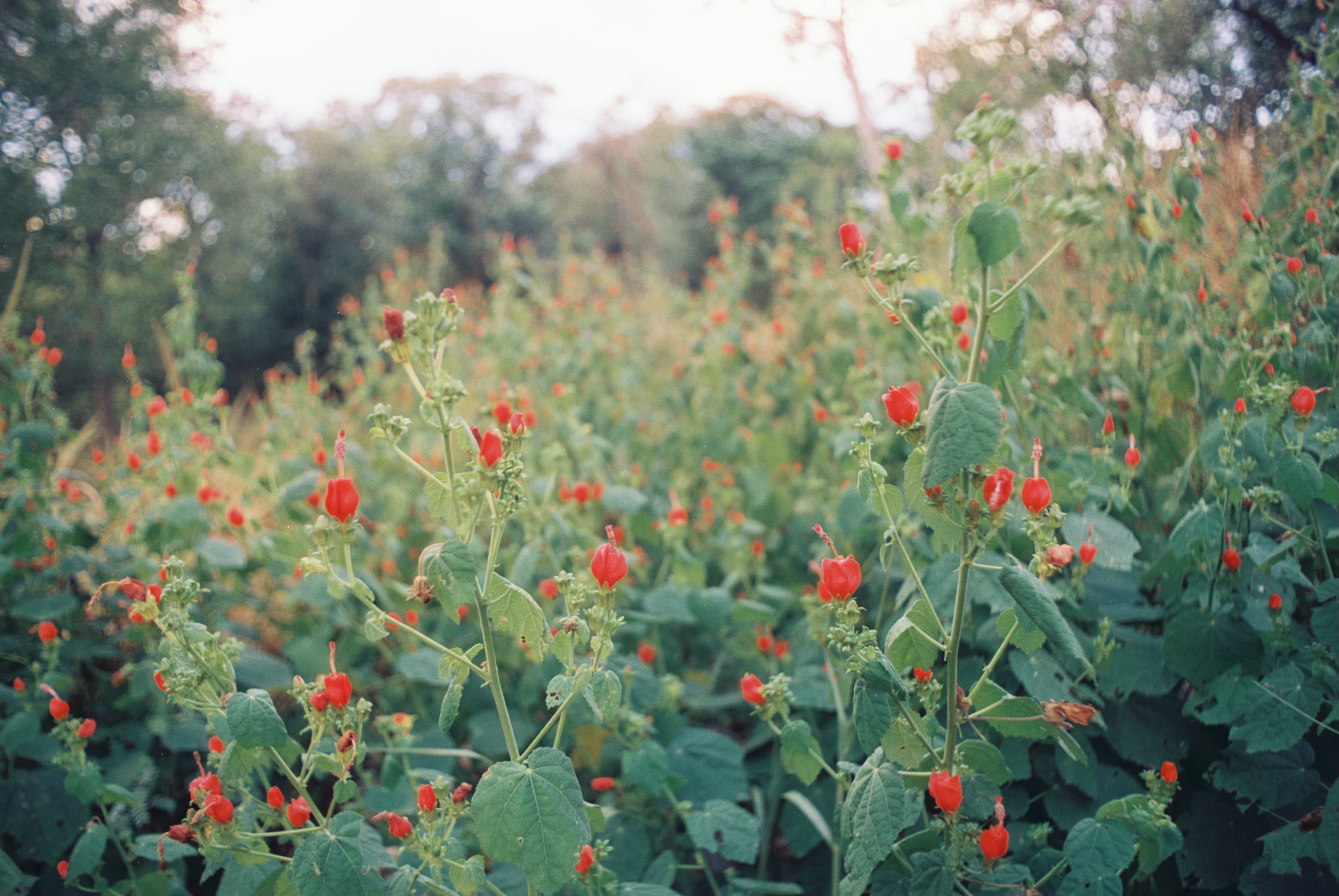
The last flowers of late summer are mostly gone now, after a brutally dry end of the season, working on two months of almost no measurable rain here in Austin. The urban forest in the floodplain behind our home feels dangerously dry, maybe even on the verge of some kind of collapse. But last week’s beautiful harvest moon finally brought a break in the temperatures, and permission for the hackberries and pecans to begin to drop their leaves.
I suppose that’s why, as I hung out with my 85-year-old mom this week during her recovery from oral surgery, I found myself reading an article in the paywall-obsessed Financial Times about how the battle over leaf blowers became a front line in the culture wars, which took me down a rabbit hole into the invisible literature of landscape management marketing copy.
“Dominate any cleanup job with the industry’s highest blow force.” So reads the tag line for the RedMax EBZ9000, one of the newest and perhaps one of the last in a line of gas-powered leaf blowers, in this case a “frame-mounted throttle” that lets you carry the oversized engine and gas tank on your back while you transform your right arm with a low-slung machine extension whose Freudian echoes don’t need the embellishment of the copywriters (though I suppose the promises about “25% longer run-time than the competition” and “decreased operator fatigue” don’t hurt).

In my youth as a Midwestern lawn boy making comic book money doing the work my dad and our neighbors were happy to outsource for cheap, the company that now markets its professional-grade outdoor power products under the macho brand “RedMax” went by Husqvarna, which I always figured was just the name of some chainsaw-loving guy from Minnesota, the state to our north. Turns out it’s a Swedish industrial conglomerate that originated as a 17th century rifle workshop sponsored by the sovereign.
I never used a leaf blower in all those years, not even when I became a suburban homeowner dad myself. Even when I was trapped with the absurd all-American labor of cleaning up the autumn leaves, my reflexive aversion to power tools and their noise and alienation from the object kept me seeking the hand-blistered zen of the rake. When I was little, and the autumns were cool and rainy, after Dad got the leaves into piles he would burn them. By the time I hit my 30s most municipalities, including all the towns I lived in from Des Moines to D.C. to Austin, had implemented burn bans and requirements that all leaves instead be put into giant, government-issue paper bags for collection, a Sisyphean task that helped one see how against nature the whole exercise is. So sometime during the peak of the Global War on Terror I became a conscientious objector in the war on leaves, and life has been better ever since.
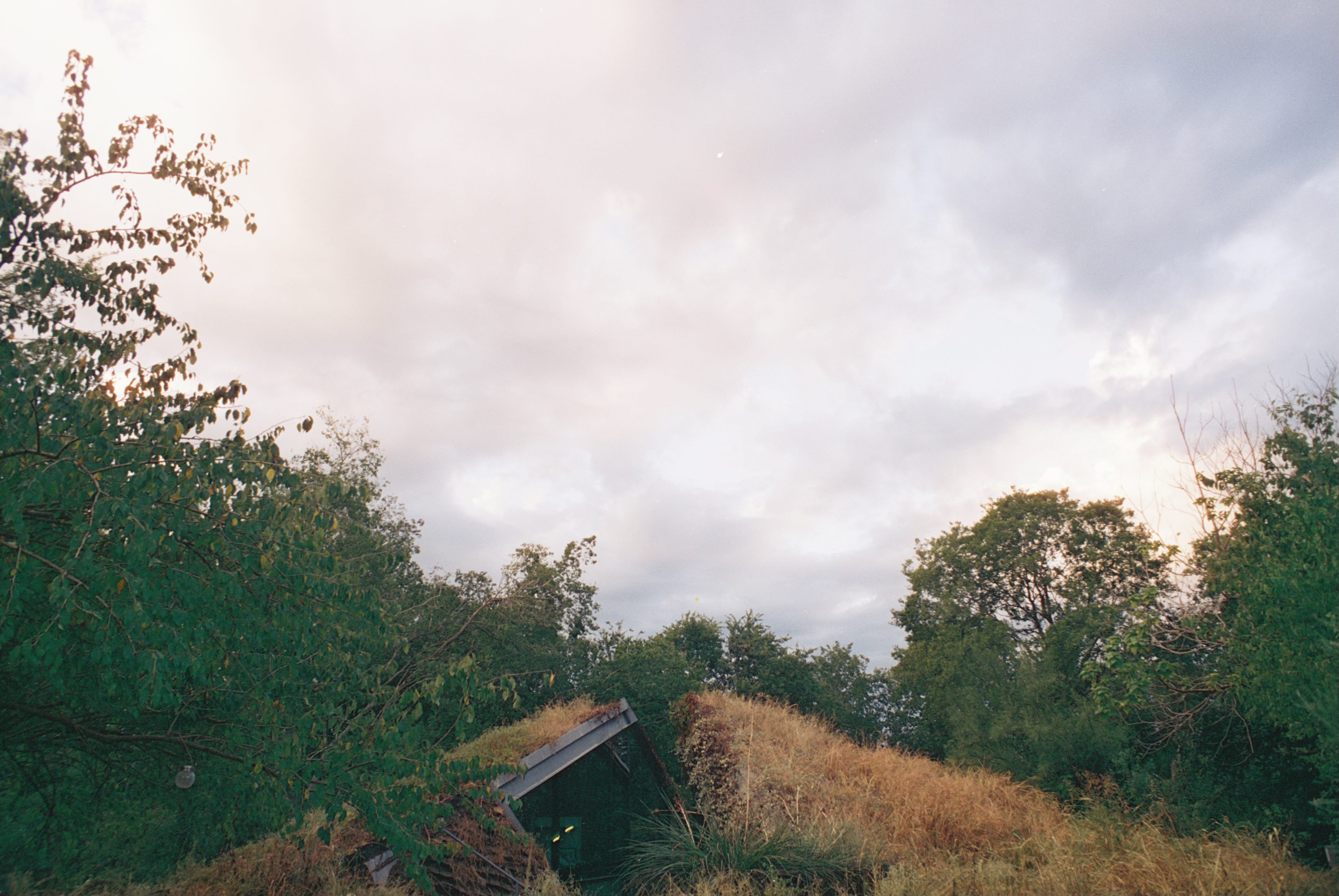
Agustina, Hugo and I ended up making our home in a brownfield acre in the edgelands of East Austin, and set about restoring biodiversity to what had been a dump site bisected by an abandoned petroleum pipeline. That involved seeding the soil — including on the roof over our heads — with native plants that thrived when this region was Blackland prairie, an ecosystem that has been almost entirely (99%) eradicated for agriculture and development, but whose plants pop up just about anywhere the mowers leave alone. And one thing you learn, tending to a yard you have tried to make into a wild ecosystem, is that in a place like Central Texas where it never really freezes, the season of falling leaves is also the real beginning of springtime, when the tall grasses drop their seeds and the native wildflowers are ready to start germinating into hardy rosettes.
This year the work beckons more than usual, as our yard is recovering from a three-year-long guest house construction project that destroyed much of the prairie restoration we had done in the preceding decade. I got the front yard started back to health in the spring, only to have that work trampled cleaning up the three big trees that came down in May’s microburst. So the full moon reminded me to put in my order, and Thursday’s mail brought three five-pound bags of fresh biodiverse life in the form of native grass & wildflower mixes from our friends at Native American Seed in Junction, Texas, who use the tools of production agriculture to enable us to restore the landscapes agriculture has destroyed.
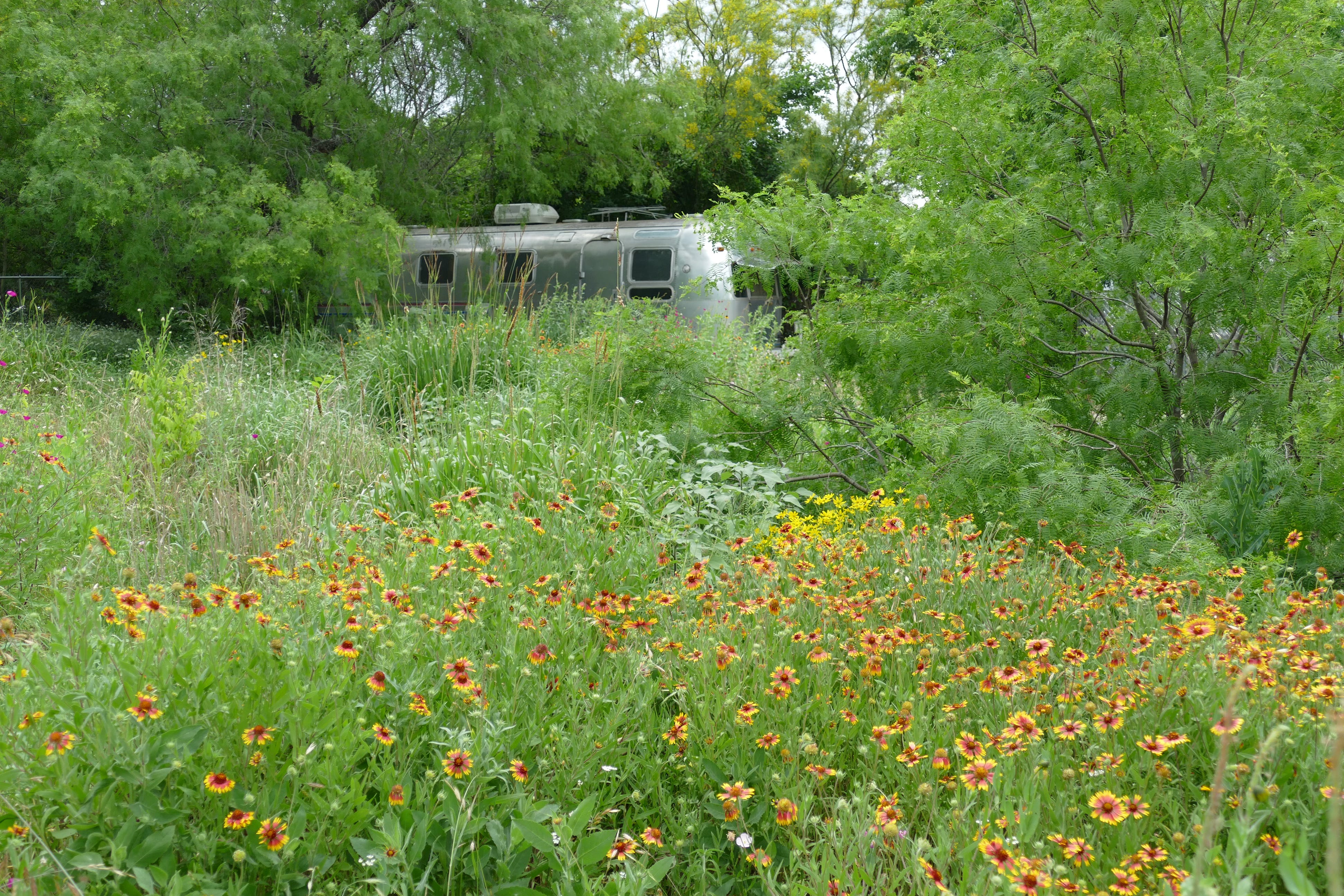
As we hung out on Tuesday I told Mom how I was thinking about trying to burn sections of the yard, the way she had taught me by example with the 200-acre oak savanna she and Dad spent three decades restoring with nothing but fire (longtime readers will remember the story of how my dad singed his eyebrows off the first year they burned). She advised me, with the authority of an experienced sorceress who has tried all the spells in all the possible situations, what a bad idea that was. So this weekend I found myself reluctantly rummaging around for a rake, to be able to clear the dead foliage of the season passed and make room to get the seed in properly.
“Just get it in before the next good rain,” said Mom.
Somehow the way she said that simple bit of gardening advice felt obliquely political. So I got after the yard work while I should have been protesting, and found myself imagining the rejuvenation of the American land a good controlled burn would bring.
Going LoCo
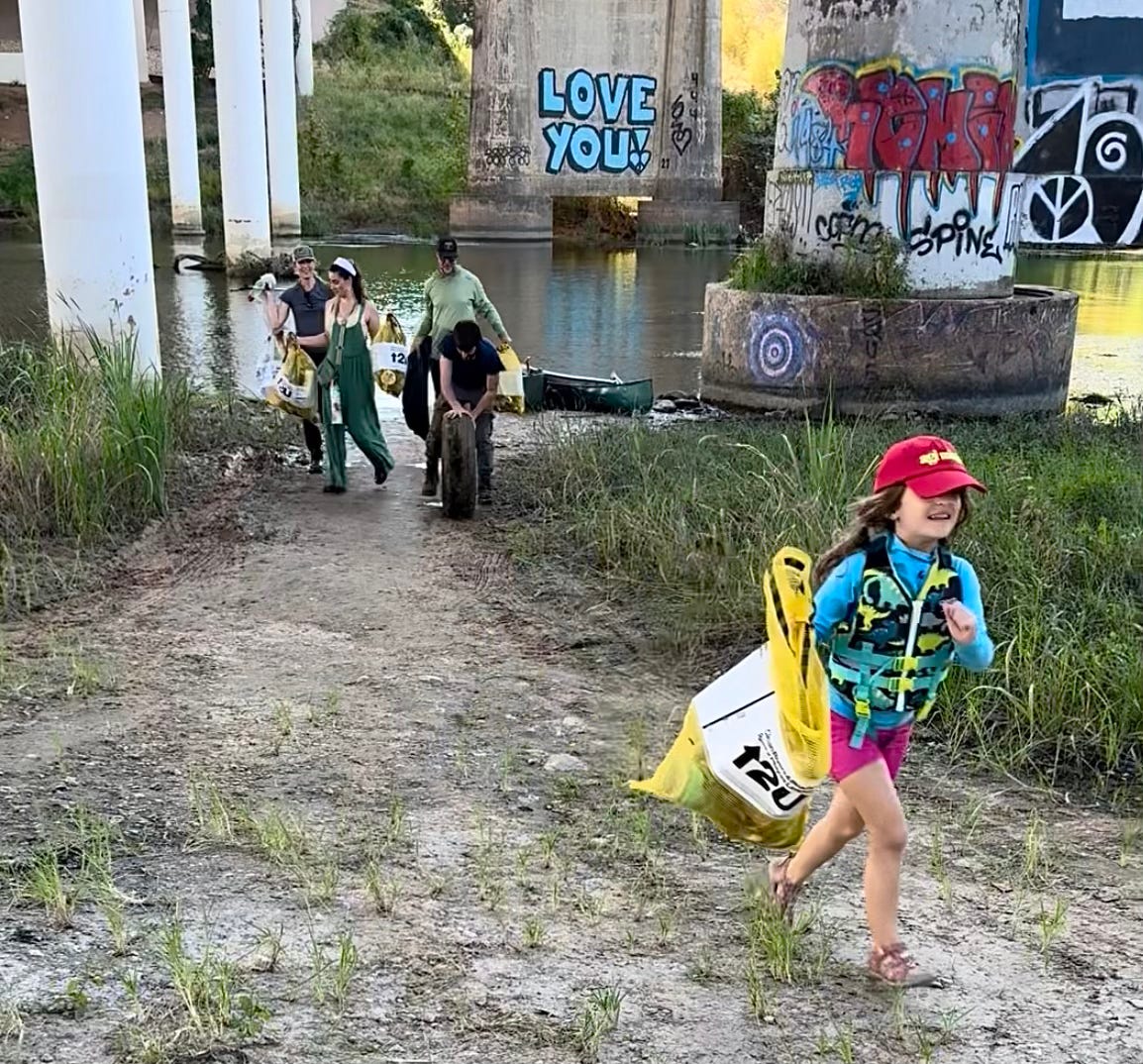
Saturday morning our six-year old daughter and I carried our canoe and paddles down to the urban Colorado and met up with our neighbors and then a bigger group of volunteers for the annual LoCo Trash Bash started a few years ago by Austin fly fishing guide Alvin Ledeaux. Who knew grabbing plastic bottles, used styrofoam, weird metal objects and the occasional diaper from the the riverbed, the green and muddy banks and the trees at the river’s edge could be so fun.
It reminded me of the insight of the eccentric French utopian Charles Fourier, who recommended work be essential labor tasks be allocated based on which members of society would most enjoy them, and that trash collection would therefore be the playful work of children. Maybe his vision of a future in which whales would tow ships through oceans of lemonade after the polar ice caps melt was also more accurate than it sounded when I first heard it as a college freshman.
The Roundup
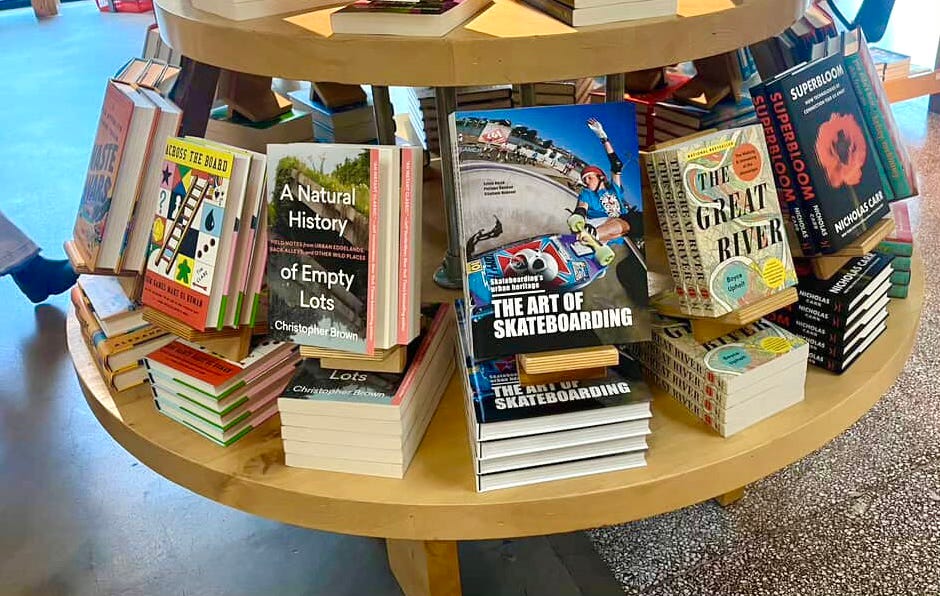
Thanks to the amazing crowd that made them pull out every last chair and strain the lawful capacity at Alienated Majesty Books in Austin last week for the launch of the paperback edition of A Natural History of Empty Lots, to Brett Gaylor and crew for the beautiful documentary short they made and let us screen (coming soon, we hope, to a festival near you), and to Alexia Leclercq of PODER + Start:Empowerment and Craig Campbell of UT Anthropology and the Bureau for Experimental Ethnography for the great conversation about how to decolonize the future. Plus extra thanks to the hard-working UPS driver who arrived with the books just in the nick of time 5 minutes before the event.
My piece for Texas Highways about the time we went looking for the Marfa Lights and saw a maybe-Chupacabra is now available online on this side of the paywall—the photos by Eli Hartman are amazing.
This week I’ll be working on the plans for the class I’ll be teaching November 5 on “Writing the Natural World: A 21st Century Reboot” for the Writer’s League of Texas. Just one 3-hour session, and it’s an online class, so you can participate from anywhere on the planet (as long as you can do it from 6:30-9:30 pm CST). Details and registration here—please consider signing up if the topic is of interest.
And the day after that, Thursday, November 6, I’ll be giving a talk about A Natural History of Empty Lots at the Joynes Reading Room on the UT-Austin campus as part of the Plan II Honors Program’s 2025-26 lecture series, co-sponsored by the Rapoport Center for Human Rights & Justice. Open to the public—details here.
This week the UN World Meteorological Organization released its report showing that global CO2 levels peaked in 2024. And the UN Environment Program released a separate report arguing for the urgent of accelerating our investment in forests.
Scholars at the University of Utah this week published their research indicating that the evolution of psychedelic Psiloscybe fungi occurred around the same time as the mass extinction of the dinosaurs, as planetary ecology adapted to the aftermath of the the asteroid that threw Earth into a brutal, prolonged winter and killed 80% of all life.
At The Nation, Maya Vinokour on the Cybertruck.
In the ideas worth stealing department, Gen Z protesters in climate-ravaged Madagascar scared the nation’s president into fleeing the country.
Coincidentally, this week was also the anniversary of John Brown’s October 16-18, 1859 raid on Harper’s Ferry. You can check out W.E.B. Du Bois’ book on Brown if you’re looking for some good cool weather reading.
For a less violent rebellion, here’s Cate Blanchett ranting about leaf blowers for the wonderful interview series Subway Takes (via the above-linked FT article):
Have a great week.
Requires time and labor, but when we lived on our 50-acre farm in a log house surrounded by a six-acre woodland I built two large compost bins into which we dumped all the yard leaves we raked into piles. Packed the leaves down, watered them soggy, and by spring they became rich brown-black compost for our gardens. We agree with Cate Blanchett.
I wholeheartedly endorse the hand-blistered zen of the rake!